This study explored the pre-post effects of a safety management by walking around (SMBWA) intervention.
They also hypothesised that SMBWA would improve the organisation-level safety climate because enhanced safety climate may act as a form of organisational resource to buttress motivation and alleviate burnout.
The sample, including control groups, was 19 working sites with 224 employees from a Chinese petrochemical organisation.
Providing background they note:
· Based on signalling theory, manager safety actions could be effective signals to convey their state and values to employees and as such, “employees can construct plausible interpretations by continuously observing these management actions” (p2)
· From managers’ perspective, their own commitment to safety is an “underlying and unobservable internal psychological state” but via signalling theory, this state can be demonstrated via their actions
· However, their actions aren’t always effective and “only those that are highly observable and consistent can be precisely perceived by employees”
· They note that, resultingly, “Leaders (managers) can have a strong influence on the organizational climate, that is, “leaders create climate” (p2)
· MBWA is an unstructured hands-on approach where managers spend time visiting work areas and interacting with employees and participating in their work activities in a casual and friendly manner
· Despite the importance of studying manager-based safety climate interventions, little evidence has focused on this to date
Results
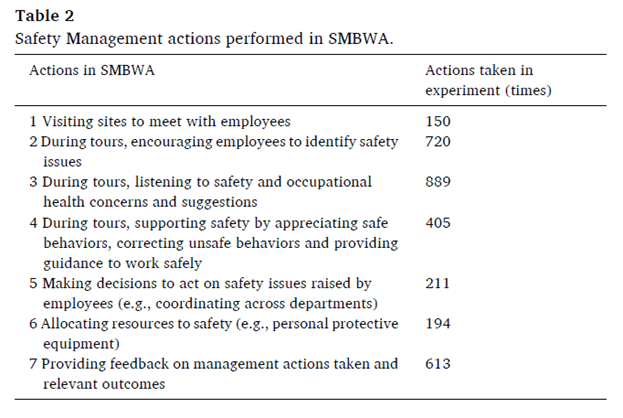
Below highlights the key actions taken by managers during their SMBWA:
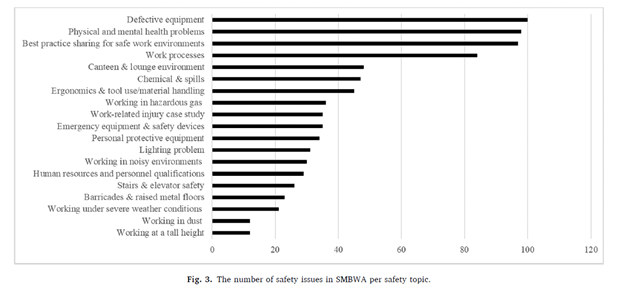
Furthermore, the data below highlights the types of issues that were discussed or raised:
Key findings from this study found that:
· by adopting SMBWA, a significant improvement in safety climate performance was found in the experimental group but not the control group
· changes in safety behaviour were also observed following SMBWA intervention
· specifically, SMBWA promoted employee safety motivation scores and reduced burnout via an improvement in safety climate
· the SMBWA intervention increased employee safety motivation and decreased burnout, both of which were mediated by safety climate
They note that these findings indicate that it’s “feasible to improve the safety climate via managers’ safety management actions, helping us to understand how managers impact workplace safety in practice” (p9)
Previous work had highlighted that SMBWA elevated safety interactions between managers and employees but didn’t specifically detail *what* specific actions managers undertook. This study highlighted seven key actions as indicated in the first image.
They argue that a positive safety climate is created by managers (at least in part), and this forms a type of job resource. This job resource can thus motivate and support employees to achieve work goals and reduce physiological and psychological costs.
They believe that this study also demonstrates not just the (quite expected) theoretical links between the concepts, but also provides a practical tool to promote safety climate.
Authors: Xu, Y., Wang, M., Feng, Y., Xu, Y., & Li, Y. (2023). Safety Science, 161, 106062.
Study link: https://doi.org/10.1016/j.ssci.2023.106062
Link to the LinkedIn article: https://www.linkedin.com/pulse/does-managers-walking-around-benefit-workplace-safety-ben-hutchinson

 SafetyInsights.org