The final two of six asserted assumptions/myths from Besnard & Hollnagel’s 2012 discussion paper.
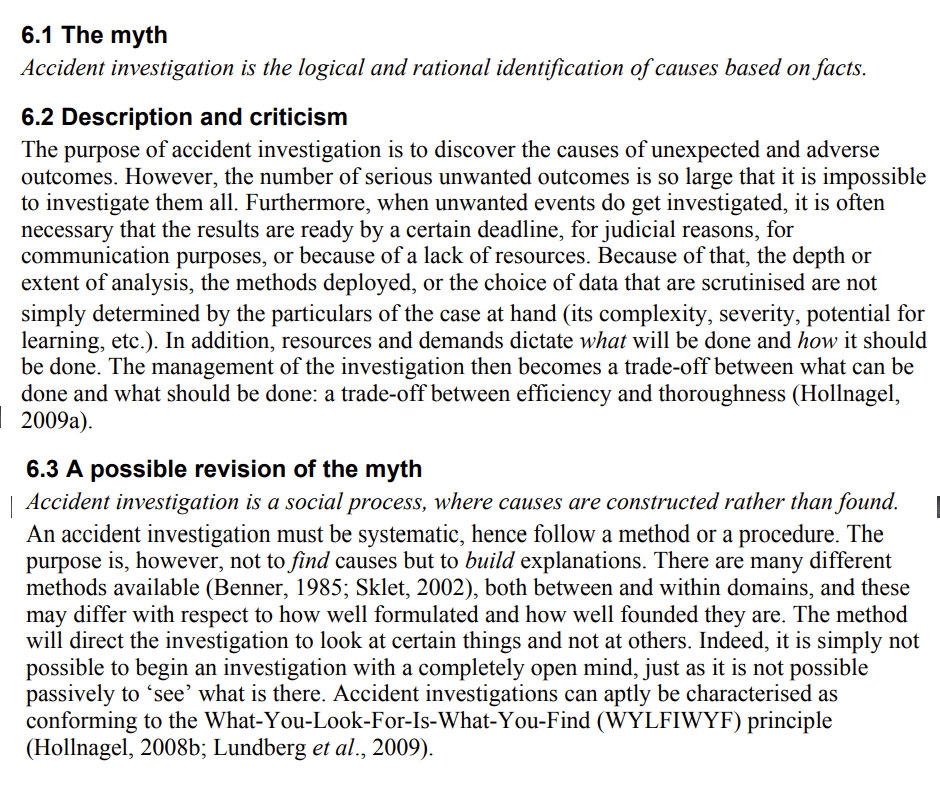
Myth 1: Accident investigation is the logical and rational identification of causes based on facts
· Here they argue that a range of factors and pressure influence investigations. Therefore, the “depth or extent of analysis, the methods deployed, or the choice of data that are scrutinised are not simply determined by the particulars of the case at hand”.
· They also argue that the selection of methodologies and the investigators and the environment itself “embody a set of assumptions about how accidents happen”.
· These assumptions shape the interpretation and the types of findings and conclusions – they focus attention to certain things and not other things, e.g. “what-you-look-for-is-what-you-find”.
· They argue that “Accident investigation is a social process, where causes are constructed rather than found” (at least in some cases).
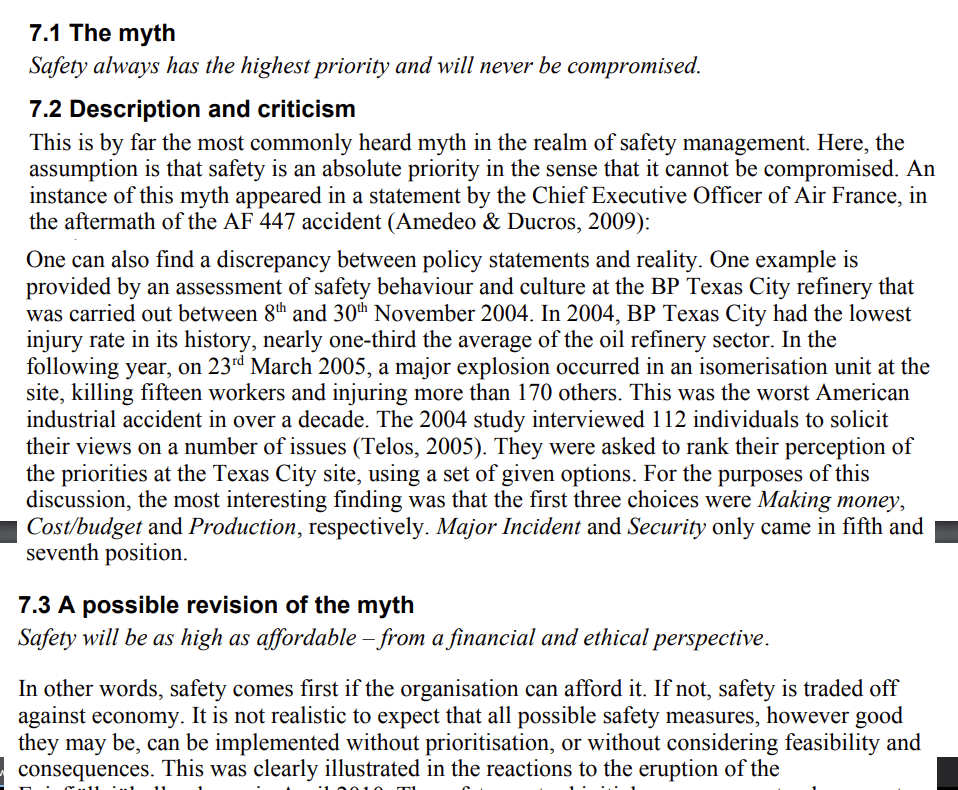
Myth 2: Safety always has the highest priority and will never be compromised
· This talks about the constant trade-offs undertaken within organisations. Official statements of safety without compromise are “concise and suited for communication purposes. They basically express a value that is both clear and noble”, which is fine, but these statements also don’t recognise the discrepancies with reality.
· They also discuss the lagged feedback with benefits of safety versus other priorities. That is, the impact of cost or time are real and immediate whereas the benefits of increased safety margins and “potential and distant in time”.
· Further, “safety performance is often measured by the relative reduction in the number of situations where things go wrong rather than as an increase in the number of situations where things go right. This means that there is less and less to measure as safety improves. The lack of information can then be (mis)interpreted to mean that the process is under control, when in actual fact the opposite might be the case”.
They believe the six assumptions presented in the paper are myths, based on the following:
· They are shared by large groups of people inside and outside of companies
· They express a set of attitudes and values that determine decisions and actions related to safety
· They are not usually noticed or questioned
· They resist change
· They cannot be verified
Source: Denis Besnard, Erik Hollnagel. Some myths about industrial safety. 2012. <hal-00724098v1>
Study link: https://hal-mines-paristech.archives-ouvertes.fr/hal-00724098v1
Link to the LinkedIn article: https://www.linkedin.com/posts/benhutchinson2_the-final-two-of-six-asserted-assumptions-activity-7025953032085401600-HOHD?utm_source=share&utm_medium=member_desktop

 SafetyInsights.org
2 thoughts on “Myths of logical and impartial investigations and safety as no.1 priority: Besnard & Hollnagel 2012”