This study explored the impact that empowering leadership can have on worker deviance. Two studies were ran – one field study and a second lab study.
Providing background, they note:
· Deviance is voluntary behaviours that violate organisational norms and which threaten the well-being of the organisation and/or its members
· Empowering leadership is “the process of implementing conditions that enable sharing power with an employee” (p1)
· Research has shown the positive effects associated with followers of empowering leaders, including higher creativity, happiness and commitment
· Empowering leadership involves behaviours like mentoring, delegating responsibilities and removing bureaucratic restraints at work
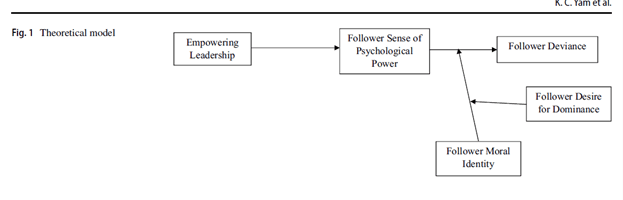
· By doing so, empowering leadership can result in a “a heightened sense of psychological power” among followers; where followers have more intrinsic task motivation and sense of control in their work and a higher perception of being able to influence others
· People with greater power are more likely to focus on their self-interests, ignore the interest of others and more likely to behave more unethically (p2)
· On the above, having more power doesn’t automatically lead to higher deviance but rather deviance in the powerful seems to relate strongly to the individual’s prosocial attributes, namely: strength of moral identity and their desire for dominance
· Moral-identity is a self-conception around moral traits. People with higher moral identity are “more attuned to the content of their daily lives, which helps mitigate immoral behavior” (p4)
· Desire for dominance is a self-serving behaviour, where people control others and the nature of work/decisions for self-interested goals
· Thus, higher empowering leadership may cultivate worker deviance in the workplace but primarily in those who have a weaker moral identity and a strong desire for dominance
· In support of the above, they cite research highlighting that compared to “powerless men, powerful men were more likely to objectify women, but only when they had a disposition toward sexual harassment” (p.4). Further, when people had natural inclinations to focus on the needs of others, their power was more positively associated with more generous behaviour
An important reason for this research, according to the authors, is that most of the research on empowering leadership has focused on the positive facets and not any negative effects. This study, among others, study the boundary conditions of common concepts.
Their model of the associations between empowering leadership, prosocial attributes and deviant behaviour is shown below:
Results
Overall, the findings demonstrated that “compared to the followers of less-empowering leaders, the followers of more empowering leaders feel subjectively more powerful and engage in more deviant behaviors” (p1).
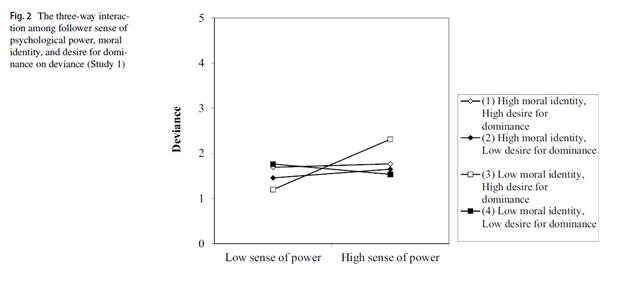
Further, they found that “the propensity of empowered followers to engage in more deviance depends on their prosocial attributes” and specifically, “empowered followers engage in the highest levels of deviance when they have a weak moral identity and a strong desire for dominance” (p1).
That is, empowering leadership doesn’t automatically increase follower deviance but rather it can/does when followers have either a weak moral identity or strong desire for dominance.
Thus, while empowering leadership can increase productivity and employee engagement, it may “also cultivate harmful effects” (p1) and, like anything, is itself “not a panacea” (p12).
In describing negative effects of empowering leadership, they go to lengths to clarify that they “nevertheless believe that empowering leadership very likely exerts a positive net effect to their followers and organizations” (p12).
Further, empowering leadership is “still primarily a positive leadership style that leaders should adopt, and that it is only a double-edged sword for a minority of followers” (p12).
This study is among a cadre of others which cover boundary conditions of concepts that, hitherto have mostly focused on positive effects (which includes other styles of leadership and psychological safety which also have boundary conditions and potentially negative effects in some instances).
Authors: Yam, K. C., Reynolds, S. J., Zhang, P., & Su, R. (2021). Journal of Business Ethics, 1-18.
Study link: https://doi.org/10.1007/s10551-021-04917-x
Link to the LinkedIn article: https://www.linkedin.com/pulse/unintended-consequences-empowering-leadership-some-ben-hutchinson

 SafetyInsights.org