This explored how employee ‘procedure-related behaviours’ (PRB)–engaged behaviours related to procedure use–are influenced by psychological and organisational factors. PRB involved:
· procedure-related voice behaviour (degree that employees voluntarily raise suggestions/concerns about procedures they use), and
· perceived usefulness of procedures.
They also explored how supervisor helping behaviour influences employee engaged behaviour in using procedures. Survey data was collected from 152 maintainers in a mining company.
Providing background, they note:
• “procedures can be difficult to understand and interpret, effortful to carry out, and may be inappropriate to use when work conditions are different from anticipated” (p46)
• When employees are engaged, they are likely to perform a range of behaviours that are beneficial for the organisation, including putting effort into their work role performance, voice (speaking up), and advocating for their organisation” and therefore “employees can invest their psychological self in the use of procedures, in the same way as they invest their psychological self in their job roles” (p47)
• For procedures, this could result in employees “to expend the effort required to comply with procedures properly (rather than just ticking the box) and contribute to the organizations’ procedure management system by voicing any ideas they have for improving the quality of procedures” (p47)
• “Although procedures are meant to represent the best practice of carrying out work tasks, formal written procedures are not always applicable to the local task environment, or when there are changes in them task environment …frontline employees tend to have first hand experience of the job task and local task environment, which allow them to cope well with the varibility and complexity of reality” (p47)
Results
After evaluating combined effects of perceived usefulness of procedures, psychological safety & job self-efficacy towards driving efforts for procedure use & procedure-related voice, only perceived usefulness of procedures was significantly related to efforts for procedure use; & only self-efficacy was related to procedure-related voice.
Psychological Safety (PS) wasn’t linked to efforts for procedure use or procedure voice.
Authors suggest that perhaps PS wasn’t statistically significant in this high-risk workplace because procedures are well-known & not personally risky to speak up. Thus, it’s more a matter of people just seeing the value in them.
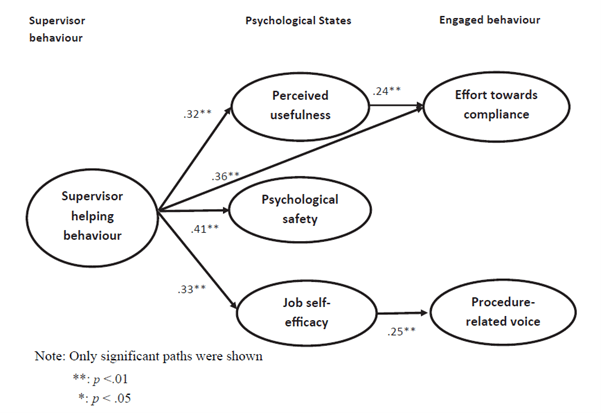
Thus efforts towards procedure use was mostly driven by perceived value of procedures. Authors note that employees can’t be expected to follow procedures that aren’t seen as useful.
If they see procedures as useful, they’re more likely to invest effort in using them & when they’re confident in their abilities (self-efficacy), are more likely to speak up with their opinions on procedures.
Supervisor helping behaviour was identified as an organisational antecedent that promotes effort towards procedure use and voice, via influencing perceived usefulness of procedures and employee self-efficacy.
As above, supervisors were found to facilitate employee support towards procedure use and self-efficacy in achieving procedures.
This provides an opportunity for organisations to improve the communication of procedure importance. Thus, supervisors could be leveraged to better support & engage by “structuring [supervisors’] roles in a way that ensures they can provide support to their team members” (p53).
To me, this raises an important point about just how much time supervisors spend ‘supervising’ & supporting employees; as supervisors may be spending far more time than managers realise in the site office doing admin work.
Authors: Hu, X., Griffin, M., Yeo, G., Kanse, L., Hodkiewicz, M., & Parkes, K. (2018). Safety science, 105, 46-54.
Study link: https://doi.org/10.1016/j.ssci.2018.01.019
Link to the LinkedIn article: https://www.linkedin.com/pulse/new-look-compliance-work-procedures-engagement-ben-hutchinson

 SafetyInsights.org
One thought on “A new look at compliance with work procedures: An engagement perspective”