A comprehensive meta-analysis that evaluated 117 studies around antecedents to Psychological Safety (PS), how it influences task performance & citizenship behaviours, & how it’s related to leader relations.
It’s a 54-page paper, so I’ll cover only a few points.
Results:
Individual-level factors – proactive personality, emotional stability & learning orientation were significantly related to PS. Contrary to author expectations, openness to experience wasn’t significantly related to PS. PS was also significantly related to work engagement & task performance; & information sharing, citizenship behaviours, creativity & learning behaviour.
For the non-significant link b.t. PS and openness to experience, authors suggest that since these people are likely to challenge the status quo and be independent thinkers, perhaps they will express independence irrespective of context, and thus not be so concerned with PS.
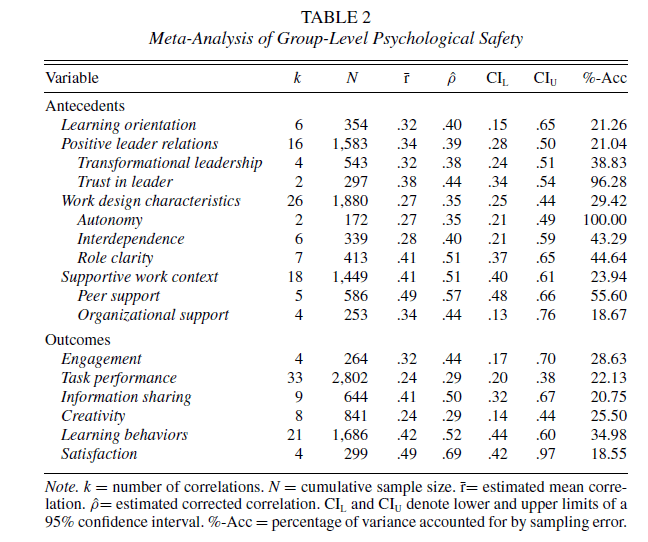
Although PS is largely conceptualized as a group-level phenomenon, most research targeted individual-level. Nevertheless, of the relationships which could be tested at a group-level, they were generally consistent with individual-level findings. Moreover for group: autonomy, interdependence, role clarity and supportive work context were also significantly related to PS.
The strong links b.t. PS and information sharing & learning highlights “the unique contributions that the psychological safety construct makes in today’s dynamic workplace” (p141), where fostering PS appears to be important for organisations attempting to maintain competitiveness.
Few studies have looked at how PS evolves over time. One study found PS perceptions to be only moderately correlated when tested 6 wks apart, suggesting that PS may fluctuate over time within individuals.
PS was also tested for incremental validity (i.e. its ability to increase predictive ability of properties beyond that of existing methods). PS was found to possess predictive power over and above the antecedents that lead to its emergence; including more incremental variance in task performance compared to citizenship behaviours. Thus “findings demonstrate the critical role of this emergent construct as a facilitator of employee performance” (p141)
Expectedly, Positive leader relations was significantly related to PS – highlighting the crucial role leaders play in fostering PS. Of the 4 leadership constructs tested (inclusive leadership, transformational, LMX, trust in leadership) – all were found to have little variation b.t. them in influencing PS. As leaders develop positive relationships with followers, higher perceptions of PS are likely to occur.
Work design & supportive work context positively influenced PS. Within work context, interdependence showed the strongest link. For supportive work, peer support also showed a strong link; highlighting interpersonal relationships and group dynamics as central drivers of PS.
Interestingly, for moderating variables, the study characteristics influenced results. Learning orientation and PS were lower in studies that used students as participants vs nonstudents. Moreover, task performance had larger effect sizes when the outcome measure was subjective rather than objective. Some PS relationships were significantly higher in published vs unpublished work, e.g. “file drawer effect”. Thus, authors suggest that publication bias & common method bias may play a strong role in PS research.
For practical implications, authors note companies can benefit from investing in employees that are proactive, as they’re more likely to “feel psychologically safe and engaged in their work” (p148). Whereas some companies use personality elements in their recruitment – results suggest they should focus on designing interview questions that “capture proactive personality and learning orientation as well” (p149).
Given that PS effect sizes may vary across cultures, companies may need to adjust their efforts to foster PS; e.g. in cultures where risk taking isn’t the norm, fostering PS may be even more important.
Further, given the importance of leadership, leaders must do more than promote “open door” policies, but rather “be trained in ways to actively pursue being challenged” (p149). Further, to the extent leaders can clearly communicate expectations & goals, this is more likely to lead to perceived PS as employees have better understanding of what they can & should be doing.
Correlations for group-level PS are below:
Authors: Frazier, M. L., Fainshmidt, S., Klinger, R. L., Pezeshkan, A., & Vracheva, V. (2017). Personnel psychology, 70(1), 113-165.
Study link: https://doi.org/10.1111/peps.12183
Link to the LinkedIn article: https://www.linkedin.com/pulse/psychological-safety-metaanalytic-review-extension-ben-hutchinson

 SafetyInsights.org