This study explored the role that physical fatigue plays on hazard recognition performance (HRP) pre and post fatigue using construction case studies and Safety Risk Assessment (SRA), which is the participant’s assessment of the frequency and severity of risks associated with identified hazards.
Physical fatigue was tracked in real-time using a wearable sensor including heart rate (HR), heart rate variability (HRV) and also via a subjective assessment via Rating of Fatigue (ROF) scale.
Participants were tested on various measures pre and post fatigue, with fatigue being generated by maximal exercise contractions.
Providing background, they note:
· Hazard recognition can be divided into two categories: 1) predictive – which deals with forecasting future working situations and anticipating safety hazards, 2) retrospective – dealing with information from previous safety accidents to help prevent future recurrences
· A previous study on hazard recognition in construction workers found that just 57% of the fatal-four hazards and 18% of non-fatal four hazards were identified by workers
· Another study found that managers’ and employees’ ability to identify hazards wasn’t predetermined by their level of training of experience
· Expectedly, distraction interferes with HRP and also SRA
· Another study found that in 95% of cases, age, gender, training and a list of other demographic factors had no association with the workers’ SRA
· Prior work has demonstrated the efficacy of wearable devices for identifying physical fatigue
Not again that this study explored physical fatigue rather than cognitive fatigue (which we’re normally more interested in for safety-critical work).
Also, participants were healthy engineering students and not actual construction workers (being more representative of new construction project engineers) and the hazard recognition scenarios were based on images and not in a real-time environment.
Results
Key findings included:
· First, moderate-to-high fatigue was successfully achieved in participants as indicated by changes in their HR and HRV (on average, HR increased ~56 BPM in the fatigued state)
· Fatigue led to a significant reduction in participants’ HRP – up to 12% impaired hazard awareness and a 28% reduction in SRA
· Specifically, participants’ situational awareness of hazards and risk assessments significantly reduced when their HR was ~135 BPM, HRV was 35.8 msec and/or ROF was 9
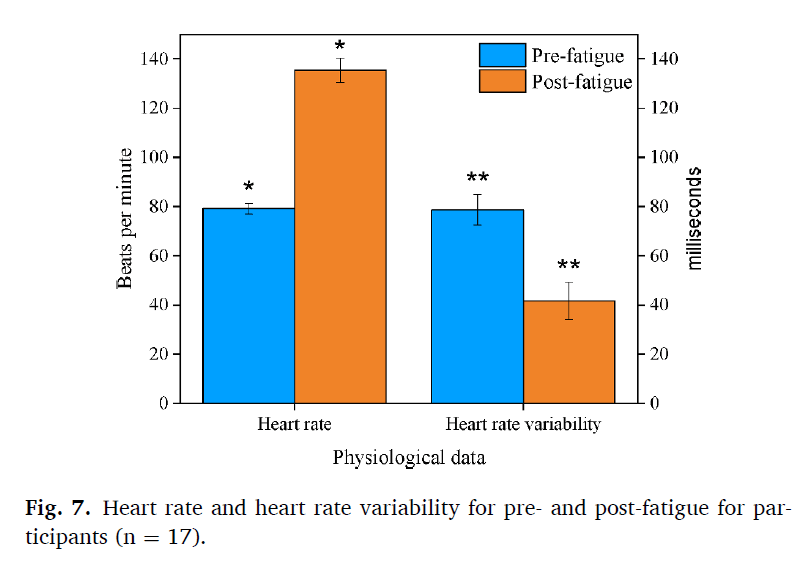
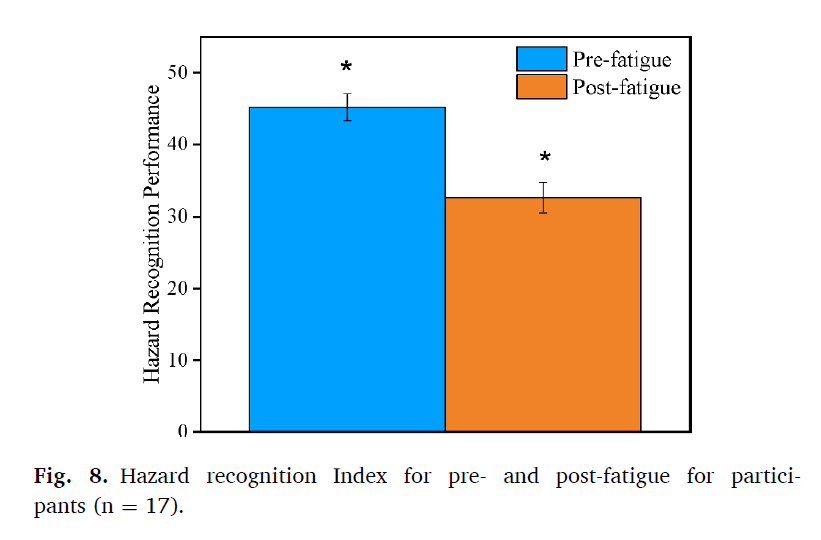
Discussing the findings, they argue that the wearable sensor and the subjective ROF scale performed well in tracking pre- vs post-fatigue conditions.
Participants who were physically fatigued were less likely to identify hazards and “especially ones that were not immediately obvious. Additionally, their perception of safety risks dramatically decreased, which indicates that workplace accidents, regardless of their severity, would be more likely to occur when workers are tired” (p11).
Moreover, the authors argue that significant reductions in HRP and SRA resulted from physical performance drops of around 40% of their Maximal Voluntary Contractions, therefore, and perhaps with some difficulty, “individuals should not be allowed to experience up to 40 % deterioration in their MVC before construction professionals use targeted fatigue relief plans such as rearranging schedule, regular breaks, (re)training, staffing” (p11).
Similarly, a score of about 9 on the ROF was statistically linked to significant reductions in HRP and SRA, and doesn’t require technology. However, it works post-hoc rather than real-time as in the tech.
Further, this study found that HR and ROF were better metrics for predicting physical fatigue’s influence on HRP compared to HRV.
Authors: Ibrahim, A., Nnaji, C., Namian, M., Koh, A., & Techera, U. (2023). Safety Science, 163, 106103.
Study link: https://doi.org/10.1016/j.ssci.2023.106103
Link to the LinkedIn article: https://www.linkedin.com/pulse/investigating-impact-physical-fatigue-construction-ben-hutchinson

 SafetyInsights.org
One thought on “Investigating the impact of physical fatigue on construction workers’ situational awareness”