This study explored what and how safety leading indicators can be implemented in the construction industry, based on Delphi survey of construction professionals.
They sought to answer these questions:
1. How are the safety leading indicators implemented in construction?
2. What are the barriers to effectively implementing safety leading indicators in construction organizations and projects?
3. What is the relative importance of safety leading indicators in construction?
Providing background, they note:
- Legislative-driven approaches have been criticised for “helping grow a compliance culture within construction organizations and projects” (p1)
- This compliance culture overemphasises formal routines and lagging indicators like TRIRF etc
- Lagging indicators “only indicate the safety outputs and are not able to proactively convey the reasons for good or bad performance. They are limited in terms of driving actions to improve the management process” (p1)
- In contrast, leading indicators are said to focus on the organising process of safety practices and measuring safety performance by identifying weaknesses and strengths of management systems
- Work has demonstrated that construction companies “typically chose leading indicators that were easy to count or actions that were already undertaken, rather than based on the organization’s needs” (p2, emphasis added)
- A range of leading indicators have been found in construction. Nine “essential” were suggested as: demonstrated management commitment, staffing for safety, pre-project and pre-task planning, safety education and training, employee involvement, safety recognition and rewards, accident/incident investigations, substance abuse programs and subcontractor management
- Other data from the US found that housekeeping, use of PPE and substance abuse programs were the most widely used, rather than the “essential” elements as above or better systems & risk indicators
- Research is inconsistent on the impact of some safety leading indicators. Some data found positive effects of pre-task safety meetings, pre-job risk analysis and safety inspections on injury rates, whereas other data didn’t find significant relationships between inspections and injuries
- Other data found no consistent relationships between the frequencies of toolboxes, pre-brief meetings, audits or drug tests on TRIFR
- Further, accident and injury rates are only one aspect of performance – and also includes things like climate and cultures. Therefore “This calls for qualitative studies that go beyond quantitative measurements on safety leading indicator and its impacts to incorporate the complexities of safety” (pp2-3)
Results
Based on the literature review and focus groups, 17 leading indicators and sub-indicators were identified (shown later).
First, the authors discussed implementation barriers that impacted construction firms in implementing leading indicators.
Operational barriers:
Key findings included:
· The selection of appropriate indicators and complexity of measurements hindered the use of leading indicators in operations
· Quantitative measures were more widely used and preferred by many as they were easy to understand and manage – e.g. number of senior management site walks, pre-work briefings and safety observation reports
· “However, the shortcoming of the quantitative measures was commonly recognized by participants; accounting for the quantity of conducts could drive tick-box behavior that does not help learning and improvement” (p7)
· Moreover, “Quantitative measurements suggested a narrow understanding of safety performance” and needed to better reflect the quality of interactions over the number
· Firms also typically selected leading indicators that were easy to collect and quantify rather than what was useful or needed
· Some contractors used indicators to identify weak signals of poor performance, such as problems in HAZID or control, or to measure the effectiveness of learning interventions; but these were rare instances and most firms chose indicators based on convenience
Organizational barriers:
Key findings included:
· Organisational learning was seen as essential for leading indicators. While performance generally improved, repeat events kept happening and of which involved many of the same underlying or contextual factors
· Learnings were largely confined to individual projects and not the whole business
· The safety/incident reporting system and information management system were seen to not support safety learning across projects and units
· These systems were “largely separated from other organizational systems, for example, as an additional performance goal to profits” and there was a lack of resources to produce better knowledge and expertise
· Thus “It was difficult to share and embed good practices beyond the local projects” (p7)
· While safety in design was mentioned by some as important, participants believed designers lacked awareness and capability to consider construction safety issues
· Moreover, collaboration between principle designer and contractors was low, and use of BIM “was seen primarily as a tool for design and technical information demonstration and processing and not a potential forum for improving H&S collaboratively among different stakeholders” (p9)
· Tendering and procurement was another issue. It’s noted that “Clients currently have largely static procurement practices for qualification and tender, which did not provide sufficient resources to drive improvements in supply chains” (p9)
Strategic barriers:
· One barrier here was the ambiguity and uncertainty of the effects of using leading indicators
· The time lag between designing, implementing and using better systems and practices takes time but the “competitive bidding process drives construction firms to keep investment and expenditure low in order to secure contracts. Contractors tended to prioritize short-term efficiency and were reluctant to invest beyond the minimum requirement” (p9)
· For many client organisations, construction project development is only part of their business portfolio and they lack incentives to invest in this area
· Lack of investment in supply chains was also repeatedly raised by participants. Where assurance of contractors was undertaken, it was mostly directed towards checking insurance and auditing the SMS at a desktop level
· Clients and main contractors “contractors imposed the safety policies and procedures onto supply chain members without concerning about the potential interruptions to the operations” and “Few participants mentioned the provision of support for developing supply chain capability” (p9)
Data below highlights the 17 indicators identified in this study:
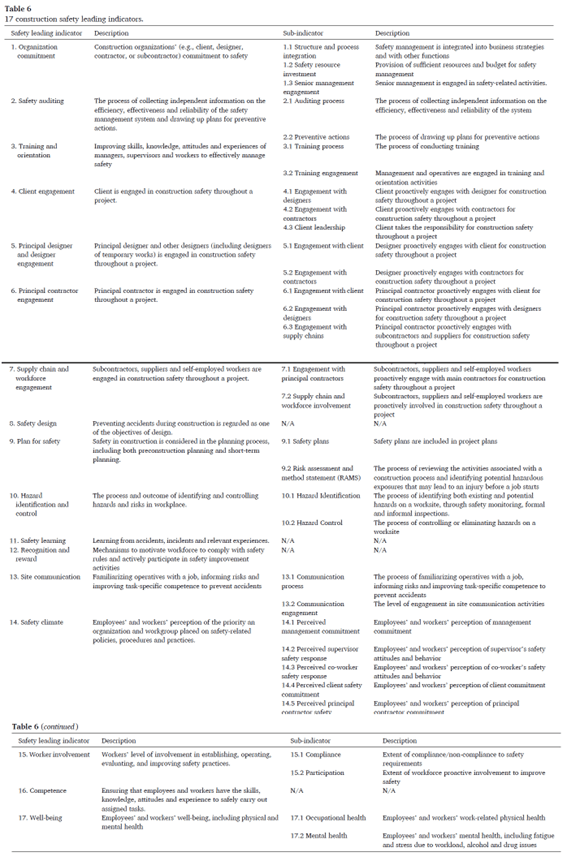
I’ve skipped the findings about the relative ranking of the indicators based on their perceived importance as leading indicators, as rated by participants.
Discussing the findings, the authors conclude that:
· The current way of selecting and measuring safety leading indicators doesn’t help learning and improvement
· This reflects “a reactive approach to managing safety, that is to comply with policies and procedures” (p10), which counteracts the purpose of leading indicators to drive proactive actions
· Moreover, many construction firms relied on a transactional business model, hindering their capability to transform practices
· Transactional business models emphasise cash flow and return on capital – driving preference for short-term initiatives at the project level rather than longer term transformation and improvement
· Therefore, “The resulting practices of securing work at low margins, pursuing low operational costs and prioritizing short-term commercial interests lead to the inability of the companies to introduce new practices and effectively manage H&S beyond the minimum requirement” (p10)
· Far better systems integration is needed between functions and including the supply chains
Link in comments.
Authors: Xu, J., Cheung, C., Manu, P., Ejohwomu, O., & Too, J. (2023). Safety science, 157, 105929.
Study link: https://doi.org/10.1016/j.ssci.2022.105929
Link to the LinkedIn article: https://www.linkedin.com/pulse/implementing-safety-leading-indicators-construction-ben-hutchinson

 SafetyInsights.org
One thought on “Implementing safety leading indicators in construction: Toward a proactive approach to safety management”