A few weeks ago I posted 3 of 5 failure patterns based on David Wood’s chapter from “Organization at the limit: Lessons from the Columbia disaster” (link to the first post and David’s article in comments). Here are 4 and 5.
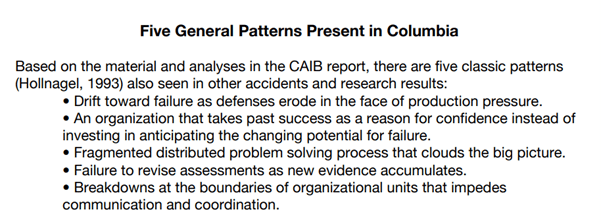
#4 Failure to revise assessments as new evidence accumulates
This relates to the challenging and ever present effects where it is difficult to revise misassessments or to “revise a once plausible assessment as new evidence comes in”.
This broad category takes many forms and labels. One term is “fixation error” (focusing, and other different but related concepts like disqualification heuristic, confirmation and outcome biases etc.) Fixation error here isn’t the type where, say, a surgeon focuses on one item at the expense of other items but where people do not update their situation assessment in the face of new and mounting contradictory evidence that their mental model is incorrect.
Initial situation assessments are said to be often “accurate, in the sense of being consistent with the partial information available early in the event” (Keyser & Woods, 1990) and the disparity often comes later during evolution of the event when new evidence doesn’t result in revision of the initial assessment.
Quoting Keyser & Woods (1990), fixation error occurs when:
1. the situation assesment or course of action has become inappropriate given the actual situation, and
2. the inappropriate judgement or action persists in the face of opportunities to revise.
It’s argued that research “consistently shows” that revising assessments successfully requires “a new way of looking at previous facts”. Providing a fresh view can involve:
- Bringing new people to the situation (a form of cognitive diversity and/or requisite variety)
- Through interactions across diverse groups with diverse knowledge and tools
- Through new visualisations capturing the big picture and re-organising data into different perspectives
Woods argues that the crux of this balance is to explore how to facilitate updates of situational assessments without having to wait for completely clear-cut evidence. If revision occurs only when evidence is overwhelming, this may mean straddling too close to failure and/or too late to properly intervene (a risk of relying on incidents and near misses, for instance). On the other side, acting too quickly or rashly wastes resources and attention to critical matters.
#5 Breakdowns at the boundaries of organizational units
This covers a type of catch 22 situation where people responsible to analyse operational anomalies were “unable to generate any definitive traction and in which the management was trapped in a stance shaped by production pressure that views such events as turn around issues”.
Woods referred to this catch 22 situation as an “anomaly in limbo”.
This anomaly in limbo appears to emerge at the boundaries of different organisational units that don’t have the structural and interpersonal mechanisms for constructive interplay.
It’s argued that in this limbo state, it’s critical that risky judgements defer to those with the technical expertise and structural organisational means to ensure mechanisms of problem solving that engages “those practiced at recognizing anomalies in the event”.
This pattern suggests mechanisms for creating effective overlap across different organisational units and to “avoid simply staying inside the chain of command mentality”.
Woods, D. (2004). In Learning from the Columbia Accident.
Post 1 on Linkedin: https://www.linkedin.com/posts/benhutchinson2_david-woods-in-his-chapter-from-learning-activity-7044431929340809216-cHCS?utm_source=share&utm_medium=member_desktop
Post 2 (this one) on LinkedIn: https://www.linkedin.com/posts/benhutchinson2_five-common-patterns-of-disaster-post-2-activity-7052049875403735040-Hy-6?utm_source=share&utm_medium=member_desktop
## Post 1 linked on this site: https://safety177496371.wordpress.com/2023/03/23/five-common-patterns-of-disaster-post-1/

 SafetyInsights.org
One thought on “Five common patterns of disaster – post 2”