This study explores several research questions around how well companies in oil & gas (pipeline companies specifically) find and fix issues when they occur, and what factors may contribute to workplaces that consistently fail to find and fix issues (risk accommodation).
Incident data from 34 companies over 12 months was included.
Results:
Of the 2,552 incident reports, 207 didn’t have enough data to assess the type of incident or seriousness of consequences. Of the high-consequence incidents (HIPO), most (~75%) investigations were rated as ‘fair’ quality (e.g. information was missing, but researchers could reasonably extrapolate from missing information the circumstances of the event). ~13% were rated as strong quality & ~11% as weak.
For events, first aid injuries and medical aid had the highest percentage of not including at least one corrective action in the investigation. However, ~14% of serious injuries or property damage also failed to result in at least one corrective action.
Further, an average of 23% of fatalities or cases of catastrophic property damage failed to result in at least one corrective action [** although I wonder if fatal events had more information under legal privilege?].
Only ~45% of investigations assigned actions to somebody to complete; 38% had a due date; 32% were completed; & only 14% were confirmed as completed. But, substantial variability existed between companies. Quoting the authors, “most companies failed to implement (complete) their proposed corrective actions: 26 (76.47%) failed to implement their proposed corrective actions more than 50% of the time” (p7).
For risk controls, nearly half couldn’t be assigned to a category (e.g. Hierarchy of Control). E.g. many reports instead of controls listed statements like “no one was hurt”, or an action to complete relating to the investigation rather than risk amelioration (e.g. a remark that more witness interviews are needed). For controls which could be categorised, the majority were administrative (~45%), with a low number for engineering and elimination (~9%).
Authors note that “although most companies have fair quality investigations, the corrective actions are of lower quality for nearly a third of the sample” (p7).
Further, based on findings that many HIPOs failed to have at least one corrective action, nor checks that actions were completed, it’s said “the sampled oil and gas companies fail to sufficiently find and fix errors once they occur, and, with a few notable exceptions, fail to consistently and efficiently ameliorate the risk of incidents reoccurring” (p7).
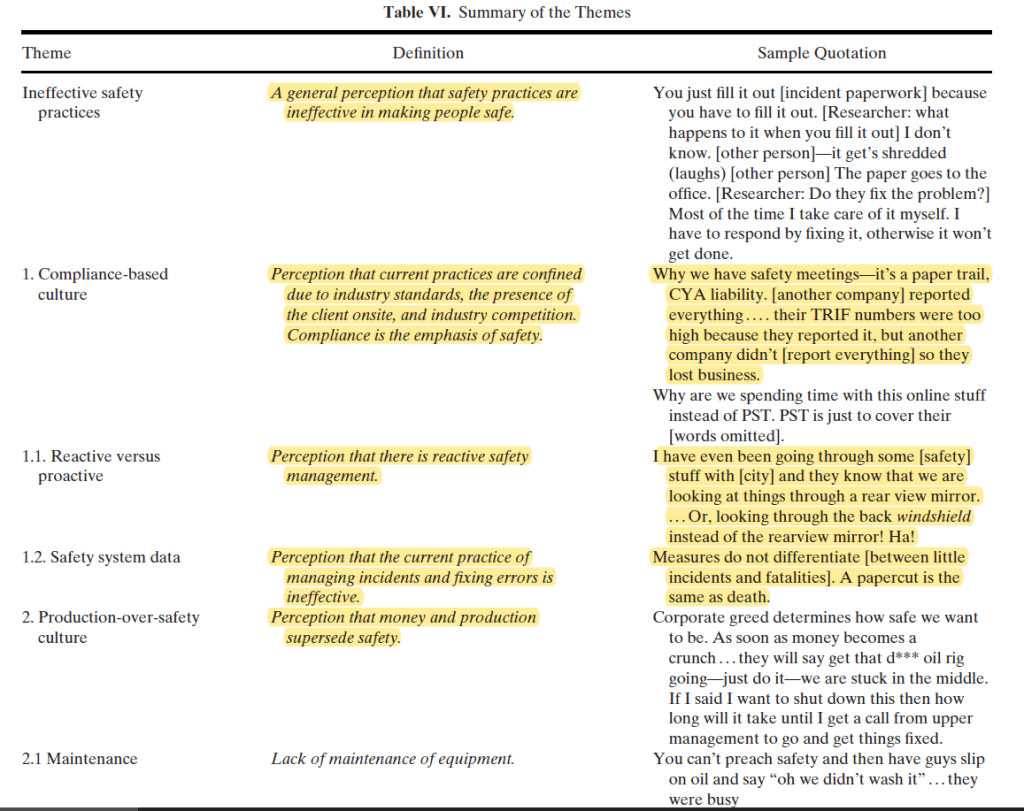
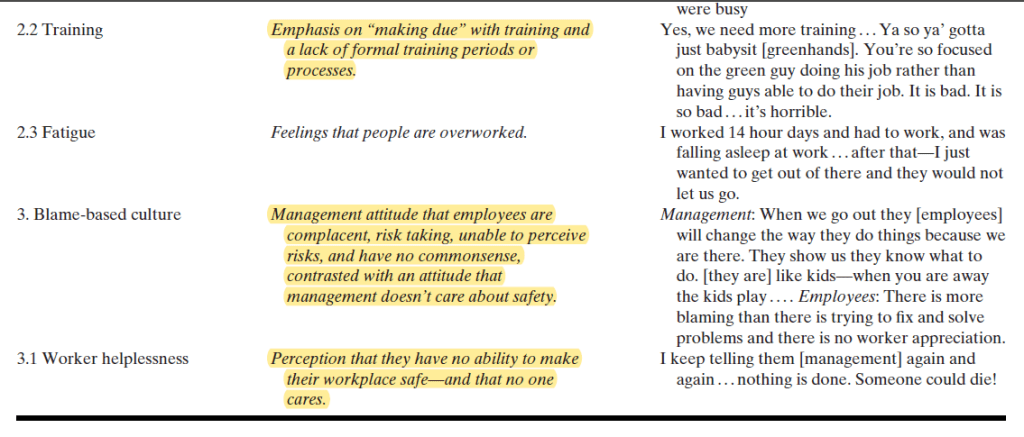
Further, based on staff interviews, factors were mapped that may contribute to risk accommodation. Some were:
- a general perception that safety practices are ineffective in making people safe
- compliance-based culture where compliance rather than risk management is the emphasis
- Perception that safety is reactive
- Perception that money and production supersede safety (trade-offs)
- Blame, where management believe workers are complacent & risk-taking, unable to perceive risks
- Worker helplessness – where people believe they have no ability to make their workplace safe
Overall, “companies are diverting the majority of their attention to investigations, without devoting sufficient attention on to remediation” (p12). That is, companies focus more effort on investigating than they do designing and implementing better controls and ways to manage risk.
Key themes from the paper are shown below:
Authors: Madelynn R. D. Stackhouse, Robert Stewart, 2016, Risk Analysis
Study link: https://doi.org/10.1111/risa.12583
Link to the LinkedIn article: https://www.linkedin.com/pulse/failing-fix-what-found-risk-accommodation-oil-gas-ben-hutchinson

 SafetyInsights.org
One thought on “Failing to Fix What is Found: Risk Accommodation in the Oil and Gas Industry”