This 1998 paper explored how safety climate and communication—organisational factors—influence the interpretation of accident contributing factors/causes.
Accident vignettes were used in two different settings. Vignettes were manipulated to have either internal cues (clues/factors pointing to a worker as the main contributor/cause of an accident) and external cues (factors outside of the worker’s control).
Providing background, it’s noted:
· Whereas investigations are intended to be rather objective searches for facts, “conclusions of these investigations, however, are often driven more by what the investigators expect to find than by the true underlying causes” (p644)
· Further, “investigators’ expectations often seem to focus on identifying an individual to blame rather than on fully investigating the nature of an accident” (p644)
· Drawing on Perrow’s work, it’s reported that while 60-80% of accidents were attributed to operators, further and more conservative estimates point to 30-40% operator involvement [** noting the empirical issues of even coming to any of these conclusions to begin with]
· Reason referred to the tendency to over-attribute or blame people proximal to events as the “blame trap”
· There are parallels between a tendency to blame and the fundamental attribution error (FAE). FAE is a tendency to overestimate the influence of personal attributes or factors related to a person while underestimating the impact of the environment, context/situational factors, actions/decisions of others
· Investigations and investigators are not immune to FAE and are likely to overestimate workers’ contributions and underestimate the contribution of situational factors, particularly under the clear light of hindsight
· FAE is likely also joined by the defensive attribution bias (DAB). DAB is the tendency for people “who perceive themselves to be personally and situationally similar to the victim of an accident to make external attributions regarding its cause” (p644)
· That is, people who are situationally similar to a victim will be more likely to attribute accidents to external factors than internal, and thus “These situationally based attributions will likely reduce their involvement and commitment to individually based safety interventions and increase resistance to change efforts” (p645)
· Safety climate and communication, among many other factors, influence interpretations and perceptions within organisations. In poor safety climates and/or blunted communication environments, people will be aware of management’s tendency towards blame and punitive responses and therefore be more biased towards external attributions of accidents
· In short, safety climate and communication are predicted to influence attributions when informational cues point towards the worker as primarily causal in the accident, such that under poor climates and less open and constructive communication environments there will be greater engagement of deflective external attributions
FYI – Probably nothing too surprising regarding the below results.
Results
Overall, they conclude that both safety climate and safety communication significantly influenced causal attributions about industrial accidents.
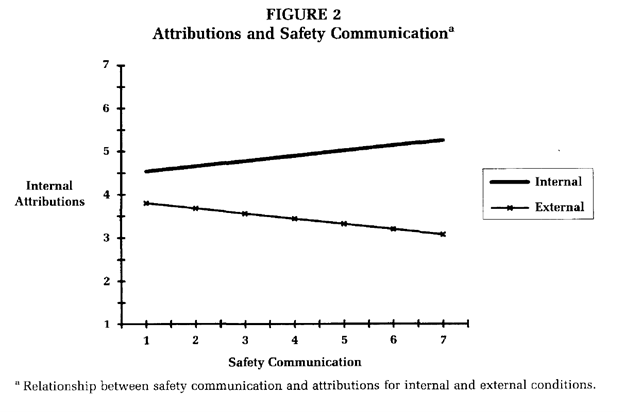
Safety communication significantly moderated the relationship (the strength) between informational cues and causal attributions. Workers in groups where safety-related issues were more likely to be openly discussed and accepted were more likely to make internal attributions when the evidence implicated the worker.
Where communication was poor about safety issues, workers were less willing to implicate a fellow worker in an accident’s genesis.
They note that it appears that workers in environments with poor communication didn’t seem to stray far from the middle regarding worker or environmental cause attribution, whereas workers were more readily willing to make attributions consistent with the evidence in more open environments [** likely things like trust and psychological safety also weigh-in here]
Similarly in the second sample, workers in teams with positive perceptions of safety climate and open communication were more likely to make internal attributions.
Also, supervisors tended to make more internal attributions about worker accidents than workers.
These findings support a body of work highlighting that investigations are not simply objective activities of facts but are strongly driven by subjective and inter-subjective factors and the ambiguities and uncertainties of real work [** and in my view, sometimes wrapped up under a seemingly false veneer of pure objectivity].
Not surprisingly, these findings support the view that “a necessary prerequisite might be a context that encourages open, positive, and free-flowing communication about negative events” (p655). That is, learning is strongly blunted and misconstrued in environments of fear and little trust.
Further, they suggest that individually-based safety interventions may be less appropriate in environments of poorer safety climates and/or impaired open communication.
On a side-note, the paper I read had mark-ups by what I assume was one of the peer reviewers. That reviewer made a really apt comment under the paper’s limitations section, highlighting that investigation reports should similarly include limitation sections and that this would further enhance transparency.
Finally, this wasn’t discussed in the paper but I wonder if a possible (and likely minor/weak) boundary effect and/or unintended byproduct of higher perceived safety climate and communication could be a drive towards more worker attributions?
That is, better perceived climate and comms led to workers feeling safe to implicate accidents more to worker action (because of less consequences of blame for putting their hands up).
But could this also, to a small/weak degree, lead to less improved learning opportunities around design and upstream system factors since “fixing the human” via training, toolboxes etc. is far easier to achieve, and people are more willing to put their hands up, thereby closing the report prematurely rather than meaningful and deep change?
There’s evidence for similar, but likely weak, boundary effects for psychological safety and positive leadership attributes also.
Authors: Hofmann, D. A., & Stetzer, A. (1998). The role of safety climate and communication in accident interpretation: Implications for learning from negative events. Academy of management journal, 41(6), 644-657.
Study link: https://journals.aom.org/doi/10.5465/256962
Link to the LinkedIn article: https://www.linkedin.com/pulse/role-safety-climate-communication-accident-learning-from-hutchinson

 SafetyInsights.org
One thought on “The role of safety climate and communication in accident interpretation: Implications for learning from negative events”