This study explored how the framing, language and style of an accident report affects the audience’s proposed solutions to manage the problems found.
93 people were randomly allocated one of three accident “report variants”.
The report variations were:
Variant 1: A real accident report where the original author’s writing style is human-error focussed, said to have minimal focus on underlying causes of the errors
Variant 2: Same accident report as per variant 1, but contains information which was not included in report 1. The extra info is factual and followed by a SWOT analysis of information seen to be important for success, such as: Daily activity briefing; Personnel; Tools and equipment; Work environment; Task execution.
Variant 3: Same accident as report 1, but used a multiple stories approach. Each actor’s account of the event was recounted to ensure everyone’s perspective was given, conflicting or not. They note “The issues and constraints faced by those involved and captured in their story were listed as contributing factors to the accident” (p4)
Providing background:
· A 2011 study found that use of metaphors during hypothetical scenarios in a fictional city suffering from a surge in crime influenced participant solutions to address the crime. When the word ‘beast’ was used to describe crime, people were more likely to select enforcement-based solutions whereas people were more likely to select social-reform solutions if the word ‘virus’ was used
· English language consistently uses agency of people to describe events, like “John dropped the vase”, whereas in other languages, like Spanish or Japanese, the use of agency is dropped to “The vase broke itself”. Thus, English speakers are more likely to naturally “focus upon human error because of our instinctive way of describing the world we see” (p1)
Corrective actions resulting from analysis of the report variants were then coded initially into 2 categories:
1) Human/blame-focussed
2) System-focussed
These categories were then broken down into sub-categories.
For human/blame-focussed:
1) punish the people involved
2) non-punitive action focused on the involved people (training etc)
For System-focused:
1) one-off actions such as communicating about the incident or reviewing risk register
2) changes to the physical workplace
3) reinforcement or change to the work practices
4) reinforcement or change to practices not directly involved in the accident
5) changes to documents
Note: The free open access paper gives a full description of the data and the scenarios used.
Results
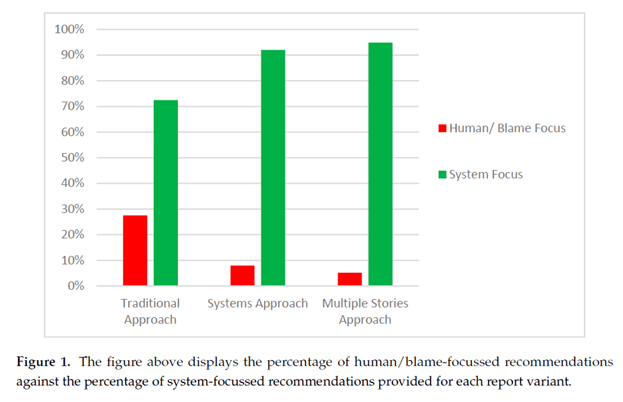
Participants were overall more likely to propose system-focussed corrective actions (86%, 255 actions) over human error-focussed (13.5%, 40 actions).
Nevertheless, which actions participants proposed to manage the issues depended on which report variant they received; thus, depended on how the accident story was framed and the language used.
Variant 1, the “traditional approach” were more likely to suggest actions with a human error/blame-focus (28%, 27 actions) compared to those in the systems approach report 2 (8%, 8 actions) or multiple stories approach (5%, 5 actions).
They note that “readers of Report Variant 1 were the only participants from all 3 reports who requested punishment for the individuals involved (4 actions, 4.04%)” (p6).
Findings are shown below:
Moreover, the types of corrective actions as a function of the type of report variant are shown below:
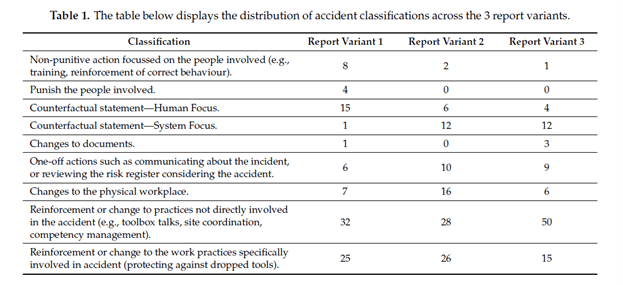
In discussing the findings, it’s highlighted that:
· Report variant 1 participants were more likely to recommend actions directed at front-line operators than those of reports 2 and 3 (again, all the same accident but presented in a different format, style and language)
· Only report variant 1 readers chose punishment as an action – although the total number of punishment actions were small – just 4 examples – none of these were raised in report variants 2 or 3
They discuss possibilities for interpreting the results. For one, the results may purely be random and mean nothing. Two, different information within each report influenced the participants. Three, different styles used to present the story influenced the actions decided upon.
They argue that interpretation one is unlikely to explain the results, although prior personal beliefs, experience and factors shaped by society, religion etc will influence a person’s interpretation and sensemaking of the world. Nevertheless, it’s suggestive that report variant 1—the human-error focused variant—was the only variant to include the use of punishment as a corrective action. They argue that if the results were truly random then we could expect to see a more evenly distributed allocation of blame across other variants.
They further note that the style of report variant 1 is “heavily reliant on the accident facilitator’s perception and interpretation of “important” facts” (p7), and because people are naturally susceptible to hindsight and confirmation bias when analysing past events, “the style of Report Variant 1 makes it more vulnerable to omitted information than Report Variants 2 or 3, as any conflicting information creates a choice for the facilitator to ensure a linear story is achieved” (p7).
They also discuss how “Reports based on provable facts can help an organisation understand what happened, but they are far less effective in helping us understand why” (p7) and that resultingly, human error is “easy to “prove” in hindsight and with the help of post-accident procedure reviews, whereas problems within a system can be much more difficult to label as “broken” because often system issues exist among a variety of systems that are individually working as designed” (p7).
Moreover, the style of variant 1 due to its focus on what went wrong places a stronger focus on the front-line operators, which may have led report readers to decide that it was their careless action/inaction that caused the accident. For variant 2, the focus shifts from people to the system, with a focus on “what” rather than “who”. As a result, their corrective actions reflect what system factors need to be addressed. Finally, for variant 3, the focus on each actor’s perspective and the constraints they faced is heard in full; allowing the readers “a deep understanding of the world these people operated within at the time of the event” (p7).
Another point that I liked was the following: “Report Variant 1 is over-reliant on the author needing to view information sourced from those involved in the accident as important for it to be included within the final report, whereas Report Variant 3 is much less reliant on the author’s own views and is accepting of contradictory facts without resolving to a single conclusion” (p8).
Authors: Heraghty, D., Dekker, S., & Rae, A. (2018). Accident report interpretation. Safety, 4(4), 46.

Study link: https://doi.org/10.3390/safety4040046
Link to the LinkedIn article: https://www.linkedin.com/pulse/accident-report-interpretation-ben-hutchinson

 SafetyInsights.org
2 thoughts on “Accident Report Interpretation”