This explored inherently safer design principles for reducing confined space risks. A literature review and interviews with 15 confined space (CS) experts was undertaken.
An overview of safety in design for CS was given; one element relating to use of autonomous or semi-autonomous technologies for CS operation. Evidence suggests that the adoption of these technologies is still new and not systematic, and a reliance on classical risk reduction measures like work permits, gas measurements etc are still the norm. CS inspection may be an exception, where inspection technologies are common.
Where entry cannot be avoided then a variety of solutions are available. These include reducing the intensity or frequency of hazards, the energy source, the configuration of the CS space and other means. A range of retrofitting means are available, like fitting permanent ladders/stairs, anchor points, mechanical ventilation and the like. Rescue is an area particularly amenable to good CS design principles, since rescuers are said to represent a high percentage of the CS fatalities.
Way too many findings in this paper to cover, as they’ve broken down the interviews and literature reviews into several categories. However, a framework in this paper was on eliminating CS via ‘declassification’ of the CS. Declassification was divided into three areas:
A. Total elimination of the CS
B. Hazard-oriented declassification (reduce frequency or duration of CS entry, design CS more for human occupancy)
C. Organizational declassification (lessen admin burden, reduce issues for entry/exit)
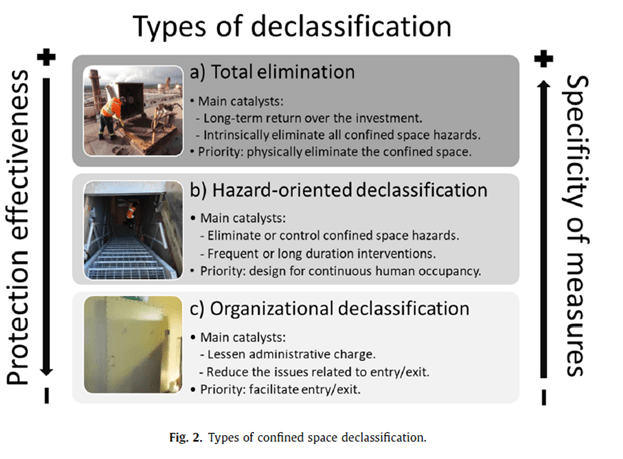
During interviews, experts had a focus on declassification to eliminate CS. However, this area was said to possibly contribute to a false sense of safety as its impact on risk reduction “depends on how end- users reduce inherent or task-induced risks as low as reasonably practicable” (p1). That is, one can ‘eliminate’ a CS by altering factors that mean it doesn’t meet regulatory definitions of a CS but still not “eliminate the confined space physically” (p4).
Challenges of elimination were highlighted. This can include the fact that some CS have smaller CS within them, or the issues of trying to retrofit design improvements due to budget limitations or compatibility issues of the physical environment. Better design therefore is easier to implement upstream during initial design. Furthermore, consideration of the CS’s life cycle in design is said to be very marginal.
Also, designers are said to replicate previous designs which may not be intrinsically safe designs, which then leads to retrofitting design options down the track which may cost more and be less effective.
Examples of total elimination included decommissioning CS, installing a hydraulic cylinder to lift an item of plant out of the CS in order to prevent an entry, or reducing the size of a CS to make entry impossible (with other changes eliminating the need for somebody to actually enter). Another example was downsizing a single large vessel to several smaller ones.
For hazard-oriented declassification, which involves modifying the space for human occupancy, it’s noted that “continuous human occupancy” can be ambiguous in its interpretation. One notable point here is that its requirements can be influenced strongly by what the organisation considers acceptable risks (but that’s probably the case for most things). Other improvements included installing permanent anchor points, better lighting and other means to improve the functionality of CS for maintenance and operation activities.
For organisational declassification, it was found to be the most popular but the least effective. It focused on improving the ease of access or egress to CS while reducing the administrative cost of the activity. They note that improving access/egress via stairs may declassify the CS under certain regulatory definitions but atmospheric hazards may still remain.
Some examples here included temporarily declassifying CS. One method included cutting a large tank or silo open at the side after it was emptied and cleaned. This meant it could be declassified as a CS and removed the need for permits etc.
The study then looked at other areas of CS safety. For instance. Eliminating the need to enter a CS was noted to “[offer] the best balance between protection level, cost reduction, and productivity in existing structures” (p7).
Further, many of the proposed controls to eliminate entry requirements were seen by the experts to involve minor to no design retrofitting in the space, and thus involving little capital investment versus the risk reduction potential.
While use of remote operated devices were considered by many experts, their widespread use has been limited. This includes not just cost and expertise, but applicability to completing tasks. Use of other lower tech means, like adapted tools for fishing objects out of spaces or other extracting equipment are more straightforward.
Several barriers to implementing design solutions were discussed. An expected barrier was for small to mid-sized businesses which may lack finances to adopt design solutions.
Another issue relates to client-designer relationships where the consideration of the CS’s full lifecycle is marginal. For instance issues related to maintenance are not as strongly considered in the design phase as they should, and designers may rely on outdated designs.
There was a clear trend in postponing issue rectification down the CS lifecycle due to economic or performance factors.
In summary, the research highlighted that lifecycle considerations are marginal, designers tend to rely on past or outdated designs which may not incorporate best knowledge of safety in design, decisions are pushed downstream which involve post-construction retrofitting, and definitions of declassification of CS may invoke false senses of safety since they can focus on discrete definitions rather than risk reduction.
Authors: Andres Gonzalez-Cortes, Damien Burlet-Vienney, Yuvin Chinniah, Abdallah Ben Mosbah, Ali Bahloul, Capucine Ouellet, 2021, Process Safety and Environmental Protection
Study link: https://doi.org/10.1016/j.psep.2021.11.044
Link to the LinkedIn post: https://www.linkedin.com/pulse/inherently-safer-design-isd-solutions-confined-spaces-ben-hutchinson

 SafetyInsights.org
One thought on “Inherently Safer Design (ISD) solutions in confined spaces – Experts’ practical feedback in Quebec, Canada”