This studied perceptions of risk & links to behaviour of UK construction site dumpers and Subject Matter Experts (SMEs). 40 construction site dumper drivers and 7 SMEs ranked their perceived risk of various scenarios encountered during dumper operation.
It’s argued that risk perception is a poorly specified hypothetical construct, where people can be cued into certain responses about risk in research settings; which may have little bearing on the ways they actually perceive risks in everyday life.
Also, some existing research has been criticised for over-emphasising the links between attitudes & behaviour and not sufficiently accounting for social & cultural factors.
Providing background they note:
- The lack of a standardised definition of risk, with multiple definitions used for multiple purposes
- Also a lack of standard definition of risk perception. While some research has linked risk perception with likelihood and consequence as dimensions, for “most ordinary people severity of outcome is a stronger dimensional factor than probability” (p56).
- Moreover, not only is “risk perception a poorly specified hypothetical construct” but it’s also possible to cue people into certain ways of thinking and responding about risk
- Therefore, people can make reasonably accurate assessments of risk in experimental or training settings but these judgements can have little bearing on the processes respondents use in real life
- Further distinctions are made with hazard awareness versus risk perception, with the latter involving “further calculation or consideration of the likelihood and severity of consequences of an accident” (p56)
- Some compare risk perception judgements against statistical risks (sometimes called “objective” risk). Unexpectedly, marked differences have been observed. In some cases, people overestimate risks (like farmers being injured by animals) or underestimate others (like falling from height). In construction similar findings for underestimation of fall risk has been observed and also relating to chainsaw operators. In contrast, some work in the offshore oil industry has shown workers to have a pretty well calibrated perception of risk against statistical risk
- Other disconnects exist between risk perception and risk-taking behaviour, where it’s not straightforward. Some people may engage in riskier actions without having an accurate understanding of the risk despite knowing the hazards. In other cases people have an accurate understanding of risk and still undertake the work. Various explanations have been offered here, depending on the context and research aims (production pressure, cultures etc)
- Also delineation between risk perception and risk judgements are drawn. In experimental settings “people can be cued into providing reasonably accurate risk judgments but “this does not necessarily mean that people perceive risk”. Further, for commonplace everyday activities, people likely don’t (fully) consider the risks per se but instead whether their actions will be successful or “afforded”; rather than the potential harm according to conventional risk perception theory
Results:
With some exceptions, drivers’ perception of some key risks were relatively inaccurate compared to measures of accident-derived risk.
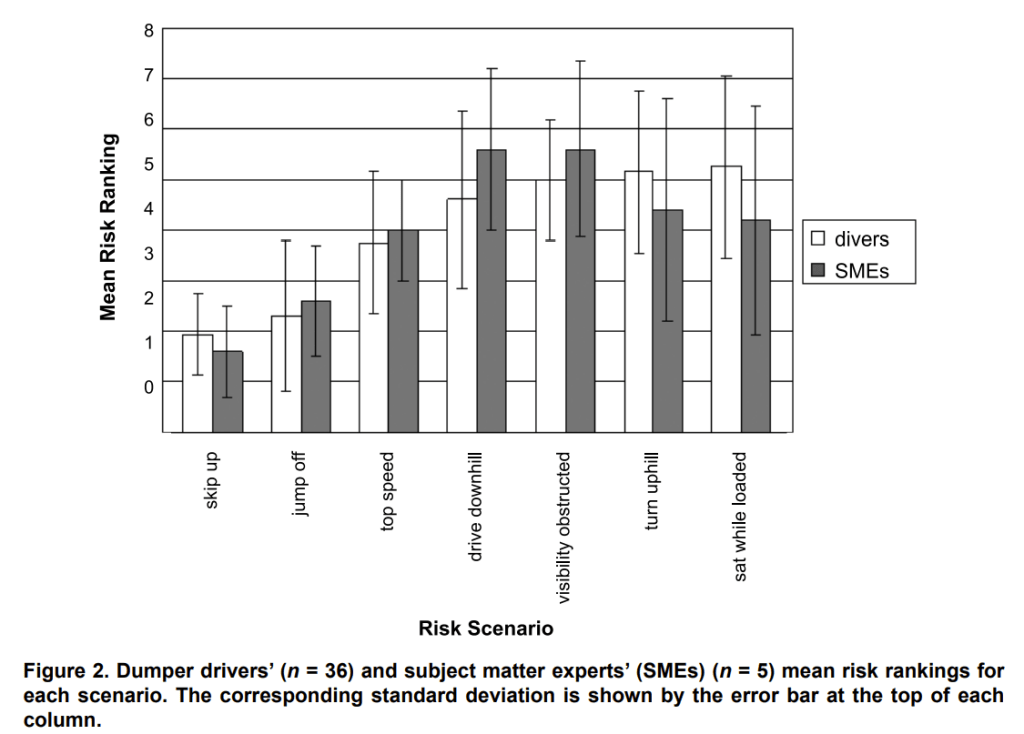
Drivers and SMEs were found to evaluate risks quite differently, with qualitative differences in how they processed risk information. Drivers tended to assign greater weight to consequences of injuries rather than likelihood. Further, drivers were more emotive in their assessments and the “risk perception of drivers in this study seems to be aligned with perceived dread rather than risk per se” (p64).
No significant correlation was found between perceived risk and risk derived from accident data. This is, in part, likely due to drivers having little conception of the objective frequency of the accident types. Only at the lower end of the risk scale was perceived risk aligned to accident risk, further suggesting that “drivers’ risk perceptions [being] aligned to the fear of injury” (p64).
SMEs were consistent in their judgement of the riskiness of scenarios, whereas driver results were more variable. This was expected, since SMEs were deliberately selected, whereas drivers represent a more fragmented industry. Expectedly, SMEs have more regular access to hazard information, compared to a more transient driver population.
Although SMEs may be expected to more ‘accurately’ perceive risk (compared to more objective measures), but SMEs also exhibited no significant correlations between perceived risks and accident risk rankings. Further, SMEs tended to overstate certain risks and understate other risks.
No significant correlation was found between the frequency of reported risk taking behaviour and drivers’ perception of risk. Findings from the risk ranking of scenarios suggests that “risk perception alone is insufficient to explain risk taking behavior” (p65).
Instead, although some drivers reported being “too lazy”, other responses indicated that situational factors influenced action. Some drivers suggested that following “best practice” would increase their risk of injury or that poor maintenance of equipment required them to remain in the vehicle. For not wearing the seat-belt, some said it was more dangerous overall; others indicated how uncomfortable the belt was, particularly over uneven ground. Belts were found by most drivers to be of poor and uncomfortable design.
Overall, the importance of learning about situational and organisational pressures and motivators to behaviour is emphasised over simpler ideas of worker risk perception. Such that, “Detailed scrutiny of drivers’ comments though revealed that there were strong situational influences on behavior” and that “both dumper and excavator drivers are victims of an overarching culture that appears to implicitly prioritize production over safety” (p66).
Some of the data is shown below:
Authors: Jonathan Bohm 1, Don Harris, 2010, Int J Occup Saf Ergon
Study Link: https://doi.org/10.1080/10803548.2010.11076829
Link to the LinkedIn article: https://www.linkedin.com/pulse/risk-perception-risk-taking-behavior-construction-site-ben-hutchinson

 SafetyInsights.org