Just read an interesting paper titled “How Not to Run an Incident Investigation” from Cassin and Barach (hard to resist such a title…)
I’ve extracted two tables that may be of interest. Image 1 covers some perceived disparities between “assumptions of the investigation models” versus local rationality of work.
For instance, an assumption could be that investigations should establish reliable accounts of what happened and why. In contrast, based on local rationality in complex systems, they suggest that there may not always be a “single authoritative account of an event as the analysis … is influenced by the emerging mental models of the people involved”.
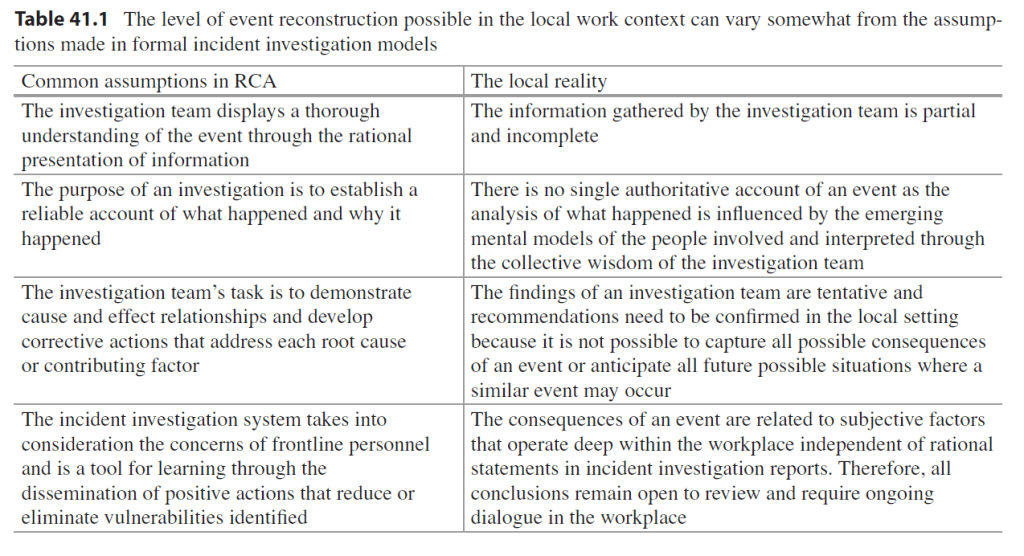
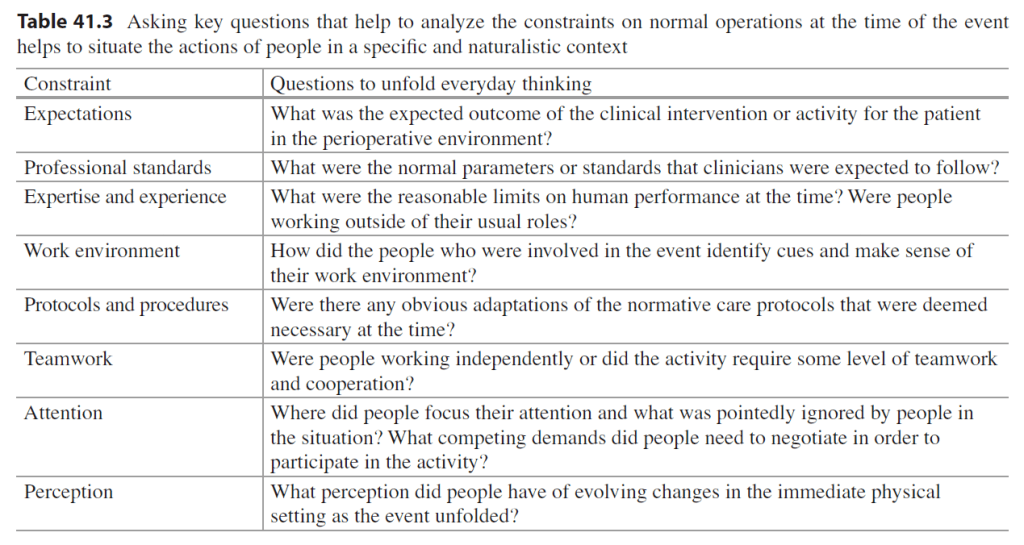
Image 2 highlights questions that may assist in analysing the constraints influencing work or the types of activities people were doing at the time. They suggest one step of “thinking aloud” to help facilitate recall of thick descriptions of work.
These questions and others may help highlight not just concrete actions but also things people wouldn’t have necessarily verbalised in-depth (thoughts, feelings, reasoning and expectations) and help disentangle “the messy flow of workplace activity”.
In all, they argue that modern advances in practice “make the challenge of doing effective incident investigation more complex and nuanced”.
And, importantly, “There is a palpable distance between the stable incident investigation activities of quality and safety departments and the continually evolving scope of surgical practice necessitating increasingly risky and complex procedures”.
In their view, investigations should be a “functional tool for discovering fresh insights about the challenging aspects of the local clinical workplace in context” over the remote management activity which is disconnected from learning about work.
I think this could also apply to other domains like construction, with complex project demands, pressures, contracting and labour arrangements and constraints.
Authors: Cassin, B. R., & Barach, P. (2017). How not to run an incident investigation. Surgical Patient Care: Improving Safety, Quality and Value, 695-714.
Link to the LinkedIn post: https://www.linkedin.com/posts/benhutchinson2_just-read-an-interesting-paper-titled-how-activity-7065453306692714496-Ycxs?utm_source=share&utm_medium=member_desktop

 SafetyInsights.org
One thought on “Better incident investigations and local rationality”