This evaluated the quality of annual work health and safety (WHS) disclosures by the top 100 companies listed on the Australian Securities Exchange and with an aim to determine if a mandatory reporting framework would improve standards.
Annual reports from the 100 companies over 2018-‘19 was included.
First the author provides some background on metrics and reporting.
- No unified definitions exist for what constitutes “quality” reporting
- WHS reporting is said to be encompassed under a company’s Corporate Social Responsibility (CSR)
- Company’s tend to be very selective in what they report and have been argued to undertake “safewashing” of their data; leading some to argue that the current quality of WHS reporting as “biased, inaccurate, incomplete and of poor quality” (p3)
- CSR activity is highest in countries with government mandated requirements for non-financial disclosures although “high levels of nonfinancial disclosures did not necessarily reduce corporate irresponsibility” (p3)
Note – I’ve skipped heaps of findings from the full paper.
Results
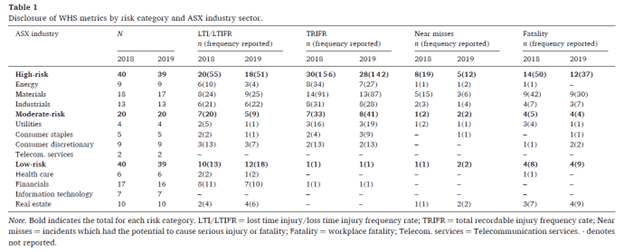
Some key findings included (and reported in table 1 below):
- Companies in the high-risk category overall disclosed more than companies in moderate or low-risk categories
- No top 100 ASX companies in the telecommunication or IT sectors disclosed any WHS information
- LTI/LTIFR was the 2nd most reported metric by companies, with ~37% of companies reporting LTI/LTIFR and the highest disclosure rate in the high-risk company category
- Variations in how LTIFR was calculated were evident (per one million hours, 200k hours, 12-month average, 12-month rolling average, rolling 3-year average)
- Inconsistencies in whether contractors were included in the data and inconsistencies with one company including fatalities in LTI/LTIFR, two companies only providing injury data on accepted workers’ compensation claims, and other including only mild to moderate severity injuries
- TRIFR was the most reported metric – with ~38% of companies reporting this. As above, inconsistencies existed in how it was calculated and what was included/excluded
- Near misses were only included in 10% of reports. Few companies clearly defined what near miss data included – with many defining it as recordable injuries and first aid cases
- ~20% of companies provided fatality data. Fatalities were more frequently reported by companies in high-risk category and somewhat commonly by moderate risk companies
- For the companies that disclosed fatalities, only a small percentage provided any information apart from the number of fatalities, location and some data.
- The industry risk category was correlated with the number of safety metrics reported. Higher risk companies reported more metrics compared to lower risk. No observable correlation was found for moderate risk companies and their safety measure disclosures.
- ~28% of companies disclosed information on completed or ongoing investigations. Of those, the “vast majority” didn’t disclose why the investigations were being undertaken, how many were conducted, nor the outcomes.
- Where information on safety auditing was provided in the annual report, this was “almost exclusively in relation to fatalities” (p6).
Discussing the findings, it’s said that only a small percentage of Australia’s top 100 companies reported their WHS performance and IT and telecommunications not reporting at all.
The author notes that given the higher disclosure from higher risk companies/sectors, this provides evidence that these companies have a higher motivation to communicate their contribution and responsibility around WHS.
Further, “this finding supports the theoretical predictions of legitimacy theory and stakeholder theory, such that firms in industries that are viewed as more hazardous have a stronger compulsion to demonstrate their positive contribution to society in order to appear legitimate and survive, relay key information to stakeholders and to conform with expectations about CSR practices in the broader interests of the firm’s reputation” (p7). They note examples from chairpeople resigning from both Rio Tinto and BHP Billiton in response to significant CSR breaches.
Even when companies do disclose WHS data, inconsistencies around how they calculate the figures makes it difficult to draw comparisons.
Moreover, companies “showed a clear preference for reporting response-based rather than severity-based metrics” (p7), despite recognised issues with these measures; e.g. “Compared to severity-based metrics, which reflect the varying degree of consequences associated with injury and illness, response-based metrics are weak predictors of these consequences and do not provide a valid or reliable measure of WHS performance, particularly with respect to serious WHS outcomes” (p7).
The author further argues that despite guidelines existing for indicators over at least a couple of decades, companies continue to “focus on invalid and misleading WHS metrics”. That is – for the measures that were actually reported, there is an “overemphasis on lagging rather than more valid and predictive leading metrics” (p8). [**** despite the notable statistical issues of some measures like TRIFR—see links below for an example—data around leading indicators is also promising but patchy and likely also affected by statistical power/sample sizes.]
It’s said that the lack of regulation around annual disclosures “provides little incentive for companies to more comprehensively report WHS outcomes” and free-market pressure seems inadequate to drive this change. Some challenges include lack of stakeholder understanding of metrics that are “highly technical and complex” and also due to competing demands.
Finally, “The current work supports assertions by scholars and policy experts that voluntary reporting is ineffective” (p8).
Author: Gardiner, E. (2022). Safety Science, 153, 105798.
Study link: https://doi.org/10.1016/j.ssci.2022.105798
Link to the LinkedIn article: https://www.linkedin.com/pulse/evaluating-quality-whs-disclosures-asx100-companies-ben-hutchinson
Statistical invalidity of TRIR/TRIFR: https://safety177496371.wordpress.com/2021/02/20/the-statistical-invalidity-of-trir-as-a-measure-of-safety-performance/
“Safewashing” of annual reports: https://www.linkedin.com/feed/update/urn:li:ugcPost:6939333066972618752?updateEntityUrn=urn%3Ali%3Afs_updateV2%3A%28urn%3Ali%3AugcPost%3A6939333066972618752%2CFEED_DETAIL%2CEMPTY%2CDEFAULT%2Cfalse%29

 SafetyInsights.org
One thought on “Evaluating the quality of WHS disclosures by ASX100 companies: Is mandatory WHS reporting necessary”