“You’re biased” is probably a common expression on social media debates. Noting this, decades of research has highlighted that everybody has their own heuristics and biases.
Indeed, biases are essential for functioning in a complex world. It’s not a dirty word, but does have important implications.
Nevertheless, a “perceived asymmetry in susceptibility to bias” exists. There are various types, including the fundamental attribution error, self-serving bias, and the bias blind spot.
The latter, the bias blind spot, was the focus of this study from Pronin et al. (2015).
Quoting the paper: “We find that our adversaries, and at times even our peers, see events and issues through the distorting prism of their political ideology, their particular individual or group history and interests, and their desire to see themselves in a positive light. When we reflect on our own views of the world, however, we generally detect little evidence of such bias. We have the impression that we see issues and events “objectively,” as they are in “reality” (p369).
Via three studies, they evaluated how different groups of people evaluated their own susceptibility to bias compared to others; the attached images highlight some of the data.
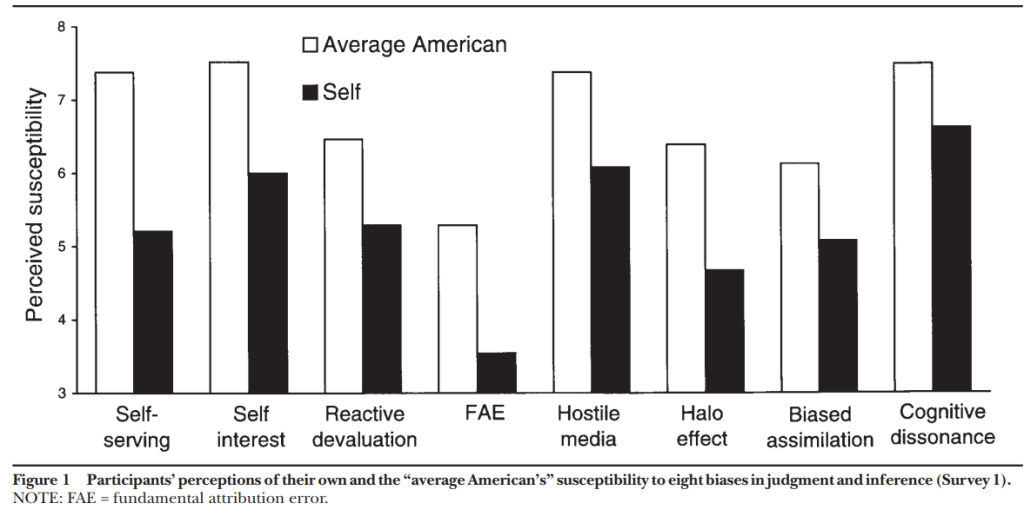
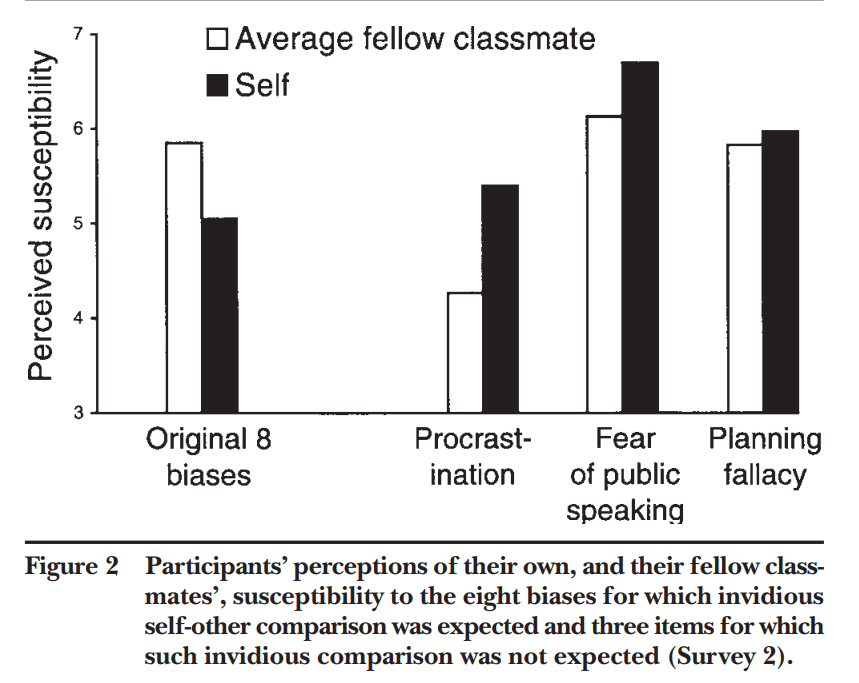
Key findings included:
· Participants rated themselves as much less susceptible to biases than others to eight common biases
· Participants who showed the better-than-average bias insisted that their self-assessments were accurate and objective even after reading a description of how they could have been affected by the relevant bias
· Participants in another study reported their peer’s self-serving attributions regarding test performance to be biased but their own similarly self-serving attributions to be free of bias
· Knowledge of particular biases in judgement and inference and the ability to recognise the impact of these biases “neither prevents one from succumbing nor makes one aware of having done so” (p378)
· The sense that we perceive our reality without distortion arises partly because we don’t have direct access to the cognitive, motivational and biochemical processes underpinning our perceptions; we perceive the outputs of these processes.
Authors: Pronin, E., Lin, D. Y., & Ross, L. (2002). The bias blind spot: Perceptions of bias in self versus others. Personality and Social Psychology Bulletin, 28(3), 369-381.
Study link: https://doi.org/10.1177/0146167202286008
Link to the LinkedIn post: https://www.linkedin.com/posts/benhutchinson2_youre-biased-is-probably-a-common-expression-activity-7067978163074592769-75H4?utm_source=share&utm_medium=member_desktop

 SafetyInsights.org
One thought on “The bias blind spot: Perceptions of bias in self versus others”