This 2004 paper used diary methodology to track employee self-reported incidents/events and errors (including recovery from errors), and also the reasons why they would or wouldn’t normally report that event.
21 operators in a chemical plant over 15 working days completed the diaries.
Providing background:
· It’s said that while use of incident reporting schemes are common in organisations “the extent to which these schemes really capture a representative sample of actual events remains a topic of debate” (p57)
· Another study from one of the authors found that hardly any workers self-reported errors in a sample of >200, despite this process plant being “highly successful in establishing a reporting culture, where, apart from small damages, and dangerous situations, also large numbers of near misses … were freely reported” (p58)
· Little intel was collected about human performance variability and whether successful recovery was undertaken or not
· Prior work has identified a range of factors with accident information reporting and processing, including information being selectively filtered before transfer to higher hierarchical levels. Moreover, the attribution of responsibility and blame was a filtering factor in one model of reporting
· Other work highlighted that, in aviation, few errors are reported and this may be partly explained by embarrassment or fear of punishment (particularly when not observed by other people)
· Research from chemical process plants highlighted that fear of disciplinary actions and fear of teasing by co-workers are major reasons for not reporting
· Other work highlights that some events may be seen as just part of the job, or influenced by “macho” work environments, like construction. That is, “Prevailing norms and attitudes, regarding which incidents are considered acceptable” influences what gets seen as worthy of being reported
· Other work highlighted that lack of management follow-up and commitment once something is reported as a barrier to reporting and “people soon find incident reporting useless when no one ever reads and uses the reports [or] the reporting rate lowers when those to whom one has to report don’t understand the job of the persons involved in the incidents” (p60)
· Other work found that “unnecessary duplication of information recorded elsewhere” was a barrier to reporting; something that frustrates people.
· Moreover, this included high levels of effort to report and investigate, not knowing which system to use, not knowing how to categorise the event, lack of incentives for reporting or in contradiction, and “disincentives” for not reporting, like bonuses
Based on the literature review, the authors categorised the reporting influencing factors into four categories: (p61)
1. fear of disciplinary action, such as from a blame environment or from other people’s reactions (embarrassment);
2. risk acceptance (incidents are part of the job, cannot be prevented, macho perspective
3. useless (perceived attitudes of management taking no notice, not likely to do anything about it);
4. practical reasons (too time-consuming; too difficult).
Results
Based on this sample, some key insights about what they did/didn’t report and why are shown below:
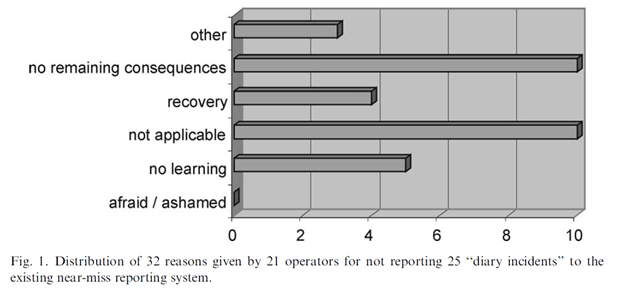
The plant’s management were somewhat surprised by these findings – some suspected higher degrees of fear or shame or perhaps indifference.
Instead, the results indicate that many workers strongly disagree with management on the importance of reporting a particular event (and what can be learnt from it); believe that it has little further consequence moving forward; or that the event just isn’t relevant or applicable.
Moreover, the lack of perceived fear or shame is a positive finding for the plant.
Several examples of successful recoveries were also noted; that is, possible accidents that were recovered in time. Interestingly, these “non-events” were judged by operators to be, on average, just as serious in potential consequences as the near misses that they would normally report to the system. [** This is a good example of the importance of trying to learn from the full spectrum of work and performance variability; we lose insights when we focus myopically on just success or failure.]
The authors argue that, based on these findings, “It is up to the plant now to set up a program to clearly communicate their sincere interest in learning about the personal and system factors that make such successful recoveries possible, instead of an attitude ‘‘all is well that ends well’’ (p65).
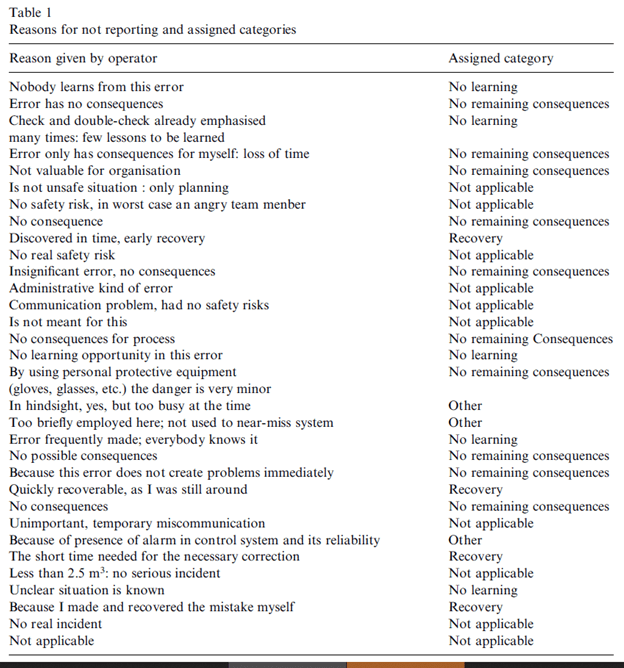
The authors also provided a larger breakdown of reasons for not reporting, shown below.
Authors: Van Der Schaaf, T., & Kanse, L. (2004). Biases in incident reporting databases: an empirical study in the chemical process industry. Safety science, 42(1), 57-67.

Study link: https://doi.org/10.1016/S0925-7535(03)00023-7
Link to the LinkedIn post: https://www.linkedin.com/pulse/biases-incident-reporting-databases-empirical-study-ben-hutchinson

 SafetyInsights.org
2 thoughts on “Biases in incident reporting databases: an empirical study in the chemical process industry”