This conference paper very briefly described a human factors analysis of rail freight yard performance, based on observations, expert elicitation and task mapping.
Five freight yards, 35 hours of observations, and >30 staff interviews were included.
Whether if you work in rail or not, this paper gives a really brief and high-level overview of how introducing more nuanced human factors and design thinking can improve performance (something construction can be far better at in my view).
Moreover, their goal was to understand how people contribute to creating safety and adapt to constraints, rather than being “points of failure”.
Providing background:
· The rail freight yard has been shown to be a “complex and challenging environment, where fluid, cognitive planning optimises physically demanding, cooperative processes” (p1). A range of activities and factors like freight yard design and environment, and external pressures, combine to create dynamic risks
· Typical events in yards are runaways in or outside of the yard, handbrakes or airbrakes left on rolling stock, wagons enter/exit in unfit states (poorly loaded etc.) which can lead to derailment, damaged parts hanging out of gauge leading to collision
· Events can directly interact with workers, influenced by usability of equipment, yard conditions (lighting, walking routes) wagon maintenance, time pressure, and the organisation of work
· Whereas a 1998 study explored violations in shunting work, a later study from the current author found few violations in their dataset and in fact, identified many underlying work pressures influencing worker action and decisions (time pressure, work arounds to complete tasks more quickly)
Results
A range of activities were typical in the yard, like receiving and stabling trains, moving wagons, composing new train sets, preparing wagons for the network and more.
The yards were described as “complex, physically and organisationally” (p3). Capacity in the yard was limited by several factors, namely:
1) specific tracks in the yard had designated purposes (e.g. refuelling) and thereby couldn’t be used flexibly to adapt to current demands,
2) wagons were stored for maintenance,
3) certain trains being stabled had to be split to fit within yard constraints,
4) track length was an issue, requiring splitting and rejoining of trains.
As a result, “yards that seemed large were often very restricted in capacity” (p3).
Rolling stock movements in or out of the yard could be high, with trains arriving every few minutes. Such high movements, and requirements to configure them for specific tasks, that physical risk associated with the moves was high as well as the number of handbrake applications.
Moves required complex comms between ground staff and shunting drivers. Reliance on this communications had the potential for overfamiliarity, leading to departures from appropriate comms protocols. Shunting also required trains to leave the confines of the yard, enter the mainline, and then reenter the yard; this required comms with the network signaller, which was also constrained by requiring a gap in other services on the network to accommodate the move.
Staffing was varied across yards. Some had 24/7 staffing whereas others were only occasionally staffed. Even with staffed yards, the work may be remote and this meant supervisors didn’t always have a good understanding of local constraints on the ground.
The yard arrangement of assets and wagons was complex, and wagons came in many different types. Train sets would also require specific combinations, thereby increasing the number of shunt moves a wagon needed to be pulled out from within larger sets of wagons.
The physical environment, walking conditions, lighting, exposed yard to the elements, all added to how challenging work was within yards. Many yards were directly adjacent to live mainlines, and yards were often broken into two or more separate areas requiring walking or driving. This increased time to complete tasks.
Tasks were also physically demanding; handbrakes required a high degree of torque to be applied and could be situated low down on the wagon, requiring significant stoop for taller staff. Other physical tasks were involved with stanchions, coupling etc.
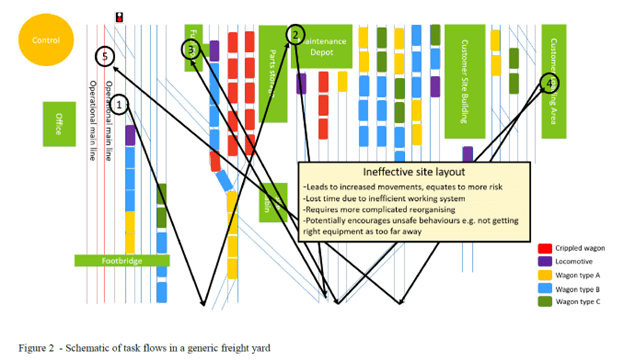
The author undertook some task modelling and task flows. I highlight this image not because of the analysis findings per se (which are specific to that yard), but rather the value that can be derived from better analysis and discussion of work and site layout sequencing and discussion of human factors and performance.
Based on this, various improvements to the work and site layout were identified. One issue was that rolling stock could require multiple steps and relocations to different parts of the yard based on configuration and task requirements. I’ve not covered most of the narrative around the site and task design issues.
In discussing the findings, the author says analysing the yard from a human factors perspective has revealed a “complex picture of fluid cognitive planning and replanning” (p7), where the “physically demanding nature of the job, plus the need to work around site constraints, further influenced the planning and execution of work” (p7).
Many external pressures from the network, train schedules etc. heavily impacted on the work in the yard. In order to manage these pressures for delivering freight, supervisors work with ground staff to tie multiple tasks together; thereby conducting them parallel or compiling together for efficiency. Or as the author says, “to put capacity back into a stretched system” (p7).
Work in the yard requires ongoing flexibility, tacit knowledge and cooperation.
Analysis and observation of normal work is important, because “understanding of work is difficult through paperwork alone … and the difference between work-as-imagined and work-as-done is significant” (p7).
Compared to the earlier 1998 study by Lawton of shunting work (finding many procedural violations), this work found that shunting varies widely across the freight yard. And, importantly, this work highlights “the degree to which back office, planning and commercial processes set the scene and constraints under which freight yard work operates” (p7).
Moreover, it’s argued that “the freight yard provides the resillience in the wider freight system – this is the point in the network that can handle short-term changes, turn trains around quickly, and adapt to changing customer demands. This is only achievable through the commitment flexibility and adaptability of the workforce” (p8)
Drawing on the work of David Woods, the author argues that this freight yard capacity is robustness, e.g. “an ability to soak up, changes and work fluidly, but not necessarily without cost” (p8).
And finally, this robustness via commitment, quality and adaptation by site staff “was evident and paramount, this kind of flexible and adaptive working will inevitably lead to trade-offs and [negative events]” (p8).
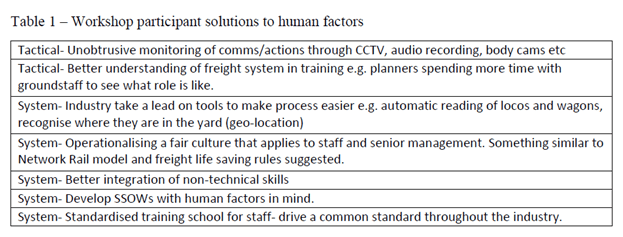
Below data from some workshops are shown – indicating some proposed improvement opportunities to perceived human factors and design matters.
Author: Ethell, David, Golightly, James, Lonergan, David. “Human performance in the rail freight yard.”
Link to the LinkedIn post: https://www.linkedin.com/pulse/human-performance-rail-freight-yard-ben-hutchinson

 SafetyInsights.org
One thought on “Human performance in the rail freight yard”