This study explored the effects of schedule pressure on construction performance, with a focus on trade-offs in scheduling.
Survey data from 102 construction practitioners from 38 construction sites in Singapore was collected, and development of causal loop diagrams.
Providing background:
· In the shorter term, contractors can avoid delays by accelerating projects via means like adding resources, increasing the work week/hours, or exerting schedule pressure on site staff
· When a project is accelerated, the productivity and quality may be sacrificed for the sake of remaining ahead of schedule, whereas “the actual schedule benefits may not be worth the time saved” (p2)
· When the project is accelerated by aggressively scheduling activities, they allow less time to complete each activity. Workers experience work pressure when they perceive that the time to complete activities is insufficient
· Perceived “work pressure intensifies as the required time increasingly exceeds the available time” (p3)
· They reason that there’s a certain ‘ideal’ level of schedule pressure where performance is optimised, similar to the effect in arousal. It’s suggested that the relationship between arousal and work performance is curvilinear, where optimum arousal is achieved at an intermediate level; the relationship is called the ‘Yerkes-Dodson law’
· Arousal is affected by stressors like threats, crisis, noise, fear, anxiety. Schedule pressure may also act as a major stressor, and thereby influence arousal. Thus, when schedule pressure is too low, performance is affected by the lack of urgency, and when pressure is too high, performance is “difficult to achieve as a result of phenomena such as information filtration and omission, adaptation, frustration, and decreased human judgment, and coping strategies tend to be active” (p4)
Results
Overall, they found that:
· “advantages of increasing the pace of work—by working under schedule pressure—can be offset by losses in productivity and quality” (p1)
· Negative effects of schedule pressure can result from working out of sequence, generating work defects, cutting corners and workarounds, and loss of motivation
· Greater degrees of scheduling pressure “slows down the construction progress by lowering the quality of work. Allocating an optimum amount of schedule pressure at the operative level is, therefore, a key to achieving a maximum level of labor output and, consequently, to providing greater savings to contractors” (p16)
· “productivity, rate, and quality of work tend to decline as the schedule pressure increases above its normal level” and “a moderate degree of schedule pressure may help to increase productivity—possibly by increasing worker alertness and attention” but too much pressure “leads to workers cutting corners, increases the amount of out-of-sequence work and the number of defects, and causes workers to lose their motivation to work productively” (p15)
Specific findings included where most respondents rated their experience of schedule pressure as high or very high. Many noted that their trades were given unreasonably short amounts of time to complete tasks.
There was also a positive and statistically significant association between schedule pressure and aggressive scheduling.
Moreover, productivity and work rate are negatively related to the schedule pressure, and a statistically significant negative correlation between work quality and schedule pressure. Thus, they infer that “an excessive schedule pressure can be detrimental to on-site performance” (p10). As noted in their figure below, “there is a definite downward trend in productivity, work rate, and quality of work when the schedule pressure increases” (p10).
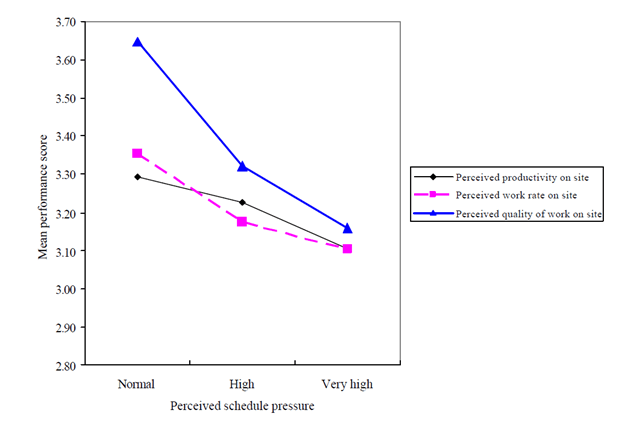
Further, most respondents reported that high-quality completions couldn’t be performed within the shortest periods of time, and that a compromise between the quality of work and a quest to meet deadlines would result in a greater amount of rework or rectification work at the end of the project.
As reported by respondents, the most significant negative effects of schedule pressure was an increase in the amount of out-of-sequence work and the number of defects, confirming that trade-offs in thoroughness and quality are necessary to meet deadlines when workers feel pressured.
They note that a large proportion of respondents disagreed that workers cut corners or would lose motivation to work as schedule pressure increases. The authors reason that this may be a by-product of the large foreign worker demographics of the Singapore construction industry; noting that foreign workers are “perceived to complain less, to be less willing to communicate potential problems, and to have much lower expectations for their working standards” (p11).
In contrast to the above findings, these findings suggest that a certain optimal degree of schedule pressure increases productivity; thus, a moderate degree may “be essential to increase the efficiency and effectiveness of the workers, but too much pressure is detrimental to productivity” (p12).
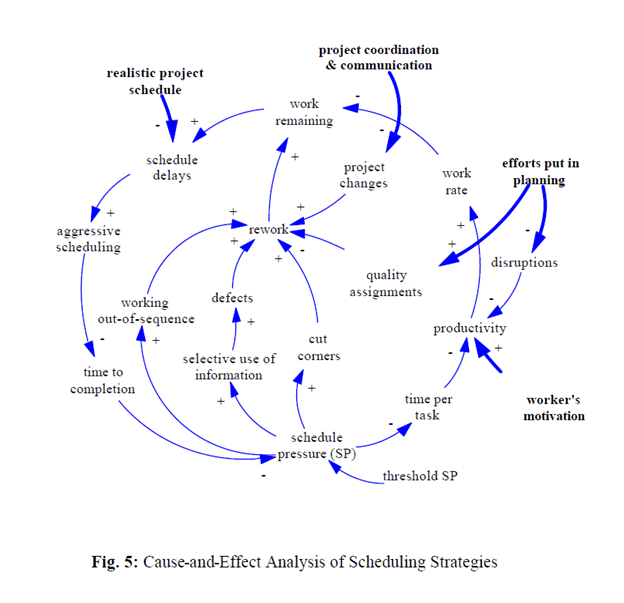
For those interested, they also provided a causal loop diagram on the links between pressures and how certain scheduling practices may exacerbate or attenuate the effects:
Link in comments.
Authors: Nepal, M. P., Park, M., & Son, B. (2006). Effects of schedule pressure on construction performance. Journal of Construction Engineering and Management, 132(2), 182-188.
Study link: https://doi.org/10.1061/(ASCE)0733-9364(2006)132:2(182)
Link to the LinkedIn post: https://www.linkedin.com/pulse/effects-schedule-pressure-construction-performance-ben-hutchinson

 SafetyInsights.org
One thought on “Effects of Schedule Pressure on Construction Performance”