When is a near miss not a clear sign of potential harm that was narrowly avoided?
Interestingly, work from Dillon and Tinsley et al. have explored this question across several studies (See attached image and links below to several of their papers).
They highlight across many studies that people can interpret near events as either a near miss or near hit. A near miss subtly emphasises the ‘success’ component of the event – things were successful because failure was narrowly averted.
Near hit subtly emphasises the failure part of an event – things very nearly went bad.
In their studies, people had a natural inclination towards near ‘misses’ – emphasising that by good management, knowledge etc., success was maintained.
Moreover, as the attached abstract highlights – near miss biases and outcome biases shape subsequent evaluations of decisions made. They note that even though luck was the only difference between the three different scenarios – e.g. luck was the difference between the mission failing or succeeding, people still significantly rated the management ability, competence and prior decisions more positively compared to missions that failed or had a near miss.
Their work shows a more nuanced perspective on the conventional wisdom of tracking near misses. That is, rather than near misses being clear warning signs in advance of major events just waiting to be found and heeded, rather, they can be interpreted as signs of success (that systems and controls are working).
In fact, several of their studies found that including near miss information actually **increased** risky decisions in organisations rather than reduced risky decisions (because people interpreted near misses as near successes); this finding was consistent even when chance/luck was the only difference between scenarios.
Said differently, those who had experienced a near miss in the past were found to take greater decision risks than those who had not experienced a near miss.
Moreover, they reason that “near-miss events will bias organizations towards riskier decisions over time as risk tolerant managers advance. The near-miss bias thus becomes institutionalized and embodied within an organization”.
Aptly, they note in one of their papers that “near-misses [masquerade] as successes” and “Recognizing and learning from near misses isn’t simply a matter of paying attention; it actually runs contrary to human nature”.
Their work provides fascinating evidence on the effects of hindsight, outcome and near miss biases on risk perception and management.
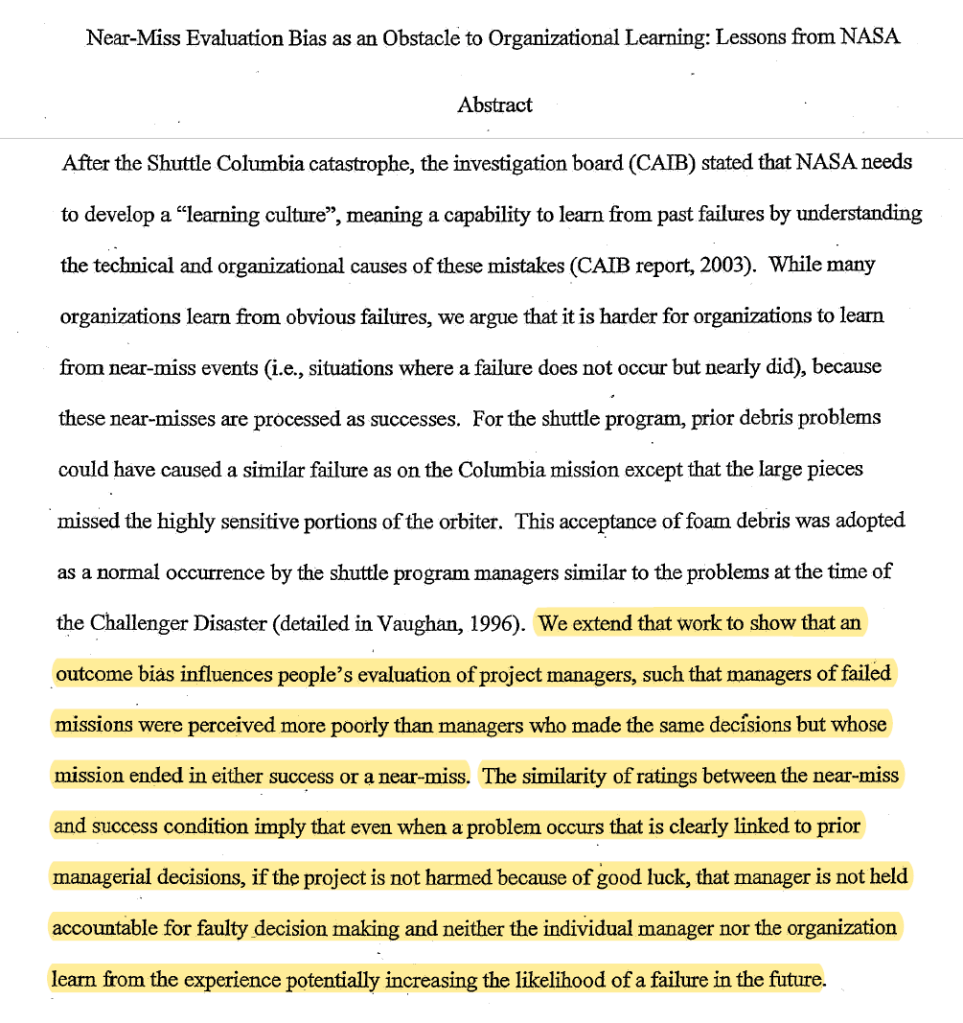
Image source: Dillon, R. L., Tinsley, C. H., & Rogers, E. W. (2006, January). In 2006 Annual Meeting of the Academy of Management: Knowledge, Action, and the Public Concern.
Links to other summaries of their papers:
1. https://www.linkedin.com/posts/benhutchinson2_how-to-avoid-catastrophe-activity-6892592292524376064-RSbc?utm_source=share&utm_medium=member_desktop
2. https://www.linkedin.com/pulse/new-ways-learn-from-challenger-disaster-almost-30-years-hutchinson
3. https://www.linkedin.com/pulse/airline-safety-improvement-through-experience-tale-ben-hutchinson
https://www.linkedin.com/pulse/near-miss-events-risk-messages-decision-making-ben-hutchinson
4. https://www.linkedin.com/pulse/research-bite-how-near-misses-influence-decision-under-ben-hutchinson/

 SafetyInsights.org
One thought on “Influence of outcome biases & near miss biases on risk decisions”