Not a summary, but an interesting study exploring the role of outcome knowledge and hindsight bias on judgements towards a student who took her own life, and the efforts a professor should have taken to provide assistance to that student via hypothetical scenarios in college students and adults.
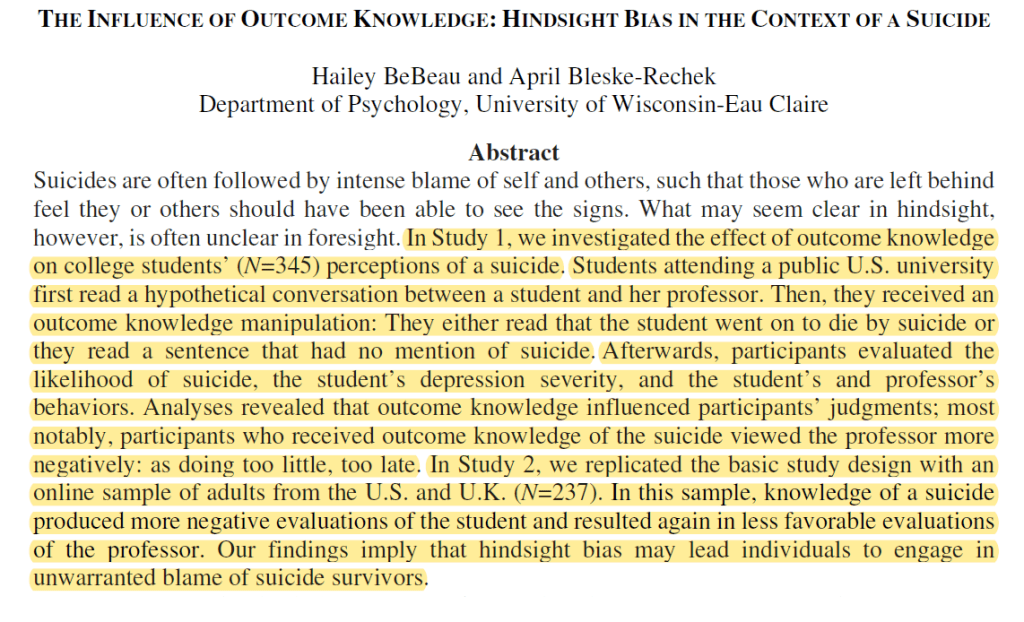
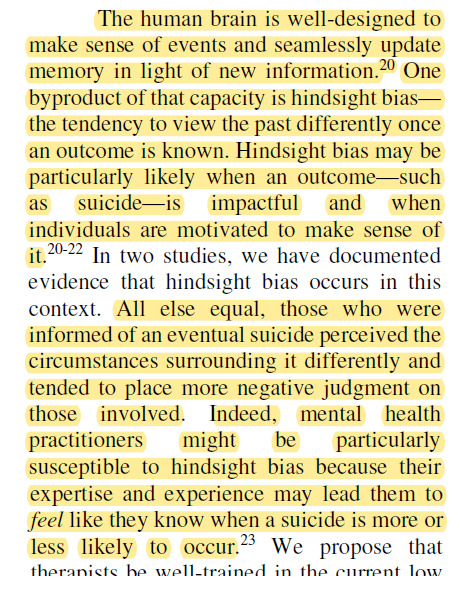
This study found that outcome knowledge (of the suicide vs no suicide information) biased the assessment of the professor’s assistance – such that when people were informed of the suicide, they were more critical of the professor’s assistance (stating that the professor should/could have done more to help).
Moreover, knowledge of suicide resulted in more negative evaluations of the student who took her life (victim blaming).
Adults judged that this student “could have taken better care of herself and tried harder to make friends [and] that she should have sought professional help sooner”.
Ref: BeBeau, H., & Bleske-Rechek, A. (2021). The influence of outcome knowledge: Hindsight bias in the context of suicide. Academia Letters, Article 2649.

 SafetyInsights.org
Thank you very much for sharing this information Ben.
I believe there are clear parallels with fatal events in several industries, including mining where I work. It would be interesting to check what happens with an entire community when people starts to spread the word about an idea of an incident and how that information impacts to the investigation teams.
Regards,
Diego.
LikeLike