Just summarised a paper that explored the role of leader feedback-seeking (asking for feedback) or feedback-sharing (openly sharing/discussing their own weaknesses or feedback) had on psychological safety.
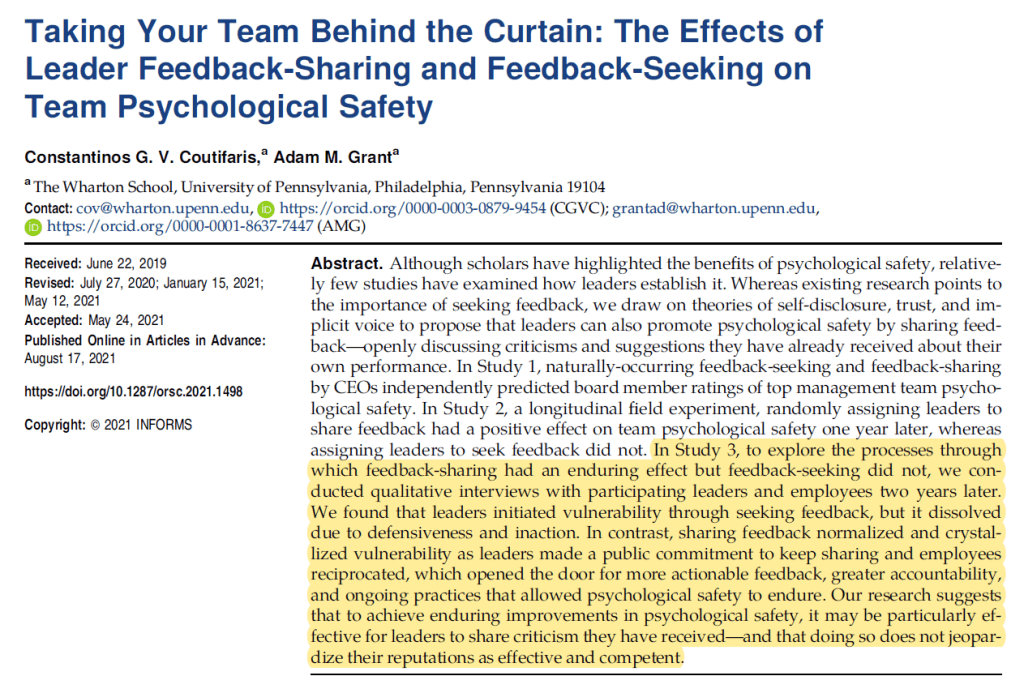
Interestingly, feedback-seeking wasn’t found to impact psychological safety. And in some cases, leaders responded to the feedback with defensiveness or discounted the feedback.
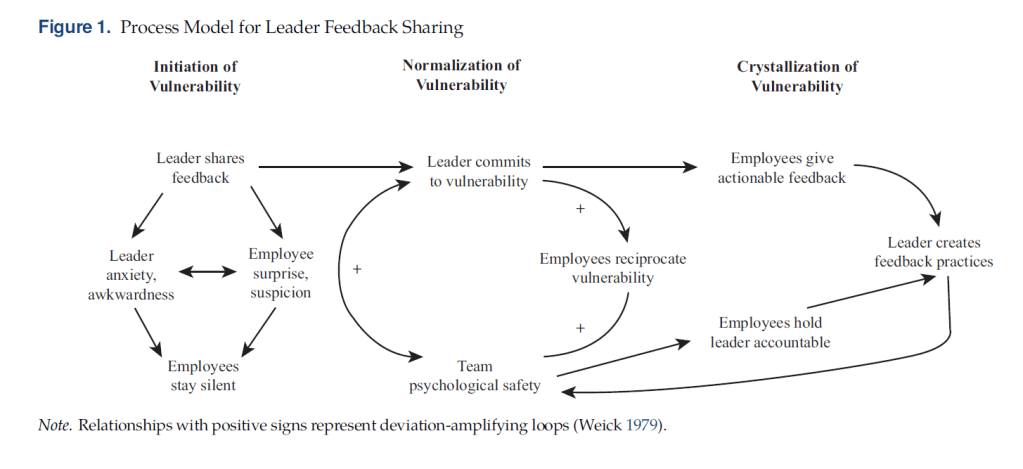
In contrast, leaders who shared their own feedback engaged in “disruptive self-disclosure”, that is, a type of role modelling of our own vulnerabilities. This was initially met with silence and discomfort from workers, but over time promoted heightened psychological safety via “cycles of vulnerability”.
This sort of leader role modelling resulted in employees reciprocating in kind, thereby normalizing the sharing of their own areas of improvement.
As the paper said, “by inviting employees backstage behind the curtain, leaders can build team psychological safety without undermining their images as effective and competent” (p1596).
A model of the leader feedback-sharing process is attached.
Authors: Coutifaris, C. G., & Grant, A. M. (2022). Taking your team behind the curtain: The effects of leader feedback-sharing and feedback-seeking on team psychological safety. Organization science, 33(4), 1574-1598.

 SafetyInsights.org
2 thoughts on “Feedback-sharing and psychological safety”