This brief overview of constructing an effective rule system may interest you.
It’s nothing mind-blowing, nor the latest thinking (it’s from 2003) – whole books, manuals and journal special editions focus on rule creation, but this may interest you nevertheless.
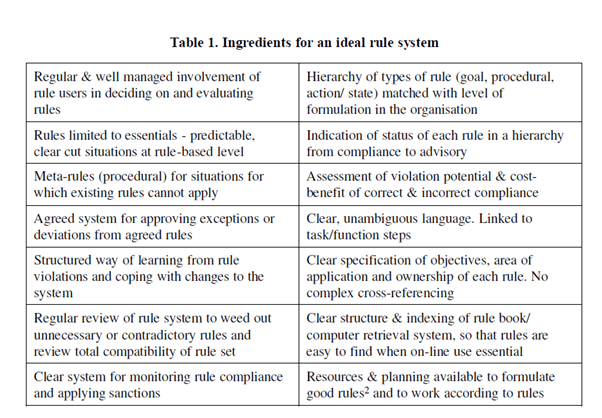
One particular research thread that interests me is along the lines of the meta-rules. I see these more often in emergency response organisations or like fire fighting, military etc and some HROs.
You can read more about their use in cognitive systems and resilience engineering research domains, among other areas.
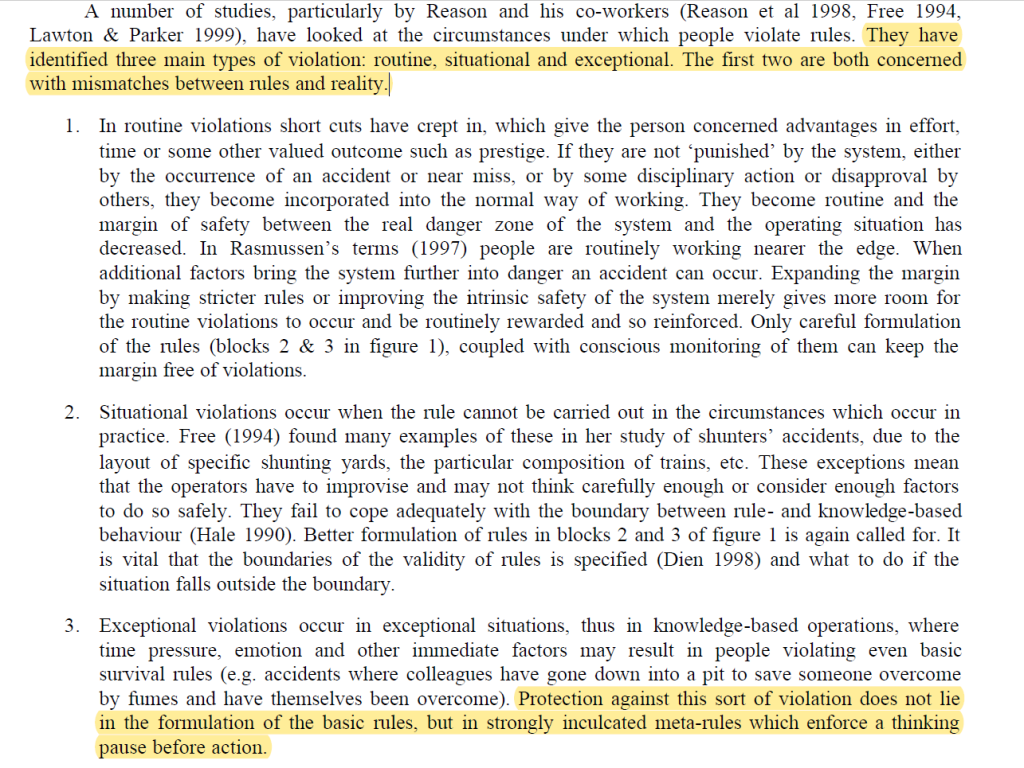
Image two describes 3 types of rule departures, based on an earlier way of categorising them [** I dislike the term ‘violation’, and rarely use it, but this was the language they used in the source, so, whatever].
These are:
1) Routine departures – incorporating work methods that have ‘crept in’ and become normalised. Making further stricter rules may create more room for routine departures to be rewarded.
2) Situational departures – these occur when rules can’t be carried out in the circumstances which occur in practice. This involves some level of improvisation. Here they note that it’s vital organisations ensure that “the boundaries of validity of rules is specified”.
3) Exceptional departures – these occur in exceptional situations, and influenced heavily by factors like time pressure, emotion and other immediate factors; sometimes involving basic survival.
I’ve included other links to a related thread of rules: namely the model 1 / model 2 perspective.
Ref: Hale, A. R., Heijer, T., & Koornneef, F. (2003). Management of safety rules: the case of railways. Safety Science Monitor, 7(1), 1-11.
Other posts on model 1 / model 2:
1: https://wordpress.com/post/safety177496371.wordpress.com/292
2: https://www.linkedin.com/posts/benhutchinson2_for-those-in-the-throes-of-developing-reviewing-activity-6933180971554934784-gTxU?utm_source=linkedin_share&utm_medium=member_desktop_web

 SafetyInsights.org
2 thoughts on “Creating rules and rule departure types”