Can you have too much psychological safety?
This study hot off the press sought to answer this question. Summary posted soon.
Over 5 separate protocols, Eldor et al. found that while moderate levels of psychological safety was associated with better in-role performance (performing standardised tasks, like most of the stuff people do in organisations each day, as compared to innovative tasks), high levels of psychological safety was associated with **decreasing** in-role performance.
They argue that research about the limits of psychological safety is “understandably sparse because much energy goes into expanding and emphasizing its importance than pointing out its limitations. This is because the former fits much more neatly with our existing paradigms” (p15).
While they did find that increasing psychological safety up to a “reasonable level” appeared to improve performance, for tasks that were routine “very high levels of psychological safety may distract and confuse workers about how to perform those tasks” (p15).
They argue that these findings are important, because whereas psychological safety has focused largely on occupational settings involving innovative and creative, less research has focused on tasks requiring more routinization/standardisation, which is argued to account for the vast majority of work.
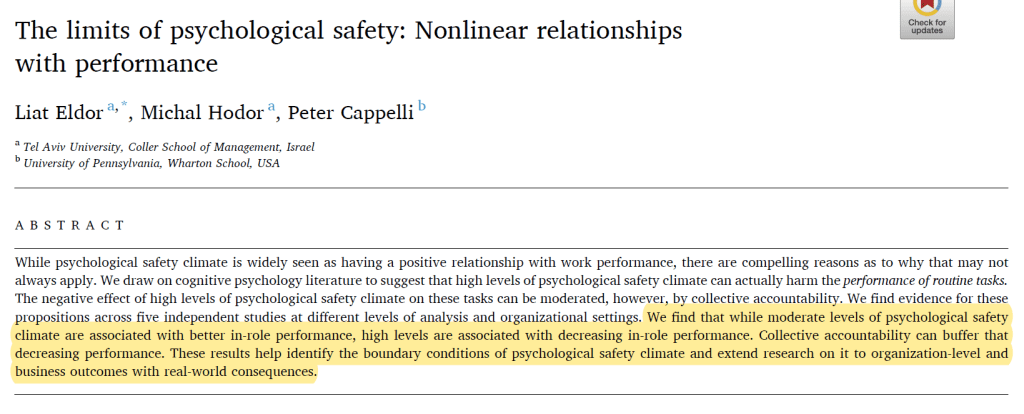
[Note: I’ll comment on the confusion around ‘psychological safety’ vs ‘psychological safety climate’ in my summary next week.]
Ref: Eldor, L., Hodor, M., & Cappelli, P. (2023). The limits of psychological safety: Nonlinear relationships with performance. Organizational Behavior and Human Decision Processes, 177, 104255.

 SafetyInsights.org
One thought on “The limits of psychological safety”