I just summarised a 2000 paper on the role of counterfactual thinking on learning lessons from near accidents in aviation.
Post in the next week or two.
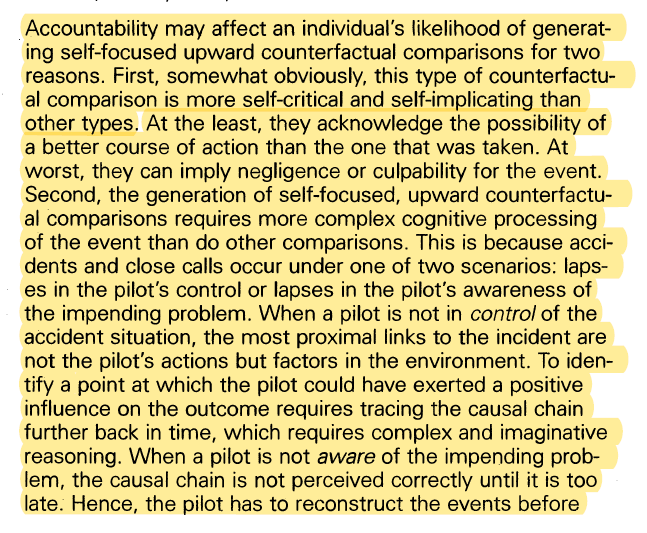
As per newer research, upward counterfactuals (imagining better alternative states, e.g. what actions could be taken in future to ensure a better outcome) compared to downward counterfactuals (imagining a worse state) were found to be more effective for pilots to draw tangible lessons from, and to set up future actions.
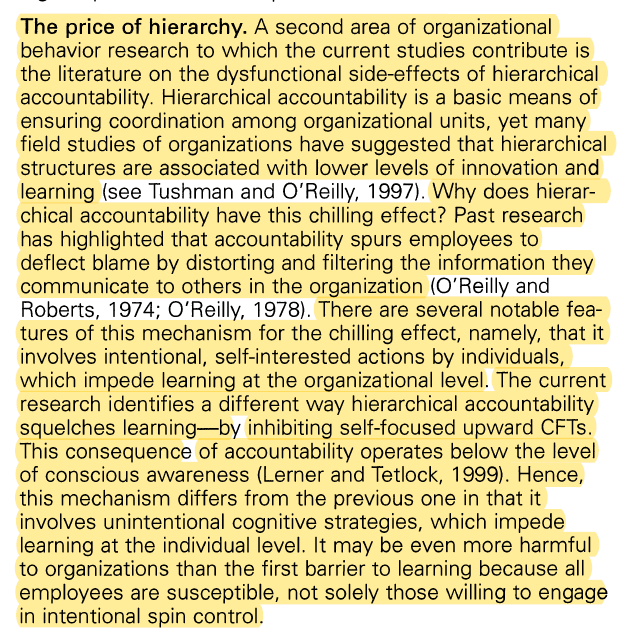
More interesting is the negative effect of organizational accountability on learning. They found that hierarchical accountability impacted the use of self-focused upward counterfactuals.
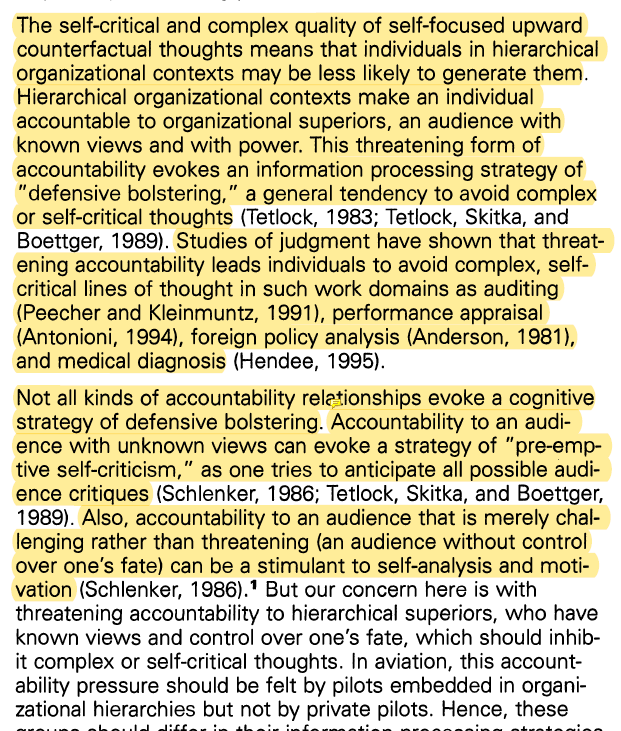
That is, pilots who work for organisations, who report to seniors, were less likely to generate the more effective types of incident learning and improvement practices compared to private pilots.
One mechanism is “defensive bolstering” – a tendency to avoid complex or self-critical thoughts, which in this context, can lead to judgements of culpability.
The authors referred to this effect as “the price of hierarchy”.
Similar concepts are defensive medicine and defensive engineering (Jan Hayes has done some fascinating research into defensive engineering).
Defensive medicine involves ordering tests, treatments and procedures primarily to help the physician avoid liability rather than substantially improve the patient’s treatment.
Similarly, defensive engineering can shift from innovating and adequately preventing major accident to limiting individual liability.
[Note: The authors of this study ** aren’t ** arguing for no accountability, especially for pilots. They explored how and when expectations of accountability can shift goals and action, and specifically, stymy learning.]
Ref: Morris, M. W., & Moore, P. C. (2000). The lessons we (don’t) learn: Counterfactual thinking and organizational accountability after a close call. Administrative Science Quarterly, 45(4), 737-765.

 SafetyInsights.org
One thought on “The ‘price of hierarchy’: how accountability can stymy learning from near accidents”