How well can safety management system approaches manage and improve psychosocial factors and complex sociotechnical factors? With considerable challenge, according to a few papers.
Given that I’m getting closer to publishing my next two papers on auditing, I feel more comfortable sharing some of the central research that informed my own research (I try to keep my summaries separate from study).
A 2011 paper from Hohnen and Hasle explored the impact that SMS certification had on safety management.
They found that:
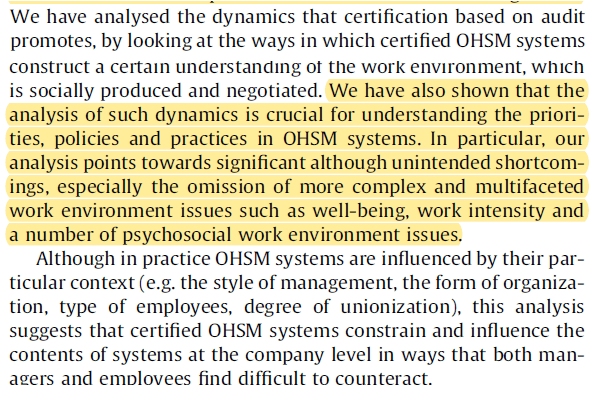
1) Certified SMSs “have problems dealing with a range of contemporary complex work environment issues”
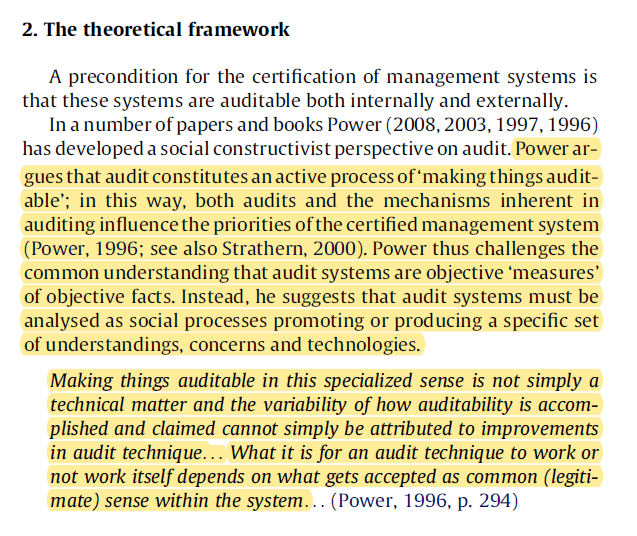
2) Certification “transforms the kinds of topics addressed and the procedures and activities applied in the system” and “actively create an environment of ‘measurable and auditable facts’
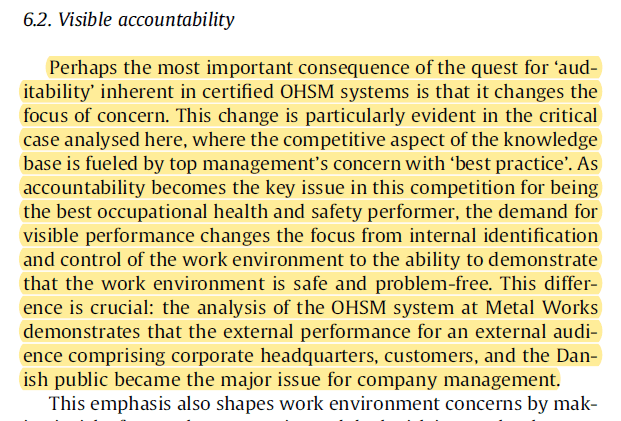
3) Another consequence of “making things auditable” is it changes the focus of concern – from managing important internal issues to managing the system due to external stakeholders and image management
4) They argue “One possible explanation for the difficulties in dealing with psychosocial work environment issues within certified OHSM systems is thus that the psychosocial work environment is complex, has multiple causes, and appears difficult for management to articulate clearly”
5) Moreover, psychosocial factors are often “interwoven with central production and management decisions” and “Not only is it difficult to measure, but dealing with it may be akin to opening Pandora’s box without having suitable (i.e. unambiguous) remedies or solutions”
6) They argue “the certified management system does not necessarily tackle the most urgent work environment issues and may exclude important aspects of the work environment such as psychosocial factors”.
That is, some SMS approaches may be ill-equipped to tackle complex sociotechnical issues and psychosocial matters, and risk collapsing these matters into simplified and neat, but incomplete, auditable factors.
These findings – supported by other studies – support Michael Power’s contention that audits [** and SMS approaches] transform organisational practices in order to “make things auditable”.
This can have the effect of transforming or simplifying functional routines into neater, but less functional, system products.
(NB. These authors have a few papers exploring this phenomenon, but their most recent paper contradicts earlier findings and found that this effect is not, of course, set in stone).


Ref: Hohnen, P., & Hasle, P. (2011). Safety science, 49(7), 1022-1029.

Study link: https://doi.org/10.1016/j.ssci.2010.12.005
Link to the LinkedIn post: https://www.linkedin.com/posts/benhutchinson2_how-well-can-safety-management-system-approaches-activity-7092654947959255040-RIxY?utm_source=share&utm_medium=member_desktop

 SafetyInsights.org
2 thoughts on “Certified Safety Management Systems, making things auditable, and the struggles of complex psychosocial factors”