What biases are present in construction safety investigations?
A new study from Thallapureddy, Sherratt, Bhandari, Hallowell & Hansen explored this question via role-play simulation interviews.
They found the following to be common biases:
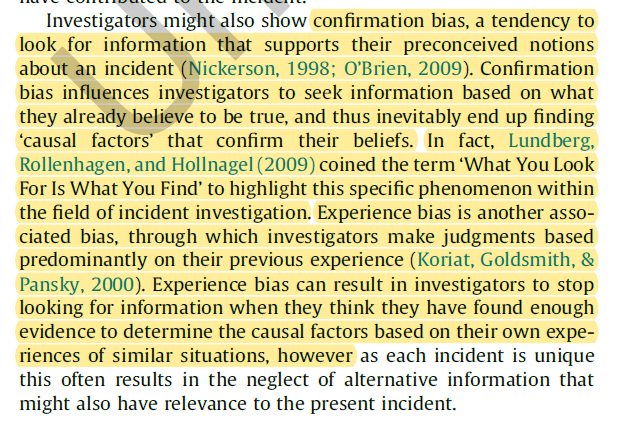
1) Confirmation bias
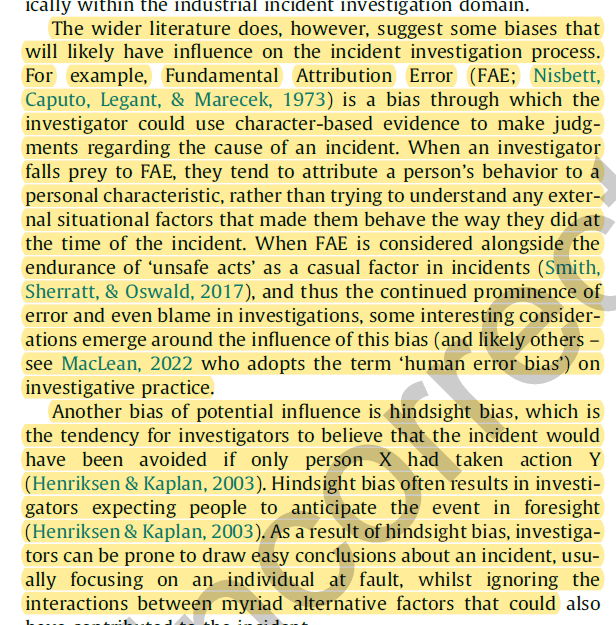
2) Fundamental Attribution Error (FAE)
3) Past experience bias
4) Anchoring bias
5) Hindsight bias
6) Conservatism in belief revision.
Post in the next week or two – but the full paper is open access, so you can read it yourself.
Some findings:
· Confirmation bias was observed in approximately 30% of investigator interviews. Here, the investigator “structured their interviews based on the initial presumptions they had stated in their pre-simulation surveys” (p6)
· FAE – A number of interviewers felt that personal characteristics of the people involved, and their resulting behaviour, contributed to the incident. One example was about an “abrasive and strong” personality, suggesting that person was impulsive or arrogant; thus “ascribing causality to inherent traits” (p7)
· Past experience bias (“Nothing surprises me anymore”) was another bias. People form judgement by relying on prior past experiences – which can result in bias
· Anchoring bias (“Getting stuck somewhere”) was another common bias. Anchoring bias can limit a broad search for information – e.g. human, process and technical aspects of work. However, many investigators fixated on just one aspect of the incident
· Hindsight bias (“It was preventable”) – Most investigators viewed the incident as preventable—had only a particular action was present or absent. However, “this is a manifestation of hindsight bias, which often hinders organizational learning from incidents as it directs investigators to easy solutions rather than to fully explore the situation” (p8)
· Conservatism in belief revision (“Taking sides and sticking to them”) – This bias was manifested where people readily took sides – e.g. most participants favoured either the IP or the witness as they made judgements about the cause of the incident
In conclusion, they state that interviews, like taken during investigations, are “unavoidably susceptible to be biased as that is simply human nature – all investigators will inevitably be biased” (p3).
I believe it’s the same dataset from their other recent paper on “New Blame” in investigations (link in comments also).
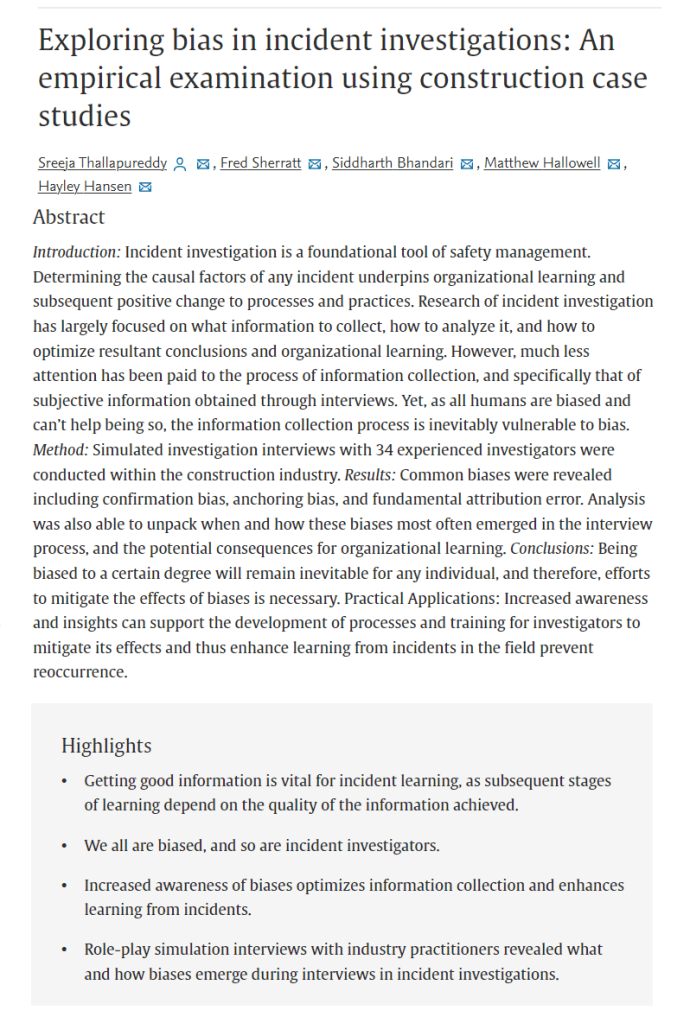
Authors: Thallapureddy, S., Sherratt, F., Bhandari, S., Hallowell, M., & Hansen, H. (2023). Journal of Safety Research.

1) Study link: https://doi.org/10.1016/j.jsr.2023.07.012
3) New blame study: https://www.linkedin.com/pulse/unintended-consequences-blame-ideology-incident-us-ben-hutchinson

 SafetyInsights.org
2 thoughts on “Biases in construction safety investigations – roleplay scenario study”