On the back of the Safety of Work podcast around safety walkarounds – here’s a systematic review of studies that may interest you.
It’s from 2014—so missing a lot of newer studies, and it’s health-care focused. But, it still evaluated 43 studies.
Overall they found that safety walkarounds:
- Heightened awareness of safety issues among senior managers – including issues that were previously unknown, overlooked or presumed resolved by managers
- Resulted in higher willingness to be open for frontline workers who participated in them
- Workers experienced greater morale, higher perceived safety climate, detection of more adverse events, higher job satisfaction and lower burnout
However, they also identified:
- Walkarounds may expose minor issues while “other significant problems remain latent”
- Leaders may be “tempted to disregard the majority of issues identified in favour of a small subset most directly related to medical errors”
- Walkarounds may be more effective for finding issues related to infrastructure-related issues, like equipment
- But, walkarounds are less effective in identifying the latent issues more connected with medical failures, and matters of “complex or potentially contentious communication”, interdisciplinary issues, difficulty accessing electronic info, and clinical decision making issues
- When leaders embark on a visible leadership program but fail to address the issues raised by workers, this can lead to frustration among workers
Finally, while many studies highlighted improvements in many facets, mostly survey measures or smaller scale studies, some of the larger, more robust studies found *declines* in safety climate and perceived performance after the safety walkaround program was implemented. Another study found improvements in some areas, but decrements in other areas.
While a walkaround sounds easy – go for a walk, talk to people, and fix a few problems, “this simplistic view is misleading”. That is, because while walkarounds can improve some facets of safety, they must be “implemented authentically and with full commitment and ability to resolve frontline staff’s concerns. Half-hearted, insincere or ineffective safety rounds can backfire, eroding rather than improving safety”.
The attached image shows some of the research findings – but there’s many more tables in the paper (43 studies in total). Paper is full open access.
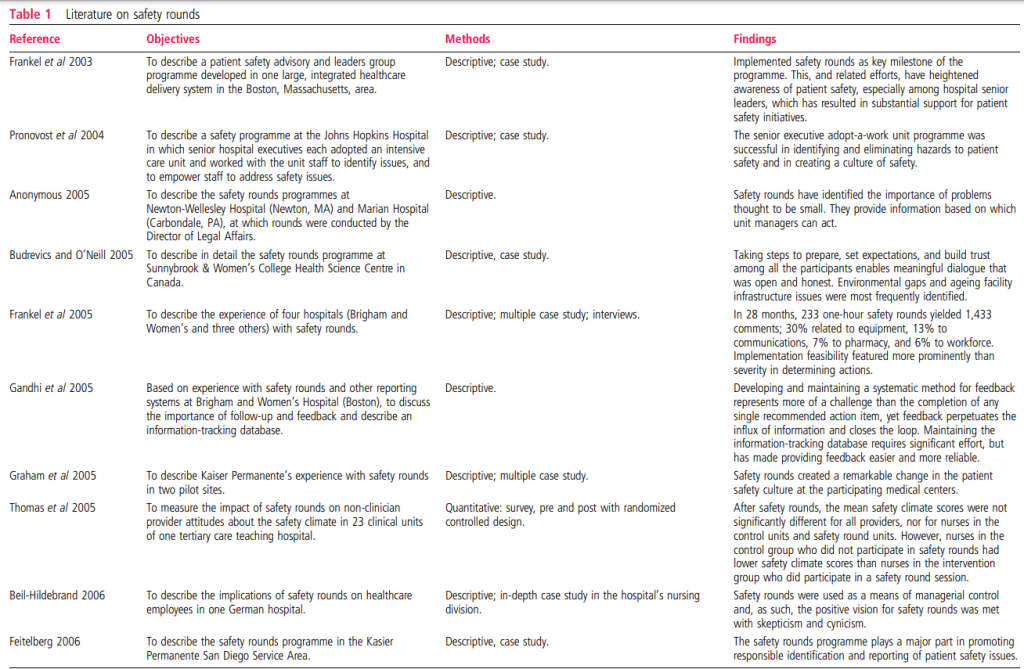
Ref: Singer, S. J., & Tucker, A. L. (2014). The evolving literature on safety WalkRounds: emerging themes and practical messages. BMJ Quality & Safety, 23(10), 789-800
Study link: https://qualitysafety.bmj.com/content/23/10/789.short

 SafetyInsights.org
2 thoughts on “Systematic review of safety walkaround evidence”