This explored how leader motivating language and follower self-leadership influence a follower’s feelings of psychological safety (PS).
Data was via online survey and 427 respondents from India and 452 from USA.
Providing background:
- When people don’t feel safe to take interpersonal risks, innovation suffers and people stop helping those around them to avoid emotional pain, and withdrawing from interpersonal connections
- Most PS research to date has focused on positive work behaviours as organisational and team levels, and not so much on changes in leader-follower dyadic behaviour, particularly through leader communication, like motivating language
- Strong self-leadership skills can create an internal buffer against workplace stress by developing self-efficacy. Thus, “self-leadership is associated with higher job performance which creates external work buffers against many adverse situations” (p2)
- Leader motivating language and follower self-leadership may reinforce each other to nurture PS
-
- Leader Motivating Language (ML) can significantly and positively influence critical follower behaviours, e.g. performance, absenteeism, job satisfaction – and more strongly than many other management concepts
- ML can be divided into three types: direction-giving language (providing workers with info on actions towards goal attainment or to dispel role ambiguity), empathetic language (initiates and maintains supportive emotional relations between workers and leaders), and meaning-making language (intersects a follower’s personal goals with the organisational goals or visions, and promoting an understanding of the culture)
- Self-leadership maintains that followers act as their own leaders and “basing their actions on internal maps of the world and personal belief systems thoughts, and natural rewards” (p4). Self-leadership involve other strategies, like positive self-talk, mental rehearsing and conscious evaluation of personal beliefs and values.
Results
Key findings were:
o Self-leadership and ML significantly influenced PS in India and USA
o This influence occurred via mediating influence of trust in leadership, leader inclusiveness and role clarity
o Mediation fully explained motivating language’s relationship with PS, but only partially explained self-leadership relationship
o Self-leadership showed an overall consistency. Self-leadership had a weak or non-existent relationship with PS without leader communication support, but a positive and strong relationship with PS when in the presence of ML
There were a lot of hypotheses tested in this paper, so you can see the tabulated results below.
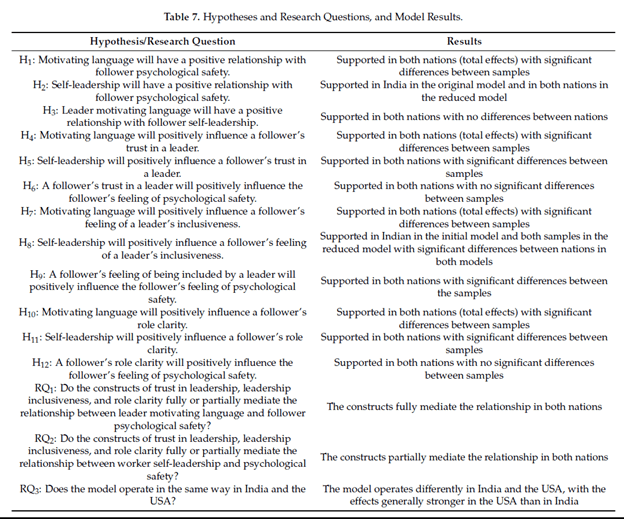
Thus, ML and self-leadership positively influence a follower’s feeling of PS. The mechanisms involved were found to be trust in leadership, leader inclusiveness and role clarity.
ML had significant links with all three mediating variables in the USA sample, it was only significantly indirectly linked in the Indian sample via a follower’s self-leadership.
In the Indian sample, a one standard deviation increase in ML was linked to a 0.98 increase in follower PS. In the USA sample, a one standard deviation increase in ML was linked to a 1.90 increase in follower PS.
Compared to other known relationships in management research, this effect ranks in the top 5% of all such effect sizes.
Interestingly, while both ML and self-leadership influence PS, the role of leader guidance and support was critical in self-leadership application. They say that while most self-leadership research focuses on the individual, these findings underlie the importance of leaders facilitating follower self-leadership.
That is, “that to promote a follower’s psychological well-being, even workers strong in self-leadership need the guidance and support of a leader” (p20).
Finally, they argue that “First, leaders should have an awareness of how strongly their communication can influence a follower’s psychological safety. While we usually think in terms of how increases in motivating language use can improve this outcome, leaders must also recognize that drops in motivating language use can have an outsize influence on psychological safety”.
Authors: Mayfield, M., & Mayfield, J. (2021). Administrative Sciences, 11(2), 51.
Study link: https://doi.org/10.3390/admsci11020051
LinkedIn Post: https://www.linkedin.com/pulse/sound-safe-role-leader-motivating-language-follower-ben-hutchinson

 SafetyInsights.org
2 thoughts on “Sound and Safe: The Role of Leader Motivating Language and Follower Self-Leadership in Feelings of Psychological Safety”