Which management/HR concepts have the strongest impacts on organisational behaviour indices?
This 2016 study, impressively, compiled and calculated the pooled results from >250 meta-analyses from the past 30 years to answer this question.
This may be a useful reference for your own work.
Key tabulated results in the attached image (I’ve somewhat-arbitrarily highlighted the effect sizes in the 0.3 range). Higher p values = stronger effect sizes. Also, lower SDρ values give us more confidence in the values (this is adjusted standard dev), and higher SP & SP w/o outliers give us more confidence (statistical power).
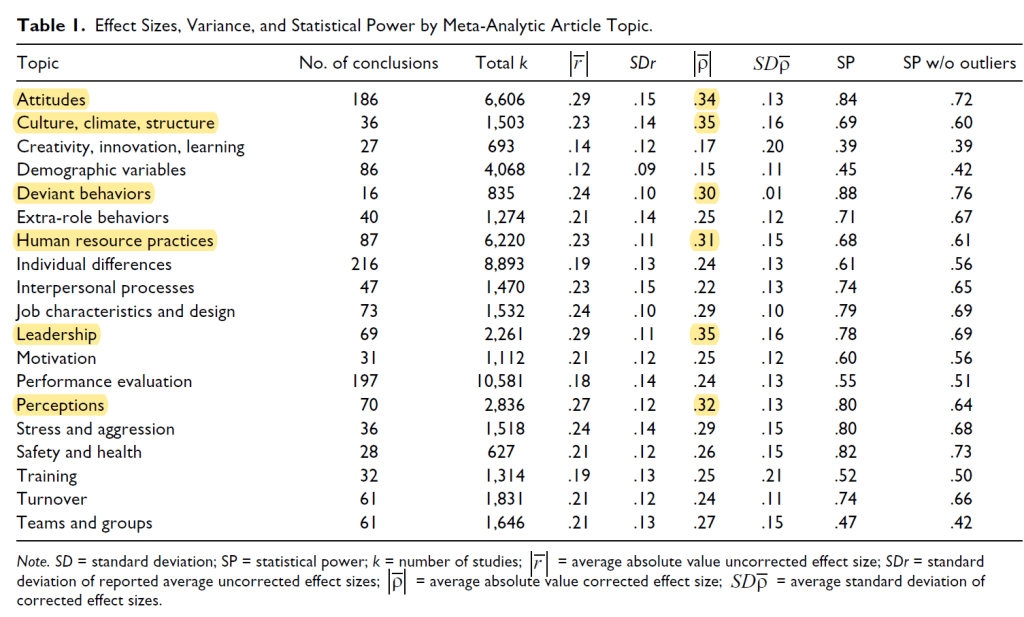
The strongest adjusted effect sizes were for (in no particular order, but all within the 0.3 range)
· Attitudes
· Culture, climate, structure
· Deviant behaviours
· HR practices
· Leadership
· Perceptions
Stress and aggression and job characteristics and design both had effect sizes at 0.29.
Perhaps unsurprising, but leadership, culture, climate and structure variables had among the strongest effect sizes with three major dependent variables: job attitudes, performance, and turnover.
They argue that this finding “potentially provides evidence for the predictive strength of leadership theories and measures”.
However, they provide an alternate and more sceptical interpretation of leadership constructs: “that leadership’s high correlations with other variables is driven mainly by the fundamental attribution error. In other words, when workers are satisfied with their jobs they tend to overattribute this to their leaders” (p.72).
Demographic variables (gender, age, education level etc.), had the weakest relationships with other variables.
Other notably findings were that:
· Variables that are usually “other-rated” or objective tend to have smaller relationships with other variables, compared to self-reported variables
· The ‘file drawer problem’—publication bias, the selective reporting/publication of findings, usually positive findings—wasn’t found to be a significant concern in these data, i.e. “the file drawer problem is trivial, at least within the OB/HR fields”
· But other sources of bias and underpowered statistical sample sizes are present
Ref: Paterson, T. A., Harms, P. D., Steel, P., & Credé, M. (2016). Journal of Leadership & Organizational Studies, 23(1), 66-81.
1) Study link: https://journals.sagepub.com/doi/abs/10.1177/1548051815614321

 SafetyInsights.org
3 thoughts on “Meta-analysis of 30 years of management and HR constructs: leadership, culture, climate & structure the strongest predictors”