Which accident learning practices differentiate a high performing mature organisation versus a lower performing one?
Summary in the next couple of weeks of a study which explored & ranked learning practices across 17 organisations.
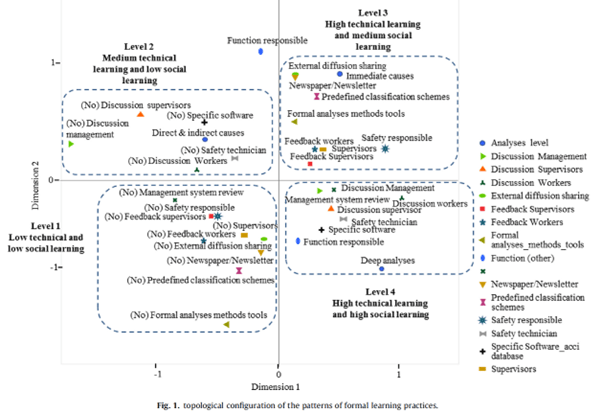
Four tiers of learning maturity were observed: At level 1 organisations are doing the minimum, being collecting accident data but having no formal procedures about who collects the info, no formal methods of analysis, and how to provide or circulate the findings. Level 4 undertakes deep analysis, improvements and info circulation.
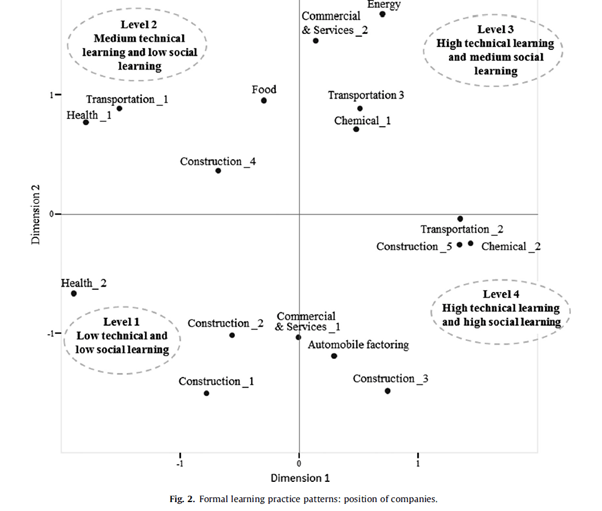
The authors argue that “only at levels 4 and 3 (Fig. 1) can one accept or state that organizations are really learning from their accidents” (p107). See image 1 & 2.
Other findings:
· All analysed organisations had established procedures to report accidents and to collect accident data, but there were “organizations that still do not maximize their means of learning from work accidents” (p102)
· Organisations with “good safety practices tend to follow the complete learning cycle” (p102)
· Further, “only a few companies have, in fact, a full learning cycle that could allow them to optimize or achieve a better learning outcome” (p112)
· As expected, having OHSAS certification represented a mixed-bag; i.e. “OHSAS certification is not related to a company’s level of learning” (p110)
· However, organisations with an integrated Quality, Environment and & OHS system were more likely to have more mature learning practices across the lifecycle [** but we don’t know the direction of the relationship]
Note: Sample size is small (17), so findings represent organisations rather than industries.
Authors: Silva, S. A., Carvalho, H., Oliveira, M. J., Fialho, T., Soares, C. G., & Jacinto, C. (2017). Organizational practices for learning with work accidents throughout their information cycle. Safety science, 99, 102-114.
Study link: Study link: https://doi.org/10.1016/j.ssci.2016.12.016

 SafetyInsights.org
One thought on “Learning from accidents across learning life cycle”