This study tracked the implementation of a restorative justice approach in a NHS community and mental health trust in the UK.
The implementation occurred over a period of 18 months, where restorative justice focused on “understanding, healing, and learning”.
Providing background:
- In this trust, responses to incidents had previously been “driven by human resource & patient safety policies and practices that mostly (if unwittingly) followed a retributive just culture script—organized around rules, violations and consequences” (p2).
- In a retributive environment, questions from incidents revolve around culpability, e.g. “it assesses how bad (“reprehensible”) staff errors are; and accordingly administers proportional consequences“ (p2)
- Retributive environments put downward pressure on people’s willingness to raise bad news, changes how they share their stories, omits issues of substantive justice by ignoring matters of staff support or the fairness of rules, is said to be linked more to power than it is justice, and “leaves the age-old procedural question of ‘who draws the line’ fundamentally unresolved” (p2)
- Restorative just culture, said to originate across multiple ancient traditions, asks different questions: “who is hurt; what do they need; and whose obligation is it to meet those needs?”(p2)
- The success of restorative approaches is said to hinge on getting the community involved in collaboratively resolving those questions and “arriving at a solution that is respectful to all parties”
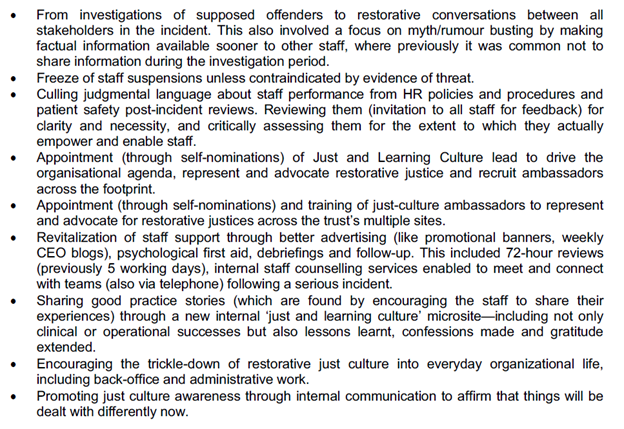
The restorative approach involved a number of activities. See the below image for a list:
Results
Implementation of the restorative approach resulted in noticeable and “apparently uniformly beneficial consequences for staff and organization alike”.
For example, benefits included:
· A downward effect on the number of suspensions and disciplinary cases
· Increased usage of staff face-to-face counselling (up from an average of 283 requests per year in 2014 to an average of 378 in 2017)
· Moreover on seeking counselling, there were less presented issues involving bullying, career, formal procedures, health, job situation, employment, trauma and violence/assaults
· Increased reporting of adverse events (up from 7% to 18% per year from 2014 to 2017)
· Reduction in absence due to illness
· Improved staff retention
· Increased trust across different organisational levels
· Increase in compassionate leadership and psychological safety within teams
· And lots more listed in the paper.
Economic benefits were also observed. They found a “meaningful saving” of approximately 1% of the total costs and 2% of the labour costs. After correcting for inflation, acquisitions and anomalies, they found that salary costs when averaged over two fiscal years were reduced by £ 4 million per year. The trust also gained £ 1 million in saved legal and termination expenses.
They “conservatively attribute half of these savings to the introduction of a just and learning culture itself, and the other half to non-related factors” (p8). With this assumption, they estimate savings to the trust of £ 2.5 million (1% of total costs or 2% of labour costs).
In all, they note that “In the example of Mersey Care we see that after the move from a retributive just culture to a restorative justice, the initial reluctance on people to come forward with bad news is overcome, as was suggested by the literature”.
Note. Robert J. de Boer kindly pointed out that there is an update to this study, in the book “Restorative Just Culture in Practice”. Link below.
Authors: Kaur, M., De Boer, R. J., Oates, A., Rafferty, J., & Dekker, S. (2019). In MATEC Web of Conferences (Vol. 273, p. 01007). EDP Sciences.

LinkedIn post: https://www.linkedin.com/pulse/restorative-just-culture-study-practical-economic-nhs-ben-hutchinson

 SafetyInsights.org
2 thoughts on “Restorative Just Culture: a Study of the Practical and Economic Effects of Implementing Restorative Justice in an NHS Trust”