Good to see investigation reports drawing on contemporary thinking in their narratives, like practical drift from Snook and incorporation of HF/E.
This report comes from the ATSB (who are usually pretty progressive – another great example is the Columbia shuttle investigation).
It describes findings from the 2020 train derailment at Wallan; killing two and injuring 8.
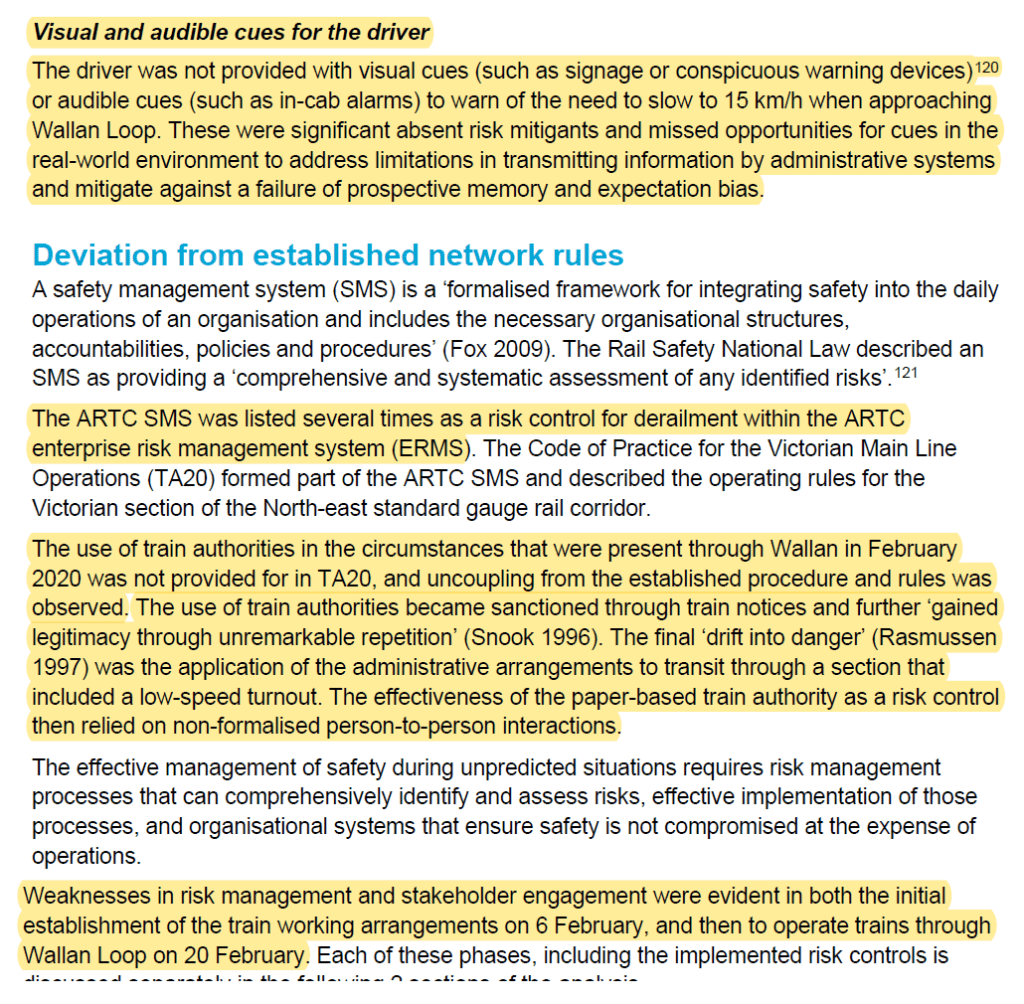
Among many factors, they identified that the driver didn’t receive notable visual cues to warn of the approaching Wallan loop. See image 1.
Moreover, ordained and gradual uncoupling from established procedures via “unremarkable repetition”, leading to practical drift.
They also note how the driver “likely developed a strong expectation that ST23 would be travelling on the straight track through Wallan”, because the driver had operated other services through the location 8 times in the preceding 12 days, and on all occasions the loop track was locked out of service.
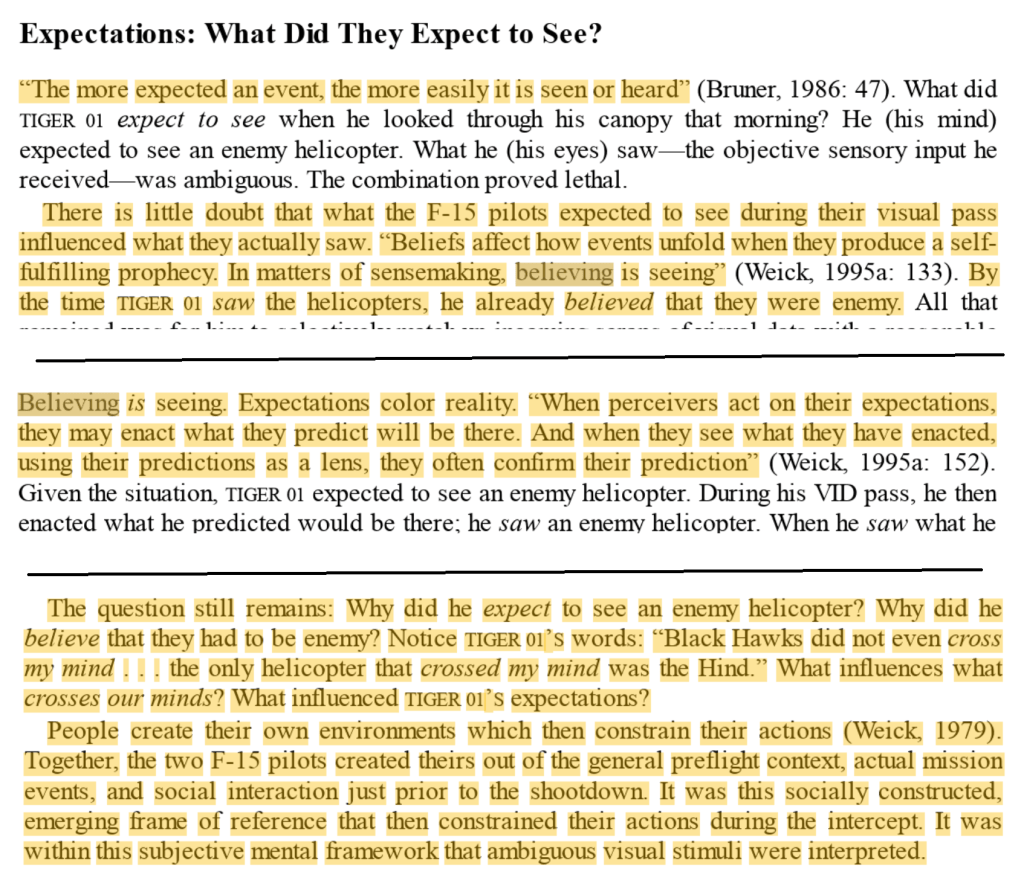
This also relates to what Snook discussed in his book (image 2 – from “Friendly Fire”, not the ATSB report), highlighting that we see what we expect to see.
Snook further remarked that “the more expected an event, the more easily it is seen or heard”.
Further, as argued “seeing is not necessarily believing; sometimes, we must believe before we can see”.
Refs:
Image 1: Derailment of XPT ST23, Wallan, Victoria, on 20 February 2020. ATSB
Image 2: Snook, S. A. (2000). Friendly fire: The accidental shootdown of US Black Hawks over northern Iraq. Princeton university press.
Link to report: https://www.atsb.gov.au/publications/investigation_reports/2020/rair/ro-2020-002

 SafetyInsights.org