“Do Your Own Research” (DYOR)… What could possibly go wrong?
A fascinating podcast from You Are Not So Smart covered recent research around this expression/movement – DYOR. (Links below)
Dave McRaney talks with Sedona Chinn about a paper of hers exploring DYOR.
DYOR was said to be made a slogan by an American conspiracy believer, and has since been used frequently from anti-vaccine advocates and elsewhere.
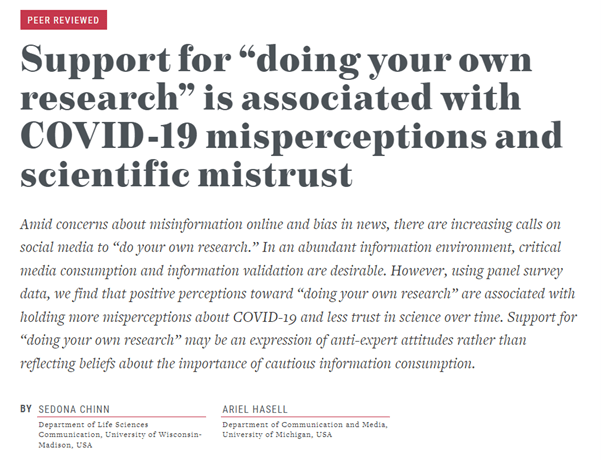
Chinn found that: (quoting her linked article)
· “Positive perceptions toward DYOR are associated with holding more misperceptions about COVID-19 and less trust in science over time”
· “Support for DYOR may be an expression of anti-expert attitudes rather than reflecting beliefs about the importance of cautious information consumption”
· “Calls to DYOR often use language that appeals to democratic ideals, personal freedoms, and individual empowerment. But strong support for doing one’s own research may instead reflect anti-expert attitudes and mistrust, leading to inaccurate beliefs”
· As people more strongly adopt DYOR epistemic beliefs, they “may have greater justification for engaging in motivated reasoning and cherry-picking expert voices to support appealing beliefs, even when those beliefs oppose a consensus of institutional experts”
· DYOR perceptions were significantly associated with decreased belief accuracy about COVID-19, and adopting DYOR was found with heightened misperceptions over time
· “doing your own research may not be about seeking information but instead be expression of anti-establishment political identity”
· “Doing your own research” is both a prudent and flawed endeavor
They argue that DYOR perceptions may be “associated with biased information processing or seeking untrustworthy information”.
Moreover, people often “overestimate their abilities to seek and interpret information … and tend to search for information that aligns with preexisting values, beliefs, and identities”.
Intriguingly, the author discusses how people who promote DYOR may not actually perform any more research than anybody else.
And when they do perform additional research, it may be more susceptible to cherry picking and motivated reasoning, and higher rates of inaccurate and misleading statements.
Finally, I’ve also linked to another paper on DYOR, co-authored by David Dunning (of Dunning-Kruger fame).
Links:
Chinn’s article covering her study: https://misinforeview.hks.harvard.edu/article/support-for-doing-your-own-research-is-associated-with-covid-19-misperceptions-and-scientific-mistrust/
Dunning’s paper: https://philarchive.org/archive/BALDYO

 SafetyInsights.org