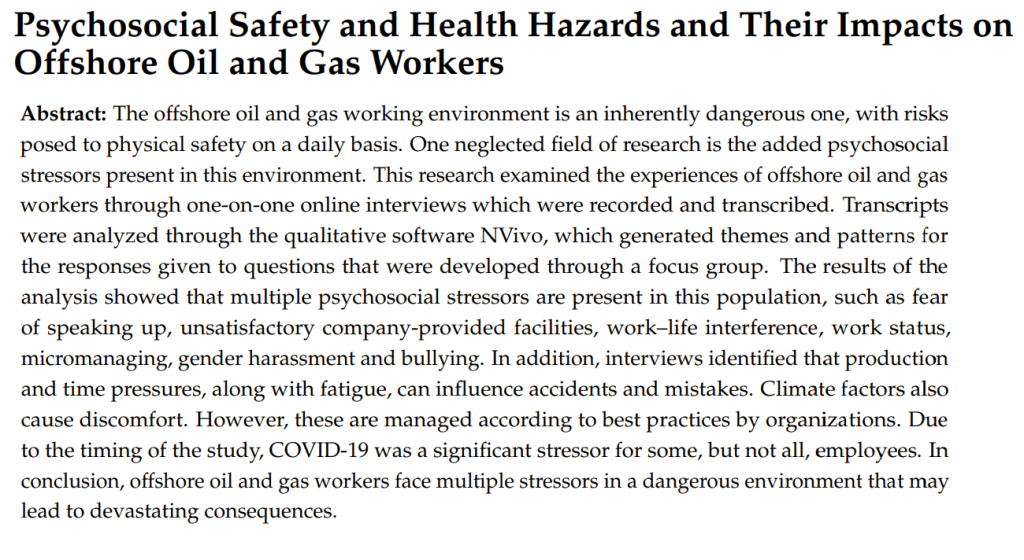
This study ran one-on-one online interviews with offshore oil and gas workers to understand their experiences with psychosocial safety and health.
Data was via 37 participants (37 male and 4 female). 17 were permanent, 4 casual and 7 contractors, and 1 casual contractor. All worked 12 h days with no days off, while offshore.
Providing background:
· Authors note that while onshore FIFO work has been subject to psychosocial research, workers in the offshore area remain overlooked in comparison
· While some data indicated elevated risk of suicide among onshore FIFO workers over the past ten years, offshore data is less clear
· Added stressors to the “usual” FIFO risk factors are aggravated geographical isolation, longer rosters, extreme weather, like cyclones, changeable ocean conditions, and helicopter travel
· Organisations that provide “empowering opportunities for employees tend to see higher levels of productivity [6] and reduced costs from employee sickness, disability, deaths, poor performance and poor productivity [7]. Failure to address poor mental health in the workplace also negatively affects attendance and accident rates” (p2)
Note: Likely few surprises with these findings, but interesting data to add to the body of knowledge nonetheless.
Results
Key psychosocial stressors present in this offshore sample were:
· Fear of speaking up
· unsatisfactory company-provided facilities
· work–life interference
· work status
· micromanaging
· gender harassment
· bullying
· production and time pressures, and fatigue – all which can influence incidents
· Climate factors also cause discomfort
I’ll cover some of these.
Inadequate accommodation, food and internet: People were generally unhappy with accommodation provided. For one, securing alone time is “extremely rare”.
Food quality was also a key part of life offshore, “significantly affecting the morale of workers” (p3). Moreover, food quality appeared to affect mood, and subsequently the character of the environment during mealtimes. As one person said: “If you make good food, they talk good conversation while they’re sitting eating where they only get together for that one hour …”, which prevents people “sitting there talking about what shit food they’re getting” (p4).
Employee communication quality with family is frequently poor. This is aggravated during peak period usage, like when shifts ended.
Fatigue and rostering were implicated with alertness and incidents (no surprises). This was amplified with time and production pressures. One participant noted the perceived pressure to finish tasks. This pressure leads to a reluctance to speak up about hazardous states.
After events like unplanned shutdowns, workers feel elevated pressure to get going again, such that a “production-focused organizational or managerial culture leaves employees feeling stressed and unimportant” (p4).
Fear of speaking up: People raised safety concerns due to fear of repercussions of job loss. This was most prominent among casual and temporary workers. Fear of speaking up “extended to the stigma around men reporting mental health issues” (p5). One person felt the stigma may deem them unfit to work offshore.
The offshore industry, and in particular roles like drilling, were seen as masculine and filled with bravado. One person noted that you don’t want to show “any sort of weakness”, and this type of behaviour is “pretty disgraceful out there”.
Diving was also seen as typically masculine and “the effect of workplace culture on whether someone will seek help for poor mental health is ‘massive” (p5). One participant said that divers wouldn’t want to seek help, as they don’t want to appear mentally weak to their diving community. They believed this was driven by the fact that you and others have lives in your hands, and mental illness could be seen as a liability or weakness.
This “Not speaking up in the context of the macho culture of a male-dominated workplace extends to reluctance to disclose symptoms of sickness” (p5), like with COVID.
Casual and contractor workers: A major finding was that casual and contract workers experience higher levels of stress linked to job status. They also experienced inferior conditions – generally performing the riskiest work and reported an ‘us versus them’ environment.
Issues around blame, micromanaging and bullying were also prominent. A culture of blame and fear existed, and anxiety among some people about making mistakes; particularly among contractors.
Blame and bullying manifested in micromanaging – people expressed frustration at the tendency for managers to micromanage. This was seen as a “damaging practice that reveals a lack of trust in workers” (p7). Several people worked under overbearing managers with strong egos and an “intimidatory management style”.
One form of micromanagement and bullying/control manifested in one organisation excessively controlling food portions.
In another case, this over-regulation of food portions may have been the result of cost controls.
Bullying from higher up was reported, generally from management-level employees. This was linked to micromanaging, like exclusion from meetings and trips, demotion, and barriers to promotion.
Bullying and tough interpersonal working conditions manifested from power discrepancies between managers and workers. Some evidence of gendered harassment was evident, although the study was underpowered to fully explore this facet.
Speaking up about issues were referred by some as being “booking a window seat on the next flight out of here” (p10).
Being away from home and family life interference were noted by many. E.g. missing special events with family, being unable to respond to family emergencies, poor phone/internet quality and more led to increased stress. This impacted inattention and mistakes at work.
Not all participants experienced support from their companies when they had difficulties back at home waiting for them. One person relayed a story of somebody he knew, whom needed time-off due to the death of his infant child. This person was bullied and harassed by the HR manager to get back to work.
Finally, unresolved interpersonal issues at home are worsened by isolation. High levels of divorce were noted by participants. Also, transitioning back to home life was challenging for some people – some believed they lived two separate lives.
Authors: D’Antoine, E., Jansz, J., Barifcani, A., Shaw-Mills, S., Harris, M., & Lagat, C. (2023). Safety, 9(3), 56.
Study link: https://doi.org/10.3390/safety9030056
LinkedIn post: https://www.linkedin.com/pulse/psychosocial-safety-health-hazards-impacts-offshore-oil-hutchinson

 SafetyInsights.org
One thought on “Psychosocial Safety and Health Hazards and Their Impacts on Offshore Oil and Gas Workers”