This paper undertook in-depth interviews with surviving family members to understand their experiences following work-related deaths in Australia.
Note, the findings date back pre-2010.
Providing background:
· Little research has been undertaken on the consequences of surviving families, following work deaths
· In 2008-9, 286 workers died from traumatic incidents at work, and as with other countries like the US, death is highest among male workers in industries like construction, ag, forestry, fishing and road transport
· Data on birthplace was limited at the time of this study, but some data suggested foreign-born workers experienced higher fatality rates
· Exposure to sudden and traumatic death “can leave [family members] vulnerable to adverse mental and physical health outcomes such as depression, posttraumatic stress, complicated grief and cancer”
· It can also lead to reduced ability to work, and poor quality of life for partners and children. On the latter, children are particularly “vulnerable to lasting behavioural, emotional and cognitive consequences that may become severely disabling”
· Family responses to workplace death are said to be characterised by anger and injustice, as compared to suicide which is characterised by things like shame, stigma and self-blame
This study explored several parts of the post-death process for families.
Results
The below table highlights the key difficulties faced by surviving families following workplace death.
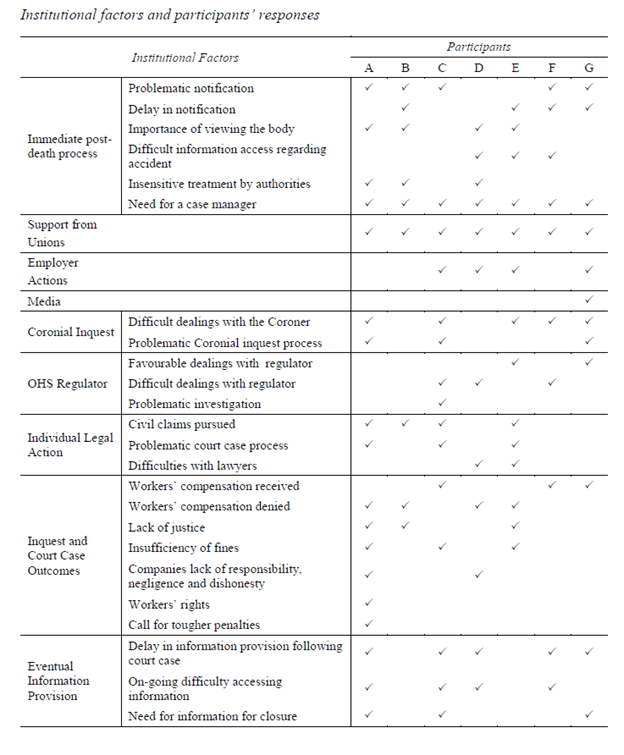
1. Notification of the Incident and the Immediate Post-Workplace Death Process
Post-death notification was a key difficulty faced by families. Families reported of no uniform notification process in terms of who contacted the family.
Few participants reported anything positive about the immediate post-death process. One participant said while police are usually the police who notify, this doesn’t always happen.
Delays in reporting was reported by participants. By the time some people are notified and they get to the hospital, the deceased may not be there anymore and taken away. Another participant was “the last person to find out”, and was unable to say goodbye to the deceased.
Another was told their relative was deceased by a doctor, spent a little time with the deceased but was then not allowed to spend any more time as the body was taken for autopsy. The participant was pressured three times to leave so the body could be taken.
Lack of communication was a particularly stressful factor. One participant didn’t know where the body was, with call arounds to the funeral provider and Coroner to find out. There was “no communication with the family”.
All participants advised the need for a support person or case manager to assist families with the post-death process. This person should communicate and inform the family of the post-death process, including autopsy, coronial investigations, and any legal actions taken.
2. Dealings with Unions, Employers and the Media
Unions were endorsed by all participants for helping to keep families informed and updated, and providing outreach and assistance. For one participant, the union was “more supportive than anybody else”.
Unions also helped with solicitors in OHS cases.
One participant said the construction company involved was “very shifty”, and the participant had to get the union involved.
Some participants had favourable contact with the employers, like the setting up of a trust fund for the deceased’ kids, but others had unfavourable encounters. However, in the case of the trust fund, the participant was sceptical of the reasons, thinking it was perhaps, in part, to placate the family and avoid being sued by the company.
In another instance, the deceased’ employer visited the family, paid out the day’s wages and left; leaving the family member “disgusted” with the exchange.
Media was mostly a stressful and negative interaction for families. In one case media intruded on the funeral, necessitating police.
Media was seen as “hounds… Very intrusive” and they “caused a lot of damage”.
Media was also seen to reinforce “a prevailing social stereotype that values married people with children above single individuals” and that this “stereotype and the media’s treatment of it, ignores what other family a single person may have”.
3. Dealings with Government and Legal Processes
Dealing with government was of pivotal experience for families.
Negative experiences with the workcover process was seen negatively by most.
Moreover, most who had experienced some or all of the formal legal processes felt negatively about this, like lack of justice, meagre fines, lack of companies’ responsibility and lack of recognition for families.
Most experienced the coronial process. This was characterised by lack of information, communication and support structures for families. Sometimes it can be decided not to hold an inquest, and a participant was unaware that family members can request an inquest.
In one case the coronial inquiry led to a working party which made changes to industry via a code of practice or similar instrument. However, this was a long process of >4 years.
Participants believed that family should have a say in coronial inquests, and in the inspectorates court case. Some believed that the only time they had a say was in the victim impact statement in the inspectorate’s court case.
Five participants discussed their experience with the OHS regulator. Two were favourable, saying that the inspector made contact with the family on day one and provided an information kit, and maintained regular contact. After the legal proceedings ceased, the OHS regulator assisted the family to appeal the low fines against the company.
Others had less positive dealings with the OHS regulator. People were confused about the post-death bureaucratic system, and had difficulty accessing information. Some had no contact from the OHS regulator, for others they did occasionally ring.
For the legal process, participants were naturally “unappeased” by the fines issued to the companies. In one case, a company was fined $65k, but they were able to carry on working. As lamented by the participant “That is how much his life was worth – $65,000” (emphasis added).
People also spoke about the site responses to site incidents, like cover up, deception and lying. Quoting a participant in the paper “We’ve heard stories where somebody falls off a roof, and while he’s laying there and they’re waiting for the ambulance to come, they’re strapping a harness onto him so they don’t get into trouble”.
Again, the workers comp system was seen negatively by many. Not all family received compensation either. For instance the wife of a killed worker was subcontracted and wasn’t entitled to workers comp.
In another case, a family struggled to get compensation for their son’s death because “he was basically disregarded within society as not having any family”.
Families struggled with poor and inadequate communication and delays with government agencies.
Discussing the findings
· Families commended the role of unions, and some people had positive encounters with employers and the OHS inspectorate
· However, there was significant problems for others with institutional responses
· This included insensitive treatment by authorities, inadequate fines and punishments for organisations, confusing inquests and lack of information
· Families “often saw their interactions with authorities as exacerbating their distress and Grief” and moreover “Formal procedures were also seen as increasing the family’s isolation from the post-death process”
· Some families were “frustrated and hurt by the perceived injustice of the system” and this was most evident in the unreasonably narrow definition of a dependent in determining compensation
Authors: Lynda R. Matthews, Michael Quinlan, Olivia Rawlings-Way, and Philip Bohle. International Journal of Disability Management, 2012, Volume 6, 37-48.
Study link: https://doi.org/10.1375/jdmr.6.1.37
LinkedIn Post: https://www.linkedin.com/pulse/adequacy-institutional-responses-death-work-surviving-ben-hutchinson

 SafetyInsights.org
One thought on “The Adequacy of Institutional Responses to Death at Work: Experiences of Surviving Families”