One of several fascinating papers exploring the language of more radical-leaning/conspiracy communities.
I suspect this topic won’t appeal to most. My prompt for reading this was an observation of similarities in language from people I’d, judgementally, considered to be more extreme-leaning. Using words like sheep/sheeple, allegedly, puppets, or putting words like scientists or research in quotation marks etc.
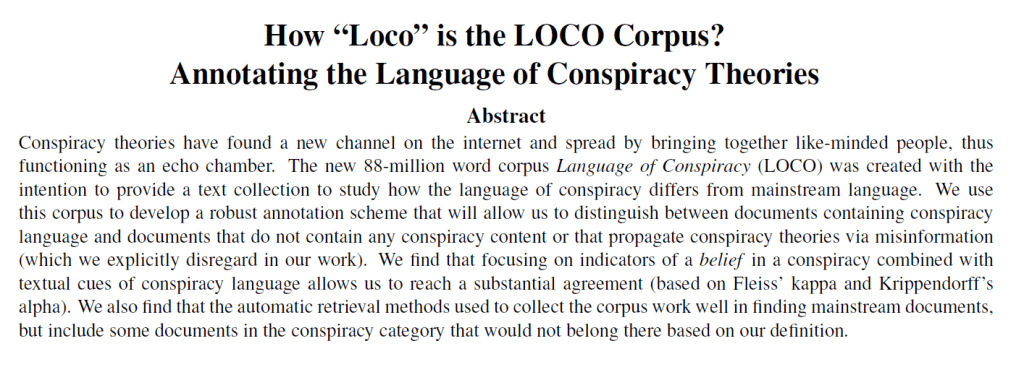
Anyways, this paper explored the discourse of conspiracy believers, based on the 88-million word corpus ‘Language of Conspiracy’ (LOCO). It’s a large, online repository of conspiracy documents/posts used for research.
The authors come swinging from the gate, arguing that “Conspiracy [believers] have found a new channel on the internet and spread by bringing together like-minded people, thus functioning as an echo chamber”.
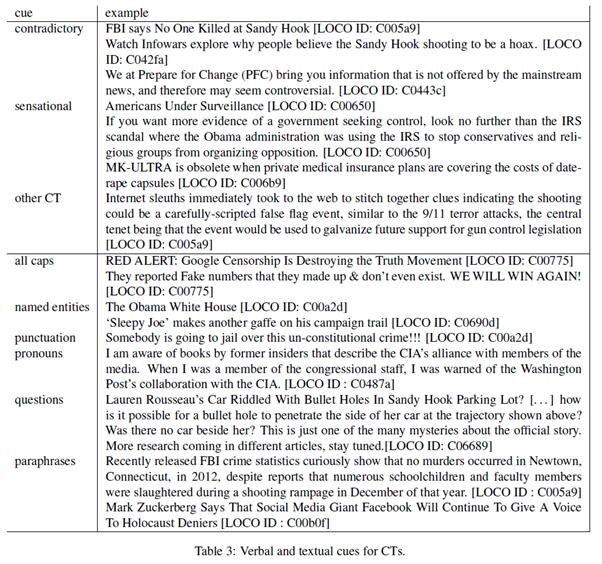
Attached are some of the key trends of discourse identified among the radical-leaning communities based on this sample.
Some examples of the conspiracy toolkit are:
1. Extensive use of all caps
2. Atypical named entities
3. Unconventional use of punctuation
4. Frequent use of 1st and 2nd person pronouns
5. Frequent questions directed at the reader
6. Paraphrasing instead of direct quoting
The attached image highlights some examples.
These conspiracy sources:
1. Provide contradictory opinion to mainstream opinion (…unsurprisingly)
2. Uses sensationalism; e.g. headlines and content are written to “excite strong emotions, often at the expense of correctness”
3. Frequently cites other conspiracy ideas. The conspiracy documents often refer to other conspiracy documents, rather than robust scientific data
4. Frequent use of “allegedly”
5. Frequently display a “lack of clarity”, which may “allow readers to impose their pre-existing beliefs or worldview; in this way, the [conspiracy belief] is perpetuated in part because it can mean different things to different people, thus contributing to the multi-faceted collection of beliefs centered around one [conspiracy]”
I also find calling the scientific establishment ‘sheep’ fascinating.
This is because some evidence highlights that the ‘sheep’ have a more demonstrably critical, broader and deeper range of robust empirical sources, compared to the conspiracy crowds (wolves… ?), who were shown to be more fixated on a narrow-set of alternative but confirming sources (indicative of motivated reasoning and cherrypicking).
As always, the study had limitations which must be considered. But, still interesting.
Ref: Mompelat, L., Tian, Z., Kessler, A., Luettgen, M., Rajanala, A., Kübler, S., & Seelig, M. (2022, June). In Proceedings of the 16th Lingusitic Annotation Workshop (LAW-XVI) within LREC2022 (pp. 111-119).
Study link: https://aclanthology.org/2022.law-1.14/

 SafetyInsights.org