Should we count crows or errors? The late, great Bob Wears discusses some challenges with a myopic focus on “error”.
Post in the next couple of weeks.
He focuses on the matter in healthcare, saying that despite the push for innovation, the industry “remains trapped by old ideas [of human performance].
He says that this view of people as unreliable components in an otherwise safe system is “in a way reassuring”.
That is, believing that our systems are basically safe allays concerns, and avoids uncomfortable and costly fundamental changes.
Importantly, this belief is “also convincing, in the same way that optical illusions are convincing; it is easy to see “errors”, especially in hindsight”.
He counters with another view of human performance, where:
· “Human error” isn’t the cause of anything, and may not actually “exist as an objective, separable, and reliably identifiable construct”. Instead, error can be a symptom of deeper trouble in the system, and to understand failure then, we “must find how people’s assessments and actions made sense to them at the time”.
· Our systems are inherently hazardous, and this facet is driven by the realisation that our systems “embody fundamentally irreconcilable conflicts among goals that must be pursued simultaneously, like production, time, cost etc.
· Human error isn’t necessarily random, but “systematically connected to features of workers’ tools, tasks, artefacts, and working environments”. Thus, improving safety can come about from understanding and influencing these connections.
Highlighting these alternate characteristics, he maintains that “underneath every simple and obvious story about error, there is a deeper, more complex story and that eliciting, sharing, and learning from that story, not the “error” story, is what leads to improvement”.
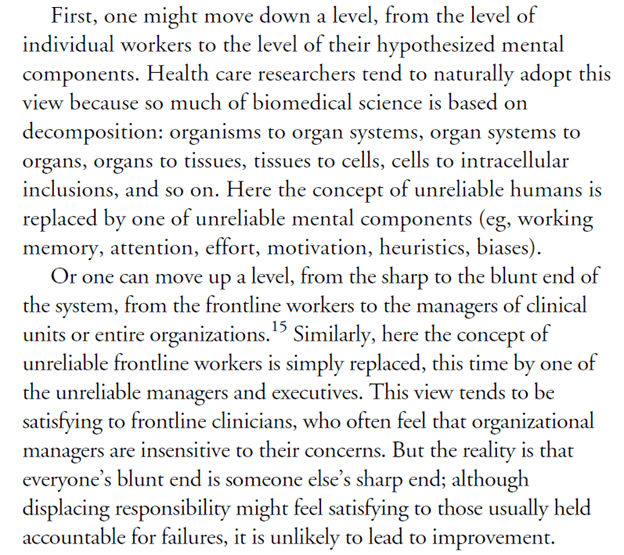
Nevertheless, best intentions to mitigate the “errors in error” can just shift blame from one level (frontline workers) to others (management).
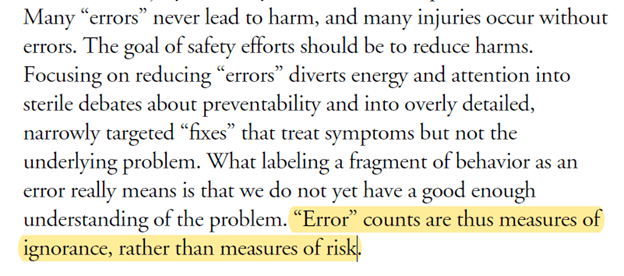
Wears remarks that “What labeling a fragment of behavior as an error really means is that we do not yet have a good enough understanding of the problem”.
Wears concludes “Error” counts are thus measures of ignorance, rather than measures of risk”.
[Of course, reality doesn’t need to be so black and white, and Wear uses these points for intellectual challenge rather than for literal application]
Ref: Wears, R. L. (2008). The error of counting “errors”. Annals of emergency medicine, 52(5), 502-503.

 SafetyInsights.org
One thought on “Error counting and old ways to think about human performance”