What is the relationship between network resilience (* capacity for) and actual project performance?
A 2016 study to be posted in the coming weeks explored this relationship across three mega-projects.
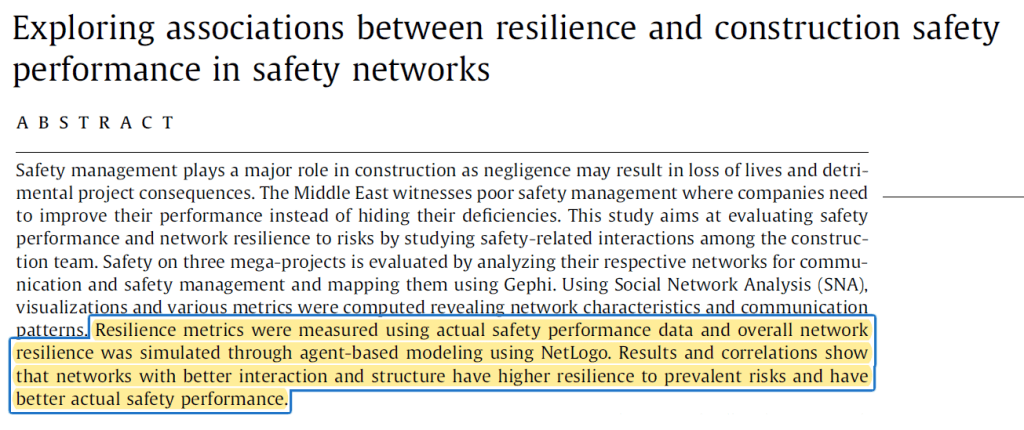
Overall:
· Networks with better interaction and structure have higher resilience indices to risks
· Higher (network) resilience indices correlated with better actual safety performance
· Network structure, communication patterns and resilience shaped performance on the projects, and thus “A more cohesive network structure on a project implies better safety communication and more resilience toward safety risks”
· Also “The stronger the network, the better its ability to respond to safety problems, recover effectively, and proactively engage in avoiding future occurrences”
The findings suggest that “Better resilience is then directly associated with improved safety performance”.
They argue that a “resilient network develops resistance to failures as it is shown to build up barriers and prevent recurrence of problems through a continuous learning process. Therefore, resilience is associated”.
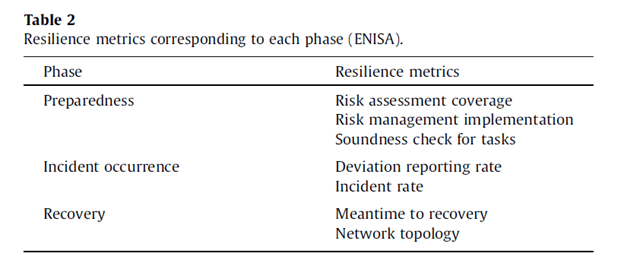
Image 2 highlights the relationship between different resilience metrics versus three temporal phases of disruptions (pre/preparedness, during/occurrence, and post/recovery).
Authors: Wehbe, F., Al Hattab, M., & Hamzeh, F. (2016). Exploring associations between resilience and construction safety performance in safety networks. Safety science, 82, 338-351.
Study link: https://doi.org/10.1016/j.ssci.2015.10.006

 SafetyInsights.org
One thought on “Network resilience, communication and better actual safety performance”