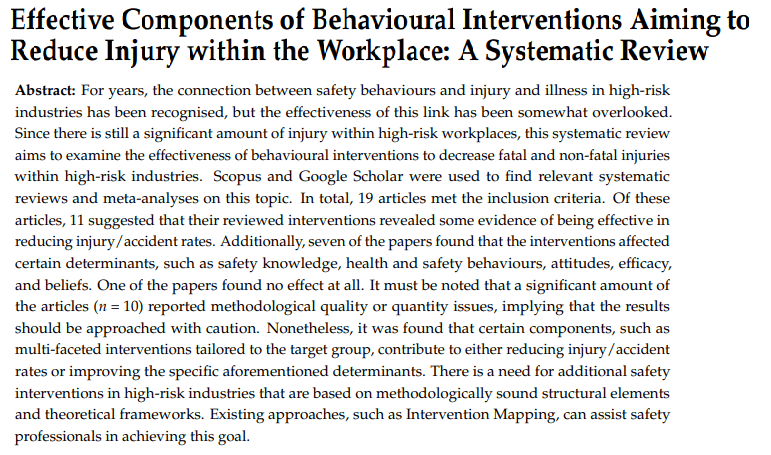
This systematic review evaluated the evidence surrounding behavioural interventions in improving safety injuries and incidents.
All the usual precautions about the stability of incident data remain.
19 studies met inclusion criteria.
While I’m not a proponent of behavioural approaches, I post this in response to comments on LinkedIn about how “behavioural/BBS programs don’t work”. I think to make this statement we should first look to the evidence.
This study considers multiple strategies to be behavioural interventions, including peer observation, incentives, feedback and specific safety training.
They also explore the effects of behavioural approaches in improving things like safety knowledge. Safety knowledge can be seen as “a “proximal antecedent” … of safety behaviours since it supplies employees with certain assets to know how to perform safely”.
Other work has found that safety climate rather than safety knowledge explained a larger amount of variance in safety behaviour.
Results
Key findings included:
· Of 19 studies, 11 suggested that behavioural interventions were effective in reducing injury/incident rates
· Seven papers found that the interventions affected certain determinants, like safety knowledge, behaviour, attitudes, efficacy, and beliefs
· One paper found no effect at all from the behavioural approach
· Multifaceted interventions were more effective, as were programs tailored to individual settings/groups
· However, “a significant amount of the articles (n = 10) reported methodological quality or quantity issues, implying that the results should be approached with caution”
As above, the majority of studies concluded that behavioural interventions that were reviewed were either effective in improving injury rates or positively affecting other determinants.
They also highlight the challenge with the relatively poor quality of evidence. As per a prior meta-analysis, this study also harked their findings by warning of a significant potion of poor methodological quality or quantity. This facet makes it hard to compare and contrast studies.
Further, 10 of the 19 studies “concluded that their review evidence was weak due to either the quality or quantity of the evidence”.
Nevertheless, the overall risk of bias was quite low. Twelve papers were assessed as ‘good’, two as ‘mediocre’, and five as ‘weak’.
One of the ‘good’ methodological studies found reductions in injuries/accidents following a BBS intervention.
As expected, multi-faceted programs were more effective than any of the interventions alone.
Nevertheless, the authors argue that “Despite the methodological issues described above, by comparing the papers, we were still able to draw some meaningful conclusions concerning key components that could aid the effectiveness of these interventions”.
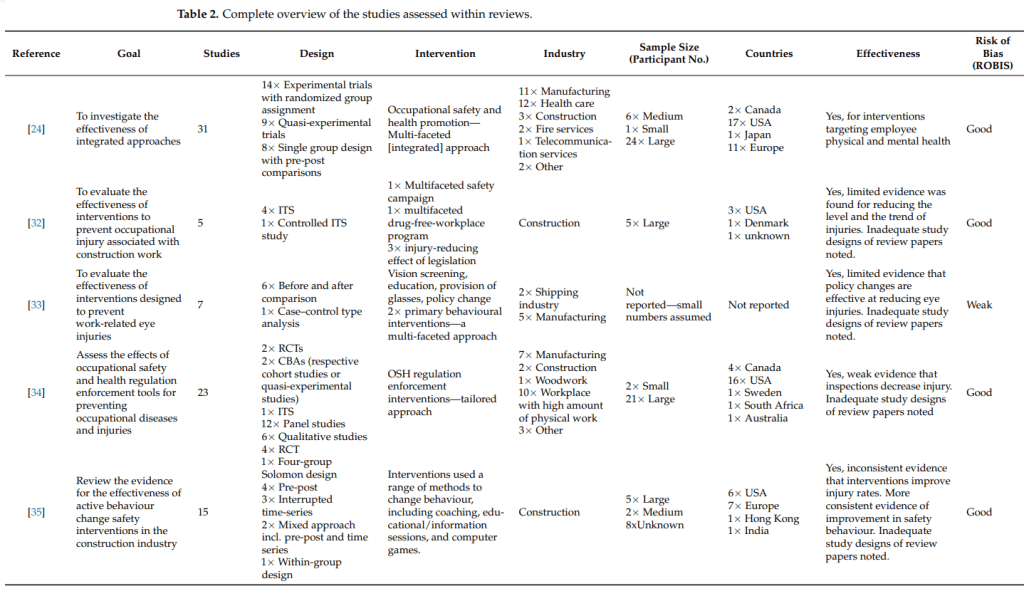
A sample of their included studies are provided below:
Authors: Bowdler, M.; Steijn,W.M.P.; van der Beek, D. Safety 2023, 9, 46.
Study link: https://doi.org/10.3390/safety9030046
LinkedIn post: https://www.linkedin.com/pulse/effective-components-behavioural-interventions-aiming-ben-hutchinson

 SafetyInsights.org
One thought on “Effective Components of Behavioural Interventions Aiming to Reduce Injury within the Workplace: A Systematic Review”