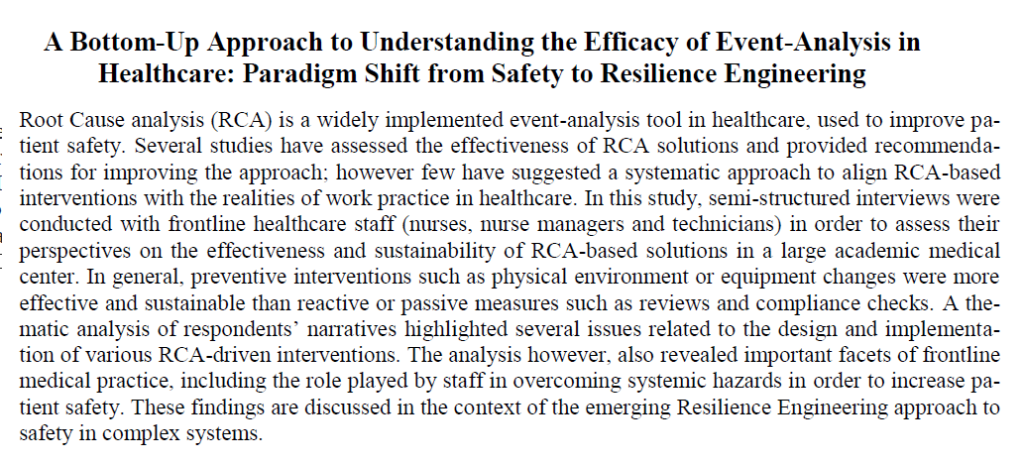
This explored the perspectives of 44 healthcare workers regarding the effectiveness of RCA-based interventions/controls, using a Resilience Engineering framing to understand the realities of their everyday work.
The study argues that a shortcoming of traditional event-analysis investigation is that they focus on incidents or adverse events – themselves only representing a small subset of hazardous situations. Thus, learning only from adverse events are “based on a holistic understanding of how the system drifts from a normal, safe state to a hazardous one”; i.e. normal work.
Results
Expectedly, interviews revealed that preventive interventions as a result of RCA interventions, like institutional change, IT structure change, physical environment change and process change based on human factors principles were more effective and sustainable than reactive solutions like training, policy change, compliance checks.
A problem resulting from the RCA interventions was that changes to forms and paperwork can lead to coordination issues, thereby necessitating extra effort for staff in terms of checking and monitoring. This delay with creating paperwork impacts work.
Another issue was with technology on workflow. It’s said that often when technology is introduced (with the goal of making the process more efficient), it can have unintended effects: These include introducing new safety hazards or process blocks necessitating workarounds or compensatory actions from staff. One example included the use of patient wrist band scanners for ID’ing patients; found to lead to “eroding the nurses’/technicians’ habit of checking the patient’s identity before transport”, eg double checks.
Authors highlight that “New technology must be preceded by a thorough investigation of its suitability, usefulness and potential unintended consequences” (p675). [Although, likewise, we could extend that to almost any post-incident intervention; to varying degrees of evaluation.]
For training, healthcare workers believed it is not a sufficient stand-alone intervention for eliminating hazardous states, although most were said to agree that it can be effective “if it is incorporated into their daily practice in a meaningful way” (p675). Expanding on this, one nurse mentioned that training may be more useful if it was properly translated into actual practice.
With design, certain tools introduced after RCA investigations were found to require additional improvement in their design to properly serve the intended function [sometimes known as workers finishing the design]. An example of design ineffectiveness was healthcare workers disabling bed alarms used to monitor patients at high risk of falling while they were working with the patient. These alarms have to be manually re-armed, but that this step is frequently missed.
Workers revealed a certain degree of autonomy and discretion in responding to situational demands, eve if it meant departing from procedures. Multiple reasons existed on why, one was seeing the provider’s judgement as superseding protocol for safety reasons, and maximising patient safety if protocols interfered with patient healing.
It’s discussed how safety and resilience are often driven by frontline staff who adapt to compensate for systemic shortcomings, highlighting the need to foster greater empowerment of frontline staff and facilitating sharing of successful strategies. It’s said that context calls for frontline staff to improvise rather than applying rules like prescribed algorithms.
Further, issues like time pressure force staff to “quickly patch the existing problem (first-order response) rather than address the underlying risk and take measures that would prevent the recurrence of the hazard (second-order response)” (p676).
The examples of proactive initiatives taken by workers to manage constraints showed the importance of involving them in policy changes and planning. Further because they have the most in-depth knowledge of work, their involvement will help establish deeper solutions to system issues rather than quick fixes.
The adaptations are seen as necessary in unstable and dynamic environments, arising form how pre-existing interventions don’t always apply. It’s said that “The danger with not recognizing the value of improvisations, workarounds or adaptive strategies is that subsequent organizational safety policy formation may inadvertently eliminate the scope for such resilient behaviour” (p676).
Thus, the role staff play in overcoming system deficiencies should be formally recognised and leveraged to enhance patient safety.
Authors: Hegde, S., Hettinger, A. Z., Fairbanks, R. J., Wreathall, J., Lewis, V., Wears, R., & Bisantz, A. M. (2013, September). In Proceedings of the Human Factors and Ergonomics Society Annual Meeting (Vol. 57, No. 1, pp. 673-677). Sage CA: Los Angeles, CA: SAGE Publications.
Study link: https://doi.org/10.1177%2F1541931213571146
LinkedIn post: https://www.linkedin.com/pulse/bottom-up-approach-understanding-efficacy-healthcare-shift-ben

 SafetyInsights.org
2 thoughts on “A Bottom-Up Approach to Understanding the Efficacy of Event-Analysis in Healthcare: Paradigm Shift from Safety to Resilience Engineering”