Does investigator experience help mitigate bias in accident investigations?
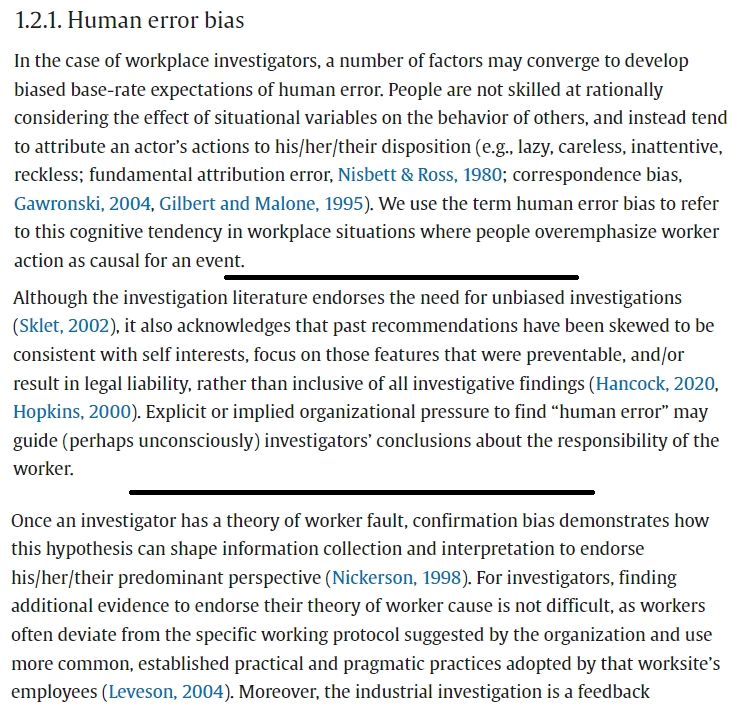
A study to be posted in the coming weeks suggests not – finding that more experienced professional investigators were more biased than laypeople when it came to implicating worker action as causal in the accident.

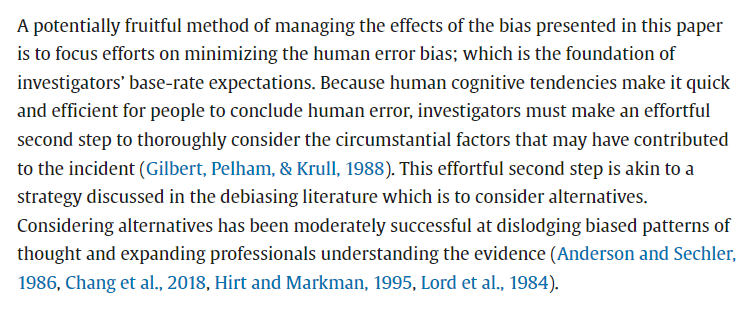
That is, experienced accident investigators were more likely to blame workers compared to students.
The authors refer to this phenomenon as the ‘human error bias’, being the cognitive tendency in workplace situations where worker action is overemphasised as a causal factor in an event.
Moreover, accident investigators “Wrongly, but confidently, believed that they were objective”. This aligns with the metacognitive literature demonstrating that “people have difficulty monitoring their cognitive processes”.
That is, people don’t “have direct access to their thoughts and because of this, when asked about their accuracy or objectivity, they rely on available cues to make inferences about their performance”.
People, therefore, “may rely on the imprecise cue of retrieval fluency to inform them of how confident they should be about their decisions. Information that is deeply learned or encountered recently facilitates access”.
[Note: Bias in itself isn’t a bad thing. We’re all biased. This helps clarify more precise understandings of how it plays out.]
Ref: MacLean, C. L., & Dror, I. E. (2023). Measuring base-rate bias error in workplace safety investigators. Journal of safety research, 84, 108-116.

Study link: https://doi.org/10.1016/j.jsr.2022.10.012

 SafetyInsights.org
3 thoughts on “Professional accident investigators attribute more blame to workers than laypeople, exhibiting a “human error bias””