Given my recent bias posts, I wanted to balance this with more posts on the effective use of heuristics; most of the time, in most situations, our heuristics (and biases, since bias isn’t a dirty word) help us navigate the world.
Gigerenzer provides several examples of heuristics (image 2), their conditions, and how they perform against more formalised calculations and the like.
However, first, he covers six common but erroneous beliefs about heuristics (image 1).
1. They’re second best results and we should be seeking to always optimise. He notes optimisation is often impossible in many situations
2. We rely on heuristics because of cognitive limitations. He notes the use of heuristics is driven by characteristics of the environment and our mind, rather than cognitive limitations
3. We rely on heuristics only in routine decisions of little importance, whereas in reality heuristic are used in both high and low importance decisions
4. People with higher cognitive capacities use more complex weightings and integration of info, whereas in reality this is unsubstantiated by evidence. Higher capacity is linked to selection of heuristics, but not in execution
And two more you see in the first image.

In all, the mind acts as an “adaptive toolbox”, with various heuristics “tailored for specific classes of problems—much like the hammers and screwdrivers in a handyman’s toolbox”.
Heuristics work because they “exploit evolved capacities that come for free, and thus they can provide solutions to problems that are different from strategies of logic and probability”.
Some selected heuristics are below:
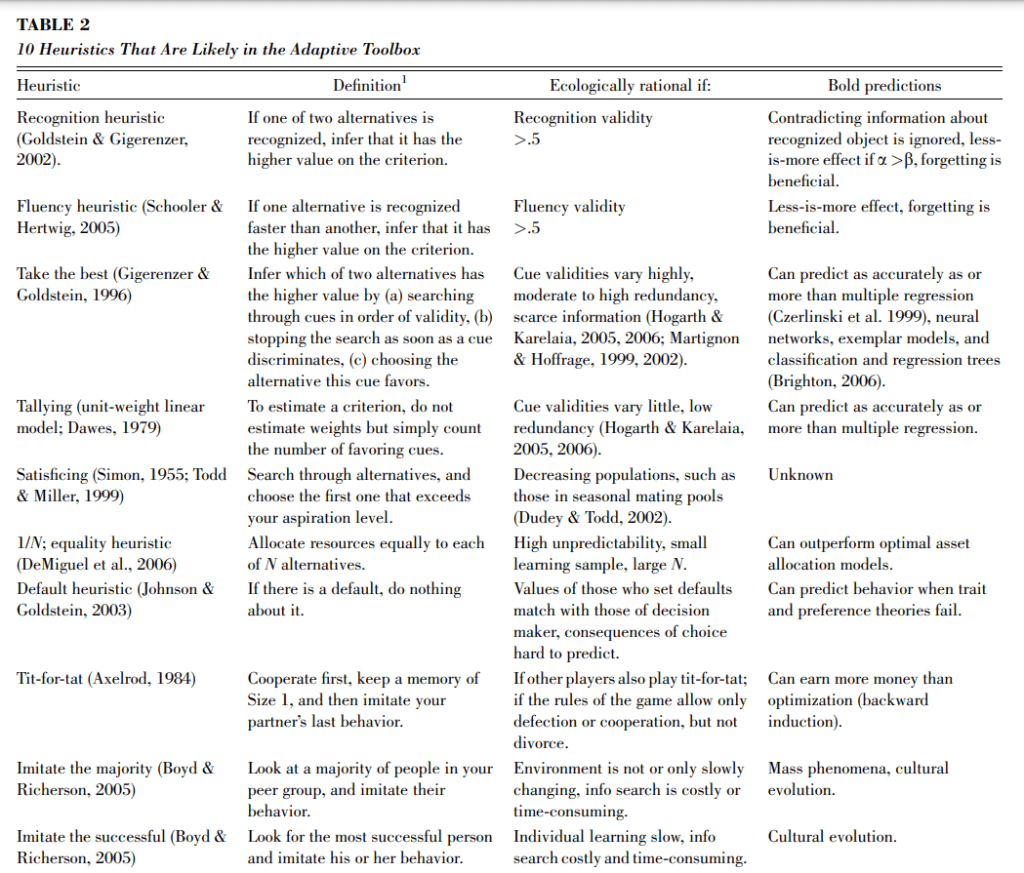
Ref: Gigerenzer, G. (2008). Why heuristics work. Perspectives on psychological science, 3(1), 20-29.
Study link: https://doi.org/10.1111/j.1745-6916.2008.00058.x

 SafetyInsights.org
One thought on “Heuristics that make up the cognitive ‘adaptive toolbox’”