This evaluated the associations between a contractor safety prequalification assessment program on leading/lagging indicators.
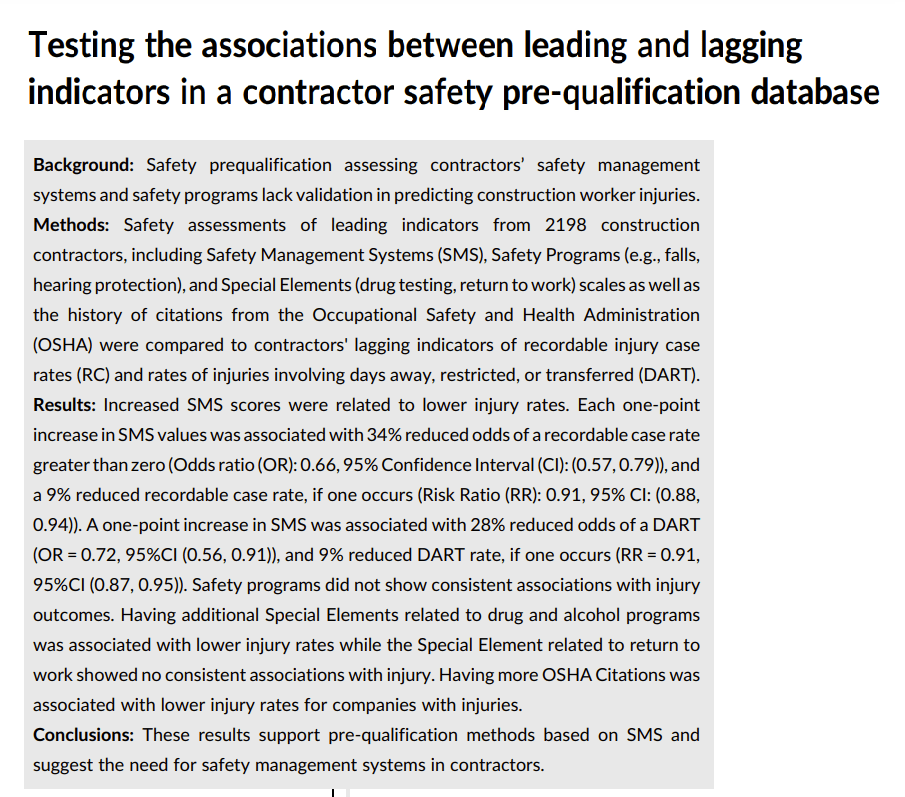
The assessment included Safety Management System [SMS] scores, Safety Programs (eg falls, hearing protection], Special elements (drug testing, return to work], history of OHSA citations, and various injury metrics.
Safety assessments from 2198 construction contractors were included.
Results
Increased SMS scores on the pre-qualification database were related to lower injury rates.
Each one-point increase in SMS values was linked with a 34% reduced odds of a recordable case >zero. A one-point increase in SMS was associated with a 28% reduced odds of a DART.
Companies with higher SMS scores were more likely to report no injuries.
Safety programs themselves didn’t show consistent associations with injury outcomes. However, having Special Elements related to drug & alcohol programs was associated with lower injury rates (less recordable cases and lower DART rate), while return to work program showed no association.
Having more OSHA citations was associated with lower injury rates for the companies with injuries.
Authors discuss some of the findings. They say that their findings are unique in that it shows an inverse dose-response relationship between safety management systems and injuries when they occur, such that higher scores are associated with lower reported injuries.
They observe that “Overall the recorded associations here are in support of having strong safety management systems in place in these contractors”.
They also discussed the lack of association between safety programs and outcomes. They say this was surprising and may be related to the point that simply “complying with OSHA standards may not be enough to reduce injuries”.
As always, there was limitations. One being that the study was cross-sectional, which prevents an analysis of temporal or causal relationships between the organisational programs and lagging safety outcomes.
Link in comments.
Authors: Manjourides, J., & Dennerlein, J. T. (2019). American journal of industrial medicine, 62(4), 317-324.
Study link: https://doi.org/10.1002/ajim.22951
LinkedIn post: https://www.linkedin.com/pulse/testing-associations-between-leading-lagging-safety-ben-hutchinson

 SafetyInsights.org