I found this excerpt interesting as I read about the normalisation of deviance (NoD) in mega projects.
NoD comes from Diane Vaughan’s analysis of the Challenger disaster, representing a series of “missteps, flawed assumptions, and a culture of risk taking”.
Further, “Social normalization of deviance means that people within the organization become so much accustomed to a deviant behavior that they don’t consider it as deviant, despite the fact that they far exceed their own rules for the elementary safety”.
As this author notes, “normalization of deviance suggests that the unexpected becomes the expected, which becomes the accepted”, and people “grow more accustomed to the deviant behavior the more it occurs”.
This paper identifies different areas that NoD impacts project performance, from project proposals and “strategic misrepresentations” (i.e. deliberate use of misleading or false information to gain advantage), client/contractor relations, and planning and scheduling dynamics (which often pits managers against other managers/functions).
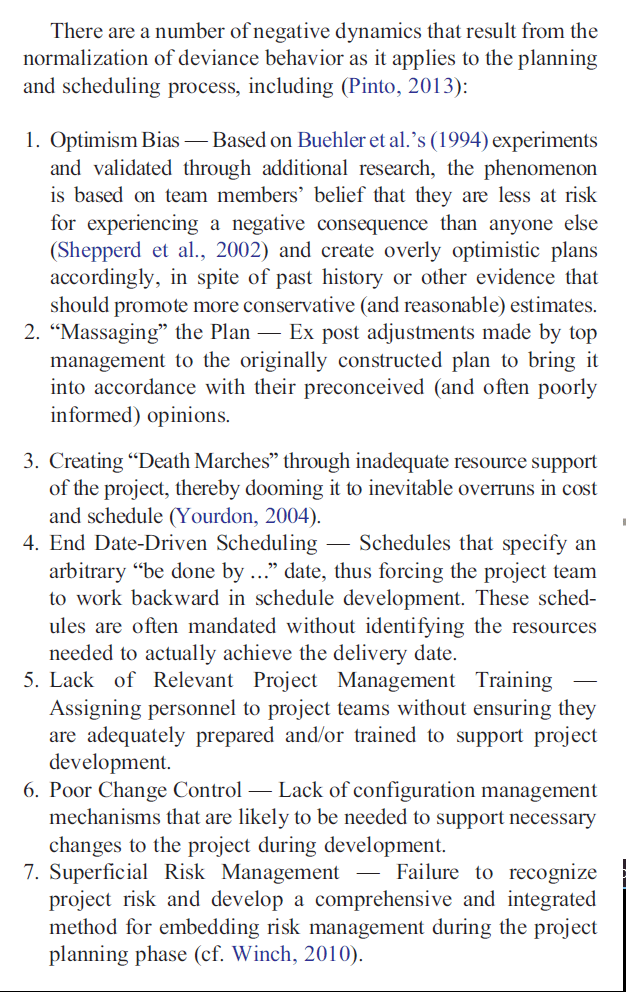
On the latter alone, the author identifies seven areas that NoD influences planning and scheduling (attached image):
- Optimism bias
- Massaging the plan
- Creating “Death Marches”
- End date-driven scheduling
- Lack of relevant PM training
- Poor change control
- Superficial risk management
Interestingly, these findings support my own work on enabling devices, decoupling and fantasy planning.
Study link: https://doi.org/10.1016/j.ijproman.2013.06.004
Ref: Pinto, J. K. (2014). Project management, governance, and the normalization of deviance. International journal of project management, 32(3), 376-387.

 SafetyInsights.org