Human error, or problematic system design creating an error trap that is, to quote this paper, “loaded and ready to strike”?
A brief paper I summarised (post in the coming weeks) re-analysed the investigation report from a “labor auditor”.

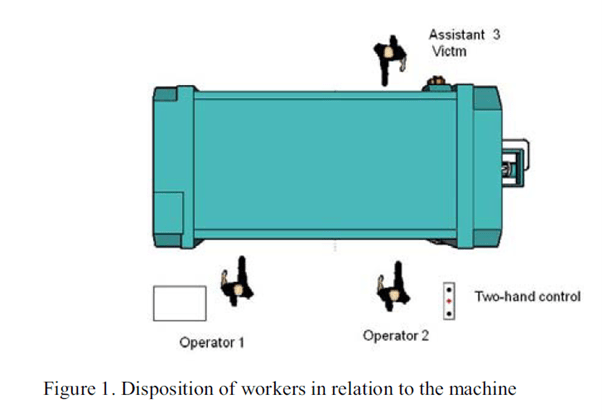
The incident involved the amputation of an operator’s arm, during operation of a brake-clutch type mechanical press.
Off the bat, they highlight how in Brazil, “accidents with machines tend to be explained in a manner that attributes blame to the victim or emphasize technical aspects of the system”.
Likewise, the official investigation found the primary fault with the “unsafe act of the colleague that had activated the descent of the hammer” while their colleague was still in the danger zone.
However, the paper, drawing on a systemic approach, unpacking cognitive traps and design/organisational factors of the event, and looking at normal work, found several insights not explored in the original investigation.
These included:
· The operators of the hammer couldn’t see the injured person on the other side of the plant.
· The light curtain didn’t function as the operators’ expected – indeed, the system did not “offer signals that help [the operators] clearly interpret … the machine’s behavior” [** what’s called mode confusion].
· Moreover, the light curtain could be traversed, leaving the operator “in a death zone” where sensors were unable to detect their presence.
The authors argue that an “illusion or false sense of protection” was harboured within the organisation around the safety of the press, despite mismatches between operator knowledge of machine logics, lack of machine feedback, and other problems.
They argue that although behaviour should still be evaluated, “the behaviors …are taken as a point of departure, as factors whose origins must be clarified in reasons that are not those intrinsic to the personality of the workers involved”.
They highlight the criticality of learning from everyday work.
Authors: de Almeida, I. M., Nobre Jr, H., do Amaral Dias, M. D., & Vilela, R. A. G. (2012). Work, 41(Supplement 1), 3202-3206

Study link: https://content.iospress.com/articles/work/wor0583

 SafetyInsights.org
3 thoughts on “Human error or an error trap ready to strike? The case of a mechanical press arm amputation”