Another upcoming summary revolves around bias in expert decision making (yes, another bias post…)
I’ll probably focus more on the positive heuristics stuff after this, but I digress.
Note, this paper is from a forensic science and criminal perspective, so consider in that in their use of language like ‘suspect’.
First, the author clarifies some fallacies relating to human bias (image 1).

Firstly, bias isn’t a bad thing; it’s a normal part of being human. It’s not about ethical issues, like unscrupulous individuals or bad apples.
Experts can also be just as susceptible to biases as non-experts; in some cases, more so (and in other areas, less so).
The author then discusses eight sources of bias (image 2).
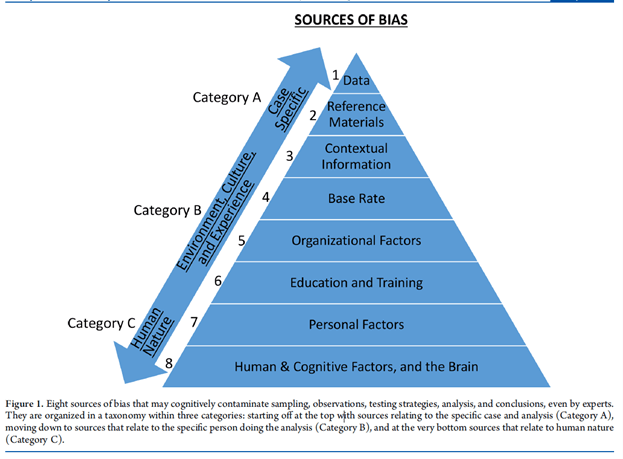
Some are:
· Data and reference materials: Analysis of specific investigation data, like fingerprints, documentation or other evidence can be biasing. Such that instead of going from evidence to the suspect, or data to theory, reference materials cause a backward circular reasoning from the target back to the evidence
· Contextual info: Experts are biased not just by the evidence itself, but the order or format that the evidence is presented. They’re also influenced by irrelevant info
· Base rate: Experts draw on prior experience, then apply this to predict and pattern match the current tense and future. This results in skewing interpretations of the current to fit prior experience, even if that association is tenuous. Base rate also includes over or under-estimating particular explanations based on their assumed prevalence in the community
· Organisational factors: A raft of factors here, including politics, conflicts of interest, production pressure (closing out a report quickly) and more
· Personal factors: These include motivation, personal ideology and beliefs
· Cognitive and physiological factors: These relate to the physiology and cognitive side of the brain and its sensemaking systems. The eyes aren’t a video camera feeding the brain; instead, the brain has to create perceived reality. A range of factors are implicated here, like social interactions, in-group biases, availability biases, processing fluency, and more.
The author then discusses the snowball and cascade biases, where bias doesn’t “impact only the individual in isolation or just one aspect of the work; often the bias cascades from one person to another, from one aspect of the work to another, influencing different elements of an investigation.
Author: Dror, I. E. (2020). Cognitive and human factors in expert decision making: six fallacies and the eight sources of bias. Analytical Chemistry, 92(12), 7998-8004.
Study link: https://doi.org/10.1021/acs.analchem.0c00704

 SafetyInsights.org
One thought on “Fallacies and biases in expert decision making”