This study evaluated base-rated error in workplace safety investigations. In particular, it sought to evaluate the magnitude of professional industrial investigator’s bias to attribute cause to a person more readily than situational factors.
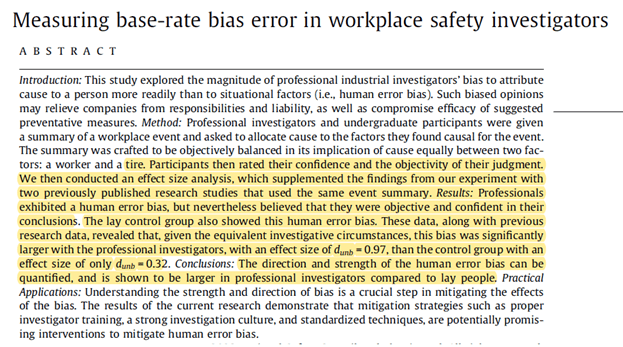
50 undergraduate students and 12 professional industrial incident investigators from the forestry industry: 1) read a summary of a workplace event and developed an initial hypothesis of what most likely caused the event, 2) reported their confidence in their cause allocation judgments and their level of objectively when making the judgment.
Providing background:
- All people are biased, including all investigators
- Prior research has shown people, not just investigators, are “inclined to attribute more cause to individuals involved in an event than the evidence would support
- Biases may “undermine honest investigators’ good intentions
- and hard work” and “Bias is not random error, it is the systematic deviation from evidence-based objective judgment”
- Note that bias isn’t a dirty word, nor does it necessarily mean something bad or to be avoided
- Some sources of biases range from brain architecture and constraints, whereas others originate from contextual factors that are related to the environment or event specific
- When assessing events, people naturally compare that event to a base-rate frequency (its probability)
- Judgements can be biased when population base-rates, said to be the actual frequency of an occurrence, are inconsistent with the investigators’ beliefs; leading them to believe that the event was more or less likely to occur compared to the population frequency
- They call ‘human error bias’ as the cognitive tendency in workplace situations where worker action is overemphasised as a causal factor in an event
- Moreover, “Explicit or implied organizational pressure to find ‘‘human error” may guide (perhaps unconsciously) investigators’ conclusions about the responsibility of the worker
- They note that once “an investigator has a theory of worker fault, confirmation bias demonstrates how this hypothesis can shape information collection and interpretation to endorse his/her/their predominant perspective”
- More thorough investigation may simply entrench that belief with additional confirming evidence
Results
Key findings included:
- Professional investigators exhibited a human error bias, but at the same time believed that they were objective and confident in their assessments
- The lay student group also showed this bias, but “this bias was significantly larger with the professional investigator” groups than lay people
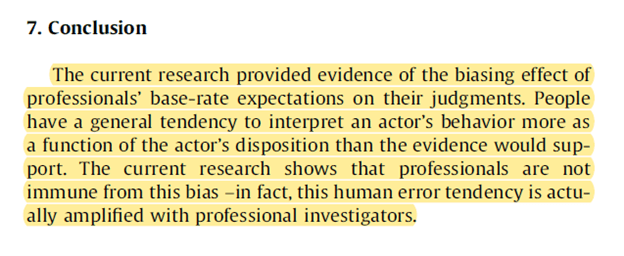
- That is, a ‘robust human error bias’ was present in both groups, but more so the experienced investigators, and this led to worker action being implicated as causal in the accident than other factors
They explain that these findings are consistent with the metacognitive literature, demonstrating that people have difficulty monitoring their own cognitive processes. That is, we don’t have direct access to our own thoughts, and thus, “when asked about their accuracy or objectivity, they rely on available cues to make inferences about their performance … People may rely on the imprecise cue of retrieval fluency to inform them of how confident they should be about their decisions”.
While people rated themselves as fairly objective and fairly confident that their hypothesis would be proven true “their ratings were unrelated to their cause allocations”.
This indicates that this “miscalibration between judgments and confidence is that safety initiatives could proceed based more on the persuasiveness and confidence of the investigator rather than on the quality of their findings”.
Authors: MacLean, C. L., & Dror, I. E. (2023). Measuring base-rate bias error in workplace safety investigators. Journal of safety research, 84, 108-116.
Study link: https://doi.org/10.1016/j.jsr.2022.10.012
LinkedIn post: https://www.linkedin.com/pulse/measuring-base-rate-bias-error-workplace-safety-ben-hutchinson

 SafetyInsights.org
2 thoughts on “Measuring base-rate bias error in workplace safety investigators”