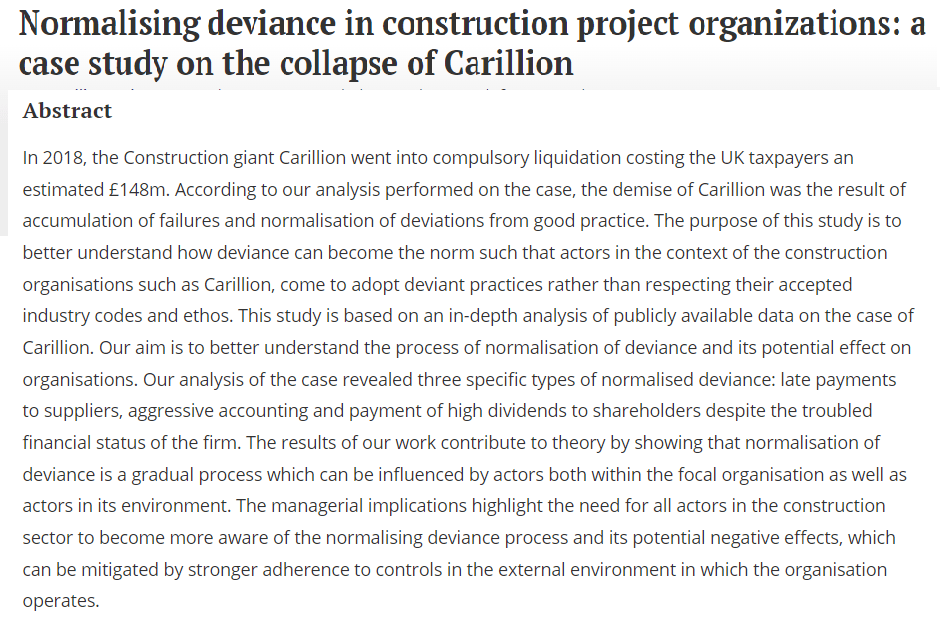
An upcoming summary explored the normalisation of deviance (NoD) in the collapse of British construction and facilities firm Carillion.
NOD was first introduced by Diane Vaughan in her Challenger Launch Decision book.
It occurs when “individuals within an organisation become gradually insensitive to deviant practice so that it no longer feels wrong”.
NOD is typically the result of “a series of deliberate choices that have become institutionalised over time” and thus reflects “gradualism and the accumulation of (and organisational acclimatisation a series of decisions that individually, may not signal disasters but taken collectively, and applied continuously, will eventually, lead to serious repercussions.
It’s said that to become deviant, an action 1) must be contrary to norms, 2) the action must find support in the new norms of a given group, 3) the action must be known and supported, 4) new members must be socialised to participate in this new action or belief.
Also, what constitutes normalised deviance isn’t simply some departure of norms itself, but “repeatedly violating defined and established standards, rules and norms, without being frowned upon thus becoming the usual way of doing things”.
NoD was observed in the fall of Carillion. While in hindsight these practices would be viewed as unacceptable, their development occurred over a course of years, “indicating that normalising deviance is likely to be difficult to detect in the initial stages of its emergence”.
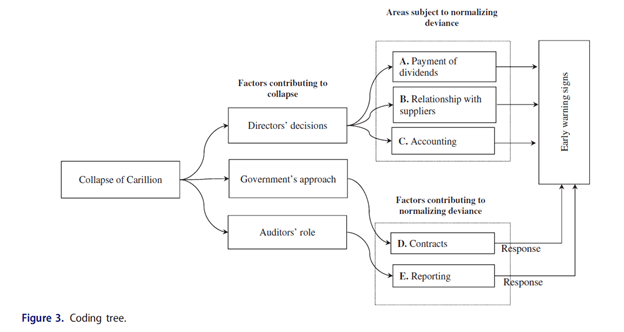
Three core factors drove NoD in Carillion:
1) Payment of high dividends to shareholders despite the poor financial performance of the firm.
2) Transferring the consequences of its weak financial position to suppliers, by delaying payments.
3) Aggressive accounting practices that made the financial position look better than what is was and hid increasing financial responsibilities and problems.
They argue that while NoD is obvious in hindsight, it’s far more difficult for people to recognise in the moment. Countering NOD is difficult because of the gradual accumulation over time.
Thus “Once deviation is entrenched, rooting it out is challenging”.
Ref: Hajikazemi, S., Aaltonen, K., Ahola, T., Aarseth, W., & Andersen, B. (2020). Construction Management and Economics, 38(12), 1122-1138.
Study link: https://doi.org/10.1080/01446193.2020.1804069

 SafetyInsights.org
One thought on “Normalisation of deviance and the collapse of construction company”