How does project complexity influence safety, and what impact does an organisation’s capacity for resilience moderate this relationship?
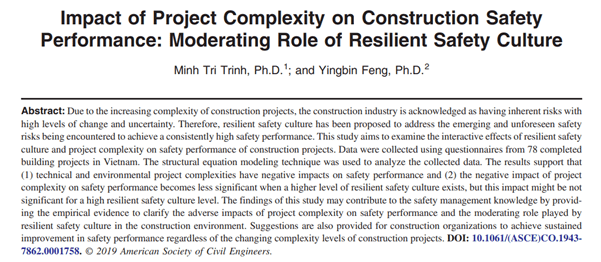
An upcoming summary studied the complexity/unsafety relationship and also the impact that a “resilient safety culture” (RSC) had in the construction sector.
Resilient Safety Culture (RSC) is defined as “an organizational culture that fosters safe practices for improved safety in an ultrasafe organization striving for cost-effective safety management by stressing resilience engineering, organizational learning, and continuous improvements”.
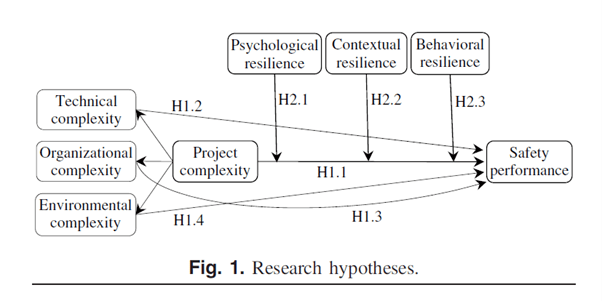
More specifically, RSC draws on an organisation’s psychological, behavioural and contextual capabilities to “anticipate, monitor, respond and learn in order to manage the safety risks and create an ultrasafe organization”
If you struggle with the idea of ‘measuring’ culture, then consider it an abstract construct that’s evaluating a collection of perceptions, states, conditions etc.
This paper found that:
· Technical and environmental project complexities have negative impacts on project safety performance
· The negative impact of project complexity on safety performance “becomes less significant when a higher level of resilient safety culture exists, but this impact might be not significant for a high resilient safety
Thus, uncertainties related to technical and environmental aspects of construction can increase the occurrence of incidents.
The impact of project complexity on safety performance is lessened in the context of a higher level of resilient safety culture performance.
Thus, this finding “clarifies the value of resilient safety culture for the improvement of the organization’s capabilities to manage safety risks”.
[And yes, we need to be cautious about using incident data, but findings are interesting nevertheless.]
Authors: Trinh, M. T., & Feng, Y. (2020). Journal of Construction Engineering and Management, 146(2), 04019103.
Study link: https://doi.org/10.1061/(ASCE)CO.1943-7862.0001758

 SafetyInsights.org
One thought on “Project complexity, unsafety and resilient safety culture”